
Physics Department News
Marin Alexe wins Humboldt Research Award
Marin Alexe of the Functional Electronic Materials group has received a prestigious Humboldt Research Award, recognising the breadth and depth of his research career in Condensed Matter Physics. Marin will work with academics in Germany to undertake research projects at the Martin Luther University, Halle/Saale and Technical University, Darmstadt.
Further information can be found at http://www.humboldt-foundation.de/web/programmes-by-target-group.html
Mika Vesterinen awarded over €1.8 million by the ERC
On 10 December the European Research Council (ERC) announced the recipients of its latest Consolidator Grant competition: 301 top scientists and scholars across Europe. Funding for these researchers, part of the Horizon 2020 research and innovation programme, is worth in total €600 million. With this support, the new grantees will have a chance to build up their teams and have far-reaching impact.
Dr Mika Vesterinen from the Elementary Particle Physics group has been awarded over €1.8 million for a project to advance our knowledge of the fundamental physical forces of nature, using one of the particle detectors at the CERN facility. He said: “The Standard Model makes several precise predictions that are yet to be matched by experimental measurements of the same precision. The ERC funding allows me to build a team of experts that will confront this problem with innovative high-precision analyses of data from the LHCb experiment at CERN.
“A significant disagreement between our measurements and the predictions would indicate new physics beyond the Standard Model, which is the holy grail of particle physics.”
Hidden giant planet revealed around tiny white dwarf star
The first evidence of a giant planet orbiting a dead white dwarf star has been found in the form of a disc of gas formed from its evaporating atmosphere.
The Neptune-like planet orbits a star a quarter of its size about once every ten days, leaving a comet-like tail of gas comprised of hydrogen, oxygen and sulphur in its wake.
The discovery by astronomers from the University of Warwick’s Department of Physics and the Millennium Nucleus for Planet Formation (NPF) at the University of Valparaíso is published today (4 December) in the journal Nature. It is the first evidence of a giant planet orbiting a white dwarf star and suggests that there could be many more planets around such stars waiting to be discovered.
Pettifer Prize 2018-19
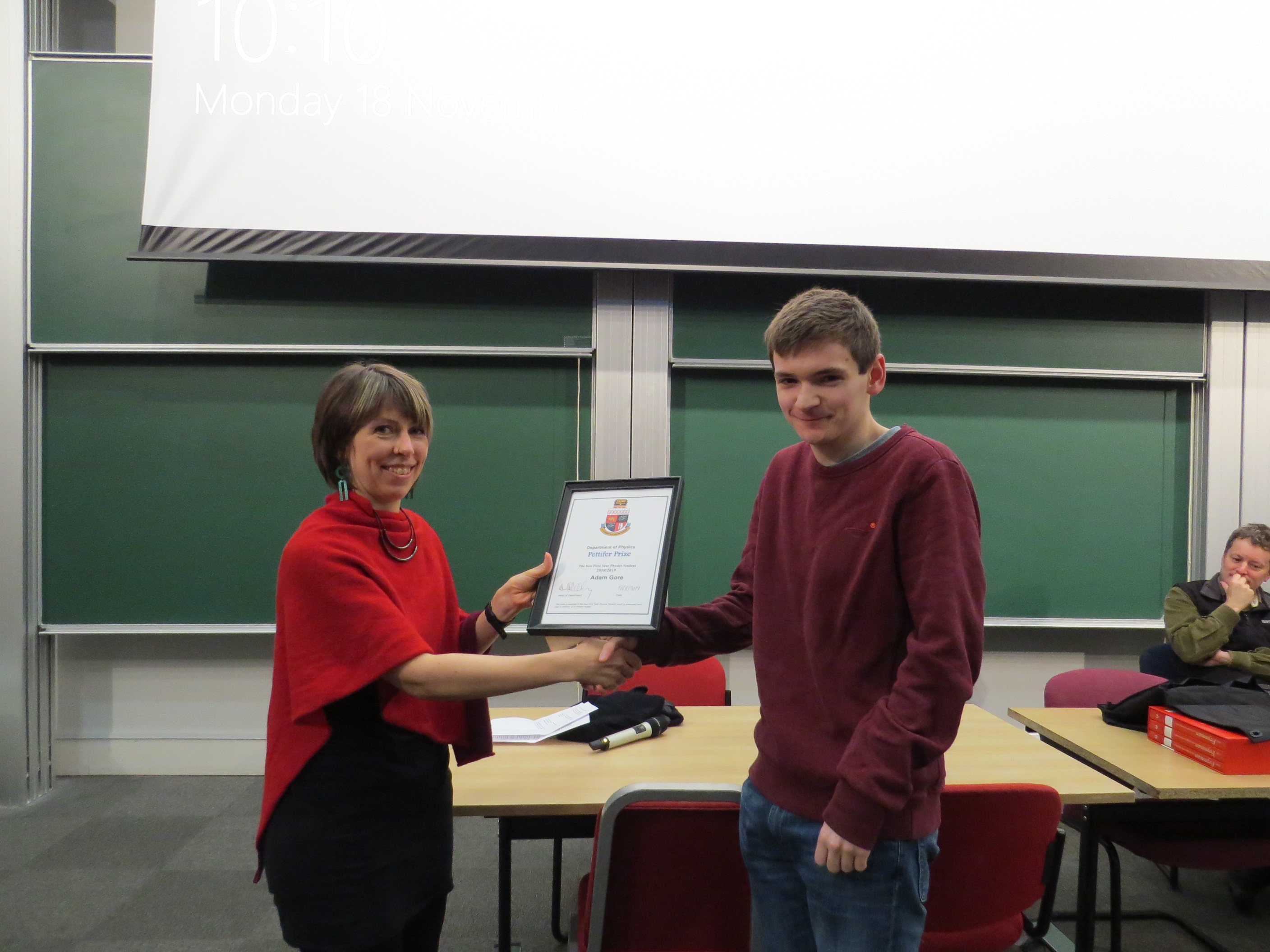
The Pettifer Prize is presented annually to the first year Physics student with the best overall examination performance. It honours the memory of Dr Robert Pettifer, who was a member of the Department from 1972 until his retirement due to ill-health in 2007.
The 2018/19 prizewinner is Adam Gore, who receives a copy of the Feynman Lectures on Physics. The prize was presented by Robert's wife, Mary, and daughter, Candice, who kindly donated an Amazon voucher to add to the prize.