
Physics Department News
University Award for Astronomers
Congratulations to the Astrophysical Transients team of Andrew Levan, Danny Steeghs, Ryan Cutter, Ben Gompertz, Joe Lyman, Sam Oates, Elizabeth Stanway and Krzysztof Ulaczyk as runners-up in the 2018 University Awards, for their detection of electromagnetic light from merging neutron stars, triggered by gravitational wave signals. The team's research has already appeared in 15 papers, enabling the origin of the heaviest elements to be ascertained and providing a new route to measuring the expansion of the Universe.
UK’s first 1GHz solid-state NMR spectrometer
Part of a new £20 million investment by EPSRC in Nuclear Magnetic Resonance (NMR) equipment across UK institutions, the £8M, 1GHz NMR instrument at Warwick will provide new structural and dynamic information in chemistry, materials science and biology. It will add to our already significant NMR capabilities that include the 850MHz high-field solid-state NMR National Research Facility, which has been serving a broad academic and industrial user-base since 2010.
Warwick Awards for Teaching Excellence
Congratulations to Mark Newton, who has been shortlisted for a WATE this year, and also to Daniel Mayoh, shortlisted for a WATE PGR.
WATE and WATE PGR winners and commendees will be announced at the end of June.
Primary Science Fair
Now in its fifth year, the Primary Science Fair took place last month hosted by the Department of Physics, organised by Ally Caldecote (Senior Teaching Fellow, Physics) and Jane Catto (Teacher, Briar Hill Infant School).
“Once again, the children surpassed themselves with projects on topics from space to slime, and much much more besides!” explains Jane who runs the Leamington Spa Ogden Primary Partnership. “Models of spiralling DNA, samples of live cress and gummy bear sweets in a variety of solutions were all set up in the lecture theatre as the children excitedly prepared to talk about their investigations.”
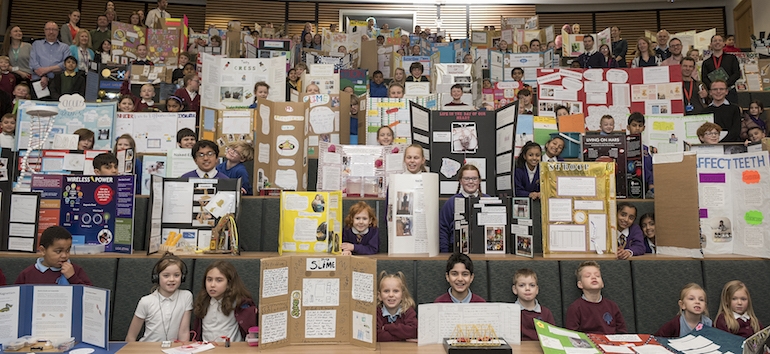
Approximately 1,000 students from 10 local schools took part in school science fairs, presenting their projects, ideas and investigations to teachers and class mates. The best projects from each year group were selected from each school and over 100 winning children presented their projects at Warwick University at the end of last term. The science fair judges made up of scientists and educationalists spoke to each of the young scientists who explained their theories and findings.
Ally Caldecote said: "It is a delight and a privilege to welcome these budding scientists to the University. It is clear to see the tremendous time and effort that has gone into these projects as well as the careful consideration they have given to their science investigations. My judging panel are always bowled over by the understanding and determination of the children that they meet, and we are certain that we will meet some of these students again, maybe studying science here at the University!"

Jane said: "It's fantastic to watch the process unfold. From gathering teachers to plan and launch the school-based science fairs, through enthusing the children to take part and involve family members in their science learning, to now getting to celebrate the winners and really give them a taste of a potential career in science. They will never forget this day!"
Each winner received a medal to proudly display, or a personalised winners’ teddy – for children in EYFS. All children also received a certificate and left the University happily wearing their shiny science medals.
Photo credit: Tennisons Photography