
News
Congratulations to Pieralberto Guarniero on winning a Warwick Award for Teaching Excellence for Postgraduates Who Teach
Many congratulations to Pieralberto Guarniero upon winning a Warwick Award for Teaching Excellence for Postgraduates Who Teach (WATE PGR). The WATE PGR programme seeks to recognise the best teachers from Warwick's postgraduate community, and Pieralberto 's enthusiasm and dedication to the subject were recognised as key factors behind his success in this years awards.
A link to the WATE PGR webpage, which includes a full list of this year's winners as well as a statement on Pieralberto 's achievements, can be found here.
Professor Jane Hutton appointed as USS Director
Professor Jane Hutton has been appointed with effect from 1st November 2015 as a UCU-nominated director of USS - the Universities Superannuation Scheme.
Professor Hutton has been one of the leaders in substantial efforts to challenge the large changes to USS which are in train as a consequence of the latest actuarial valuation, and hopes to continue to ameliorate the effects of those changes. The USS has assets of about 42 billion pounds.
There are 12 directors: four appointed by UUK, three appointed by UCU and five independent directors.
Dr Martine Barons to help save the bees.
Dr Martine Barons is about to set out for Australia to help save the bees.
Martine, who works at the University of Warwick’s Department of Statistics, has been funded by the University of Warwick and Melbourne University to spend two months working with Professor Richard Huggins, an expert in estimating the population of rare species, and Melbourne’s bio-security unit. The task Martine has taken on is to develop a decision support system for those, like DEFRA in the UK, responsible for designing policies to ensure a thriving population of bees and other pollinators.
We rely on bees and other insects to pollinate an estimated one-third of food crops worldwide, and in recent years there has been much concern about declining numbers of pollinators and what this means for human food security. DEFRA issued a pollinator strategy within the last 12 months `to see pollinators thrive, providing essential pollination services and benefits for food production, the wider environment and everyone.' The strategy makes clear, however, that there are a number of gaps in our knowledge about the complex systems impacting on pollinators which makes designing effective policies challenging.
“Professor Jim Smith, Dr Manuele Leonelli and I have recently finished developing a general theory about when and how it is possible to network together diverse panels of experts within large, multifaceted systems in such a way that decision-makers can score different policy options to help decide which is the best way forward,” explained Dr Barons.
There are a number of experts at Warwick, including Samik Datta, David Chandler and Matt keeling, who have given advice about the details of the challenges facing pollinators, particularly diseases and parasites in bees.
“The abundance of bees and other pollinators depends on many factors including weather & climate, farming practices, insect diseases and parasites, national & international environmental regulations on such as the use of pesticides, town and city planning strategies, competition for food, predators and so on. This is precisely the type of many-faceted problem that our theory is designed to address and I look forward to putting it to work.”
Australia is the ideal place to start this work since, due to rigorous border controls, their bees are free of many of the parasites and other problems prevalent in the rest of the world. They keep sentinel hives at all the major ports and monitor them closely for signs of disease or parasites.
Dr Barons also joined Stratford-upon-Avon & district Beekeepers’ Association and thoroughly enjoyed a recent visit to the apiary. “I believe firmly that experienced beekeepers have a wealth of understanding which is as important as formal research to understand what is going on with bees,” she said.
Dr Barons is in contact with DEFRA and the National Bee Unit in York. With the interest and support of the experts there, she hopes to turn the mathematics into a useful, working decision support system that will help us to have a thriving population of pollinators into the future
Can fundamental life factors explain differences in how our brains are connected?
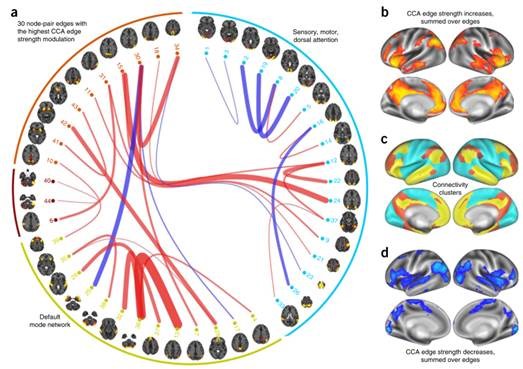
Research by Tom Nichols and colleagues has been featured in the papers with headlines like "Intelligent people's brains are wired differently" (Daily Mail, 28 Sept.). The research is based on unique data from Human Connectome Project (HCP), a collaboration with researchers in Oxford University and Washington University in St. Louis. The HCP data has produced MRI data with high temporal and spatial resolution, specifically tailored to image the connections between different brain regions. In this project, they used 461 subjects to find associations between brain connectivity and over 280 behavioural, health and demographic factors. A single factor with a clear positive vs. negative axis of life factors was found to correlate with functional MRI connectivity. Factors like memory, vocabulary, life satisfaction and being well-educated weighed against factors like substance use, poor sleep quality and anger-aggression scores. While many reports in the press have implied a causal link between "happiness" and how the brain is "wired", the current observational study doesn't justify these conclusions.
Reference:
Smith, S. M., Nichols, T. E., Vidaurre, D., Winkler, A. M., Behrens, T. E. J., Glasser, M. F., Ugurbil, K., Barch, D.M., Van Essen, D.C., Miller, K. L. (2015). A positive-negative mode of population covariation links brain connectivity, demographics and behavior. Nature Neuroscience, (September), 1–7. doi:10.1038/nn.4125
An interview with Professor Nichols covering this subject can be found here.
Illustration:

IMS Medallion Lecture 2017
Seminar Series:
- Algorithms & Computationally Intensive Inference Seminar Series
- Applied Probability Seminars
- Maths and Statistics Teaching and Learning Seminar
- Probability Seminar
- RSS West Midlands Group
- Statistical Learning & Inference Seminars
- Stochastic Finance @ Warwick Seminar Series
- Warwick R User Group
- Young Researchers Meeting