
WMG’s pioneering battery research published in Nature Nanotechnology
Wednesday 10 June 2026
WMG’s pioneering battery research published in Nature Nanotechnology
The Battery Cells and Materials GroupLink opens in a new window at Warwick Manufacturing Group (WMG), University of Warwick, is placing pioneering research in the spotlight with the publication of a new paper in the prestigious Nature Nanotechnology journal.
Written by lead authors Galo Paez FajardoLink opens in a new window, Associate Professor; and Louis PiperLink opens in a new window, Professor of Battery Innovation, “Direct evidence of metal–ligand redox processes in positive electrodes during lithium-based battery operation”Link opens in a new window answers a key question in battery research: where does the charge come from?
With rising interest in increasing the energy storage of current and next-generation battery cathodes to power the future of electric vehicles and aircraft, the paper’s findings couldn’t be more timely.
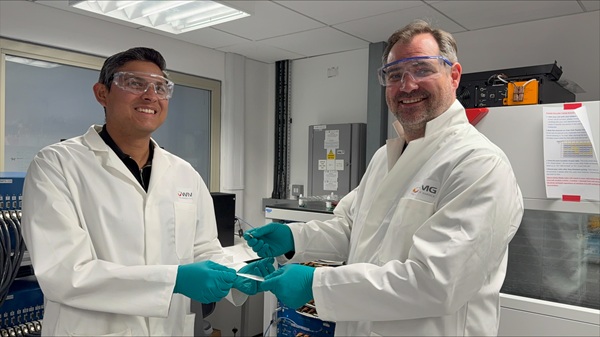
Current battery modelling and material understanding is grounded in established research about how battery cathodes operate; however, Professor Piper and Dr Paez Fajardo challenge these principles with new insights as outlined in the paper.
Until recently, the prevailing view was that electrons (the current) were removed from the metal ions -nickel, cobalt, or iron - as lithium ions were extracted from the positive electrode (cathode) during charging.
These lithium ions are then stored in the negative electrode (or anode), and when the cell is discharged the Li-ions and electrons return to their original places (within the cathode). In this model, the oxygen ions were considered passive bystanders.
WMG researchers used powerful x-ray techniques during charging to show how electrons are being pulled from mostly oxygen ions.
“These fundamental studies of real electrodes and cells are important because it puts constraints on the models used for battery material searches,” said Lead Author, Dr Galo Paez Fajardo. “Showing how and why oxygen ions participate is important for determining how to improve our current batteries.”
The study compared two of the main lithium-ion battery cathodes used today in industry: phosphates (or LFP) and layered oxides (or NMC). While phosphates showed little oxygen participation, the layered oxides showed significant electron extraction from oxygen - even larger than from the metal sites.
“Using the same physics to describe high temperature superconductors, we can explain how and why oxygen involvement occurs in layered oxides,” said Professor Louis Piper. “Simple electron counting rules from undergraduate chemistry are a good approximation, but as you really push these systems further care is needed on how oxygen ions are involved in the energy storage mechanism.”
“The reason oxygen participation varies between the LFP and NMC materials points to deeper fundamental principles,” explains Dr Paez Fajardo. “Across the family of 3d elements in the periodic table, there is an evolving balance between certain electronic interactions. It is this changing balance that dictates how and what elements participate in the energy storage process.”
This work is expected to help guide battery researchers towards making better, faster and longer batteries as part of the Faraday Institution’s Li-ion: Enhancing and Accelerating Performance (LEAP) project which funded the project. It also included research from the UK’s powerful X-ray Facility at Diamond Light Source, along with researchers in Ireland and Germany.
This work provides new design rules for engineering the next-generation high-energy cathodes. “Instead of treating metal and oxygen redox as separate, this work helps explain how they cooperate and identifies new ways to think about higher capacity cathode,” Professor Piper added.
Explore the paper and its insights in full: Direct evidence of metal–ligand redox processes in positive electrodes during lithium-based battery operation | Nature NanotechnologyLink opens in a new window
Find out more about WMG’s battery research: Battery Materials & Cells Group | WMG University of WarwickLink opens in a new window