
WMG partners with Nissan to bring future mobility services to UK streets
Monday 28 September 2026
WMG partners with Nissan to bring future mobility services to UK streets
A £3m UK Government-backed autonomous drive research project led by NissanLink opens in a new window in partnership with Warwick Manufacturing Group (WMG) at the University of Warwick and PAVE UKLink opens in a new window (Partners for Automated Vehicle Education UK) is set to revolutionise the future of mobility in the UK.
ADventure will deploy a UK mobility service in Cambridge to explore how autonomous drive (AD) passenger services can be safely introduced to benefit real-world communities. Looking beyond vehicle technology, the project will study how an autonomous mobility service can operate in a real-world environment. Working alongside local authorities, commuters and residents, the project will examine how future AD technology can create social value, improve accessibility, and address local transport challenges. One example would be potentially taking a person who doesn't drive to a medical appointment.
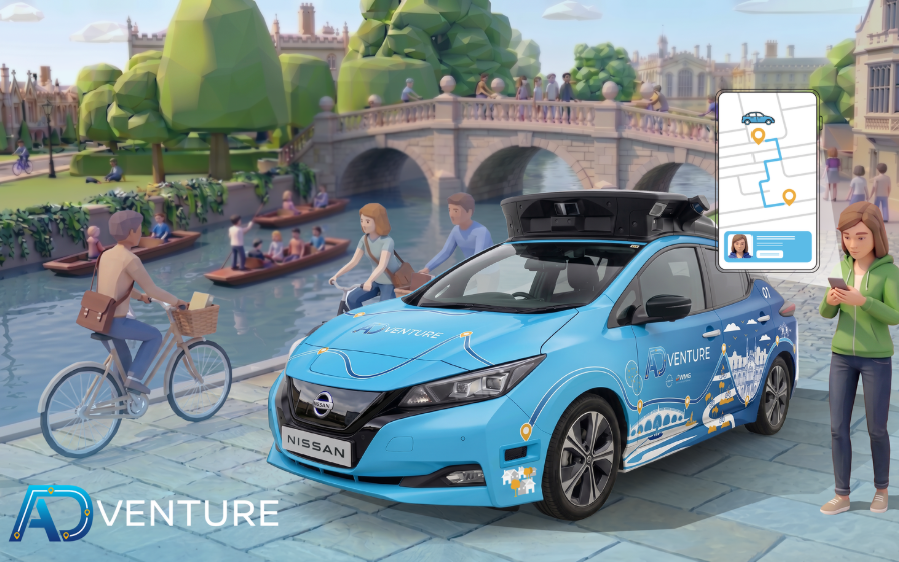
Utilising a specially equipped 2022 Nissan LEAF, ADventure will combine real-world testing and community engagement to shape city-ready autonomous mobility services, setting a blueprint for other communities using AD technology.
The project will focus on three key areas:
- Designing mobility services around cities and communities – understanding how autonomous mobility could complement existing transport networks and respond to local needs.
- Building passenger confidence – exploring what people need to feel informed, comfortable and included when using future autonomous mobility services.
- Testing technology in real-world conditions – validating how autonomous driving systems perform safely and effectively on public roads.
"This project is an important step for autonomous mobility in the UK", said David Moss, Senior Vice President, Research and Development, Nissan Africa, Middle East, India, Europe and Oceania (AMIEO).
"With UK Government backing, it will take autonomous vehicle research beyond central London and into another city, helping us understand how these services can work for different communities and real-life journeys.
“By developing and applying Nissan’s in-house expertise, combined with the wider knowledge from our partners, we can delve further into how self-driving vehicles can improve connectivity, accessibility and quality of everyday life.”
Professor Siddartha KhastgirLink opens in a new window, Head of Safe Autonomy at WMG and Director of PAVE UK, said: “We are excited to be partnering with Nissan as they bring their autonomous mobility service plans to the UK.
“Applying our deep safety and user-experience expertise to the ADventure project, we will be able to co-create a safe mobility service design with the public in a way that meets both their needs and the city’s transport priorities. This remains a shared mission for all the partners and reflects the real impact autonomous driving technology can have.”
Backed by the UK Government’s Department for Business, Innovation, Science and Trade (BIST) and facilitated through the Advanced Propulsion Centre UK (APC) in partnership with Innovate UK and inward investment, the £3m consortium project forms part of the UK's ambition to accelerate the development and deployment of connected and autonomous mobility technologies.
"Britain’s autonomous vehicle sector is world-class, and our Modern Industrial Strategy is bringing business and science together to support the innovators shaping the future of transport", said Blair McDougall, Minister for Reindustrialisation for BIST.
"By backing cutting-edge technologies with the investment they need to scale up key projects, we are backing firms like Nissan to drive growth and create jobs in every part of the UK — reinforcing Britain’s leadership in this fast-growing industry."
ADventure will conclude with a public-road demonstration in Cambridge, showcasing how autonomous mobility services could one day support more connected, accessible and sustainable transport systems for communities across the country.
Through a rigorous scoping process, Cambridge was selected for the project's first real-world trial due to its reputation and expertise as one of the UK's leading centres for transport innovation and autonomous mobility research. The city has already hosted several pioneering AD initiatives, making it an ideal environment for exploring how future autonomous services could complement local transport networks and support community needs.
Discover WMG's pioneering autonomous driving research: Safe AutonomyLink opens in a new window