
Departmental news
The students electrifying the motorsport industry across the world
- As the first team to enter an all-electric racing car into Formula Student (in 2018), students from the University of Warwick are in to Africa to share expertise and drive electric vehicle (EV) technology across the continent
- They will help launch of Formula Student Africa – a new motorsport competition for students, using only electric vehicles (EVs)
- The diverse team is passionate about increasing representation in motorsport, especially in leadership positions
Students from the University of Warwick are working with fellow students in Africa in a capacity-building project to drive forward electrification in the motor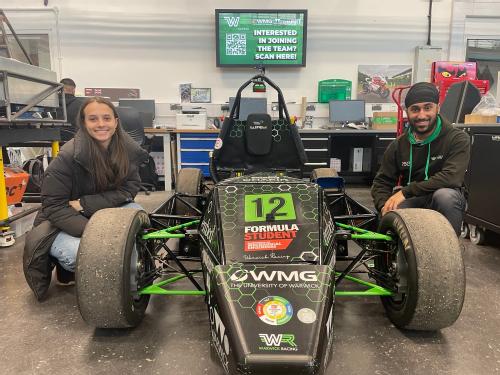 industry.
Members of the Formula Student team are in South Africa this week to share their knowledge on building and racing electric vehicles. Their expertise will be critical to the launch of Formula Student Africa, an all-electric motorsport competition for students across the continent, based on the UK model.
Six South African universities are already onboard for the series, including the University of Cape Town, University of Johannesburg, University of South Africa, Nelson Mandela Metropolitan University, Cape Peninsula University of Technology and University of the Witwatersrand.
It is hoped that Formula Student Africa will help drive the electrification of transport around Africa, propelled by technological advances in motorsport. In particular, Nelson Mandela Metropolitan University and the University of Warwick’s WMG are keen to collaborate with their state-of-the-art research into EV batteries. The student teams design the batteries themselves as well as the shape and components of their racing car.
Warwick Racing’s team principal Prem Gill, second year Mechanical Engineering student, said: “I’m thrilled to lead such a group of highly motivated and dedicated engineering students who share a passion for motorsport and advanced technology.
“The visit to South Africa is a huge milestone and aligns with my own aspirations to drive positive change in the industry and make a meaningful impact in the world. It’s an opportunity to expand our knowledge, network with industry professionals, and showcase our innovative ideas.
“This venture serves as a crucial moment in the development of Formula Student Africa, as we aim to establish partnerships and network with key players in the industry. Our aspirations for this competition are to foster the next generation of engineers and help to drive sustainability in motorsport.”
Alongside their ground-breaking work on electric racing cars, Warwick’s Formula Student team is championing representation in the motorsport industry. Of the 120 team members, more than 40 are women. 40% of the senior positions in the team are also filled by women.
Warwick Racing’s Chief Suspension Engineer Marieta Kysela, a second year Systems Engineering student, added: “Our team is very diverse, consisting of people from all year groups and degrees, allowing for innovative ideas, solutions and meaningful learning. While there is beginning to be wider representation in the industry, I would like to inspire more women to be leaders in the motorsport sector.”
Professor Robin Clark, Dean of WMG, said: “Warwick’s involvement in Formula Student is well established. It is therefore exciting to see that energy now being directed in a different direction as Formula Student Africa looks to establish itself in the calendar. I am sure that Warwick Racing will share the experience and enthusiasm that is so much part of the team with peers in South Africa and that successful new opportunities will be realised.”
Formula Student is an IMechE competition that Warwick students have participated in for many years. The competition aims to develop young engineers and encourage more young people to take up a career in engineering. The format provides an ideal opportunity for students to demonstrate their engineering knowledge, and test and improve their capabilities to deliver a complex product in the demanding environment of a motorsport competition.
The ultimate aim is to design and race a sports car. This year’s comp takes place at Silverstone. The Warwick student project team uses the name Warwick Racing.
Further details can be found here https://warwickracing.org/
Find out more about the WMG Sustainable Automotive Electrification Master's programme here.
Ends
University of Warwick press office contact:
Annie Slinn
Communications Officer | Press & Media Relations | University of WarwickLink opens in a new window
Email: annie.slinn@warwick.ac.uk
Dr Helen Nolan wins Education Innovation Award
Congratulations to Dr Helen Nolan, Warwick Medical School, who was selected for an Education Innovation Award by the ASME’s Educator Development Committee (EDC). The ASME EDC Education Innovation Awards have been developed to highlight, promote and disseminate examples of innovative educational practice in healthcare professionals’ education.
Read the full news item here Dr Helen Nolan wins Education Innovation Award (warwick.ac.uk)
5+ papers accepted to STOC 2023

Several papers from the Theory and Foundations (FoCS) Research Group and the Centre for Discrete Mathematics and its Applications (DIMAP) have been accepted to the 55th ACM SIGACT Symposium on Theory of Computing (STOC 2023), the ACM flagship conference in theoretical computer science that will be held on June 20-23, 2023 in Orlando, Florida, USA:
- "Kneser graphs are Hamiltonian" by Arturo Merino, Torsten Mütze, and Namrata.
- "A duality between one-way functions and average-case symmetry of information" by Shuichi Hirahara, Rahul Ilango, Zhenjian Lu, Mikito Nanashima, and Igor C. Oliveira.
- "Unprovability of strong complexity lower bounds in bounded arithmetic" by Jiatu Li and Igor C. Oliveira.
- "Sublinear algorithms for (1.5+ϵ)-approximate matching" by Sayan Bhattacharya, Peter Kiss, and Thatchaphol Saranurak.
- "Towards the Erdős-Gallai cycle decomposition conjecture" by Matija Bucic and Richard Montgomery.
Further, there are two more accepted papers autored by Shuichi Hirahara, who was affiliated with the department and the FoCS group during the submission time, in Autumn 2022:
- "Capturing one-way functions via NP-hardness of meta-complexity" by Shuichi Hirahara.
- "Hardness self-amplification: Simplified, optimized, and unified" by Shuichi Hirahara and Nobutaka Shimizu.
Professor Sian Taylor-Phillips has been awarded a prestigious £1.8m NIHR Professorship
Congratulations to Professor Sian Taylor-Phillips who has been awarded a prestigious £1.8m NIHR Professorship to drive national policy for medical screening tests in the UK. She is one of six research leaders to receive this award, and the first at University of warwick, her research will consider the benefits and harms of population screening, which will help support government policy making. Read the full press release here
Prof. Adi Shamir receives Honorary Doctorate from Warwick
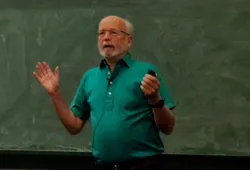 Prof. Adi Shamir (Weizmann Institute of Science), the world-renowned cryptographer and a recipient of the ACM Turing Award 2002 (the highest honour in computer science received jointly with Prof. Ronald Rivest and Prof. Leonard M. Adleman), visited our campus in January 2023 to collect an Honorary Doctorate from the University of Warwick. During his visit, Prof. Shamir gave also a research talk at the DIMAP seminar and CS Colloquium entitled "Efficient Detection of High Probability Cryptanalytic Properties of Boolean Functions."
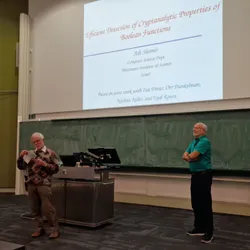 Prof. Shamir has been known in Warwick since 1976, when he spent a year as a post-doc with our own Prof. Mike Paterson. Directly after Warwick Prof. Shamir went to MIT, where together with Adleman and Rivest he invented the famous RSA public-key cryptography algorithm for encoding and decoding messages, used nowadays by millions to securely transmit messages over the internet. The work on RSA has been immensely influential and led to the 2002 A.M. Turing Award for the three co-inventors, cited for the “ingenious contribution for making public-key cryptography useful in practice.” Other noticeable awards (for RSA and other numerous contributions to cryptography and computing) received by Prof. Shamir include the 2000 Institute of Electrical and Electronics Engineers Koji Kobayashi Computers and Communications Award, the Israel Mathematical Union Erdős Prize in Mathematics (1983), the Vatican Pontifical Academy PIUS XI Gold Medal (1992), the Association for Computing Machinery Paris Kannellakis Theory and Practice Award (1996), the Israel Prize in Computer Science (2008), and the Japan Prize in the field of electronics, information, and technology (2017), and the Foreign Member of the Royal Society (2018).
Celebrating women in science
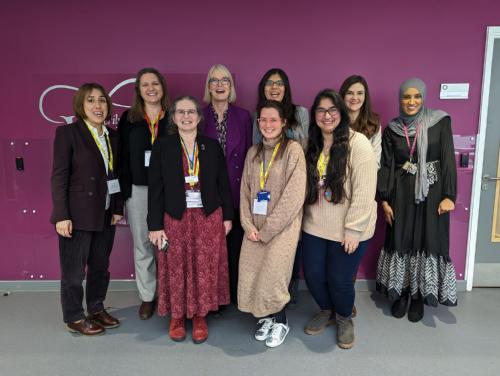 Six female scientists, from WMG at the University of Warwick, joined the students at Eden Girls School Coventry to celebrate International Women and Girls in Science Day.
The event, organised by the WMG Outreach Team and chaired by WMG’s Executive Chair Margot James, took place on Friday (10th February).
The expert panel, including Dr Claire Dancer; Antonia Betzou; Dr Elspeth Keating; Farah Villa Lopez; Magdalena Cieslak and Rupika Gulati, hosted a lively discussion with the girls about the highs and lows as a ‘woman in science.’
Each of the scientists shared their own personal journey and explained what had inspired them to pursue a career in science.
Margot James, WMG’s Executive Chair, said: “It's no secret that women have historically struggled because of the gender gap in STEM. We’re extremely passionate about this, and through our Outreach programme we are committed to build links with local schools and the community to provide role models that can help create a more equitable future.
“It was an absolute pleasure to meet such an inspiring group of girls, and I know our female scientists have helped to motivate them in their future career choices.”
A year 10 student from Eden Girls School added: “ I really enjoyed the science engineering workshop because it allowed me to understand what options are available to me after secondary school.
“Having women speak about their accomplishments and experiences really inspired me into thinking more about science, and trying my hardest to be able to achieve great things like they have. I learned so much and enjoyed everything.”
Find out more about WMG’s Outreach here: Public engagement and Outreach (warwick.ac.uk)
A “zinc” in the armour: could metal help combat common superbug?
A new study has shown that zinc plays a key role in a hospital superbug, that doctors struggle to treat due to its resistance to antibiotics.
Press Release (15 February 2023)
Our Student Experience Team are Wondrous and Wowsome!
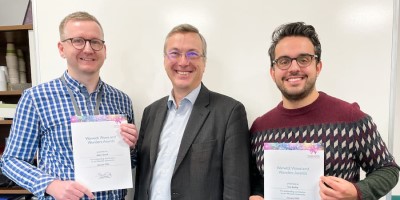
Congratulations to Adam and Tom! We are delighted you have been recognised by the University as 'Wonders & Wows Winners' for all the work you do to engage and promote the wellbeing of Chemistry students. See moreLink opens in a new window.
Appointment of Professor Charles Craddock
Warwick Medical School is delighted to welcome the new appointment of Professor Charles Craddock CBE to the Clinical Trials Unit as Professor of Haemato-Oncology. Professor Craddock will take a lead role in developing high-quality research programmes in clinical and cost effectiveness research of cancer therapies and support the University’s work on Innovation particularly in the health theme including the development of the University’s supra-regional health innovation campus Arden Cross and other projects - Read more here.
Conservation area restrictions are stifling climate action, new research finds
Homes in conservation areas may be responsible for between 3 and 4million tons of avoidable CO2 emissions every year.
Retrofitting homes can not only improve energy efficiency, but also reduce household bills and lower carbon footprint. Retrofitting can be a complex and costly process for any household. But new research shows that additional restrictions in conservation areas are putting residents off making changes to their homes, changes that could reduce the UK’s CO2 emissions by between 3 and 4 million tonnes every year.
There are over 10,000 conservation areas in England, and every local authority has at least one. Some local authorities, such as Bath, Islington and Westminster, have over 50% of their housing stock in conservation areas.
In most conservation areas, adding photovoltaic installations that are visible from the street, exterior wall insulation or window replacements requires planning permission from the local authority. Professor Thiemo FetzerLink opens in a new window, from the University of Warwick and the CAGE Research CentreLink opens in a new window, has calculated the extent to which these restrictions are deterring homeowners from making their homes more energy efficient.
Analysing data from Energy Performance Certificates and granular actual energy consumption data at postcode level for 239 English local authorities for which data was available, Professor Fetzer calculated the ‘energy efficiency gap’ of homes in conservation areas. He found that the 2 million properties inside conservation areas could save between 17,000 and 21,500 GwH in energy per year and between 3 and 4 million tonnes of CO2 emissions per year if they were retrofitted to the highest standard.
Most homes across the country are not fitted to the highest standard of energy efficiency. But a comparison of retrofitting of homes inside conservation areas with homes of a similar age, size, price, council tax status, and location outside conservation areas shows that homes in conservation areas are falling behind on retrofitting. In fact, this ‘retrofit gap’ (the difference in the amount and quality of retrofitting between homes in conservation areas and similar homes outside conservation areas) accounts for between 5 and 15% of the energy efficiency gap in conservation areas.
As properties outside conservation areas can retrofit at a faster rate (because they do not have to wait for planning departments to approve the works) this retrofit gap is widening.
The research demonstrates the urgent need for policymakers to find ways to make retrofitting easier in conservation areas. Professor Fetzer said,
Through retrofitting residents can play their part in addressing the climate crisis. But the data suggests that restrictions in conservation areas are a significant barrier. Removing or reforming these restrictions is something that all local authorities should look at urgently.
A toolkit developed by Christopher Procter of the Architects Climate Action NetworkLink opens in a new window may provide some concrete input into effective changes that councils across the UK should consider.
Professor Fetzer added:
Conservation areas originated in a period that saw fast changes to the lived environment brought about by growing car ownership in the 1960s. The climate crisis is the direct result of the carbonization of our economies and societies that followed. I hope that in 2023, residents living in conservation areas can reconnect with their original purpose: to limit the rapid environmental change. Back in the 1960s, the environment was changing because of growing car use – now, global heating is a much more fundamental threat to the lived environment. To achieve that, residents in conservation areas need to come together and become advocates for change. In the current regulatory environment, they threaten to fall behind.”
Policy wise, the government could be now very quick to announce a retrofit funding package for conservation areas. But this would be not very wise. Residents in conservation areas are, on average, better off financially than residents outside. So financially, they should not be given an untargeted hand-out to do what needs to be done. Rather, the government and local authorities should be investing in their own skills and capabilities, for example, by working with researchers together to spring to action to help residents in conservation areas to redefine what constitutes the specific character of their area and devise a plan on how to retrofit at scale in a coordinated and cost effective manner.”
- Fetzer, T. (2023) ‘Regulatory barriers to climate action: Evidence from Conservation Areas in England’ can be accessed here http://bit.ly/3jIISli
- The toolkit developed by Christopher Procter, part of the ACAN Architects Climate Action Network Existing Buildings working group can be accessed here: https://www.designingbuildings.co.uk/wiki/ACAN_climate_emergency_conservation_area_toolkit