
News
Precious metal could lead to next generation of cancer treatments
A precious metal which has never before been used in a clinical setting is being developed as an anti-cancer agent by University of Warwick researchers. The metal, osmium, is closely related to platinum, which is widely used to treat cancers in the form of the drug cisplatin. Most famously, the cyclist Lance Armstrong was treated with cisplatin for testicular cancer.
Now the researchers, based in the Department of Chemistry, at the University of Warwick, are working closely with Warwick Ventures, the university’s technology transfer office, to seek partners to help develop the potential of osmium through more extensive biological tests. The team will be presenting their work on 9 December at the national university technology showcase event, Bioversity.
Professor Peter Sadler, of the Department of Chemistry, explained: "Although cisplatin has been proven to be a very successful treatment; it is not useful for all kinds of cancer. It is also quite a toxic therapy, which can produce side effects and, from a clinical point of view, cells can also become resistant to platinum."
Osmium, with its special chemical properties, offers a new potential solution to an unmet clinical need. It has shown huge promise in treating several different types of cancer cell, including ovarian and colon cancers which have been developed and tested in the laboratory. The metal also has another advantage in that it is a much cheaper alternative to platinum.
First year chemistry student selected as judge of national chemistry prize

Polymers “battered” with nanoparticles could create self healing paints and clever packaging
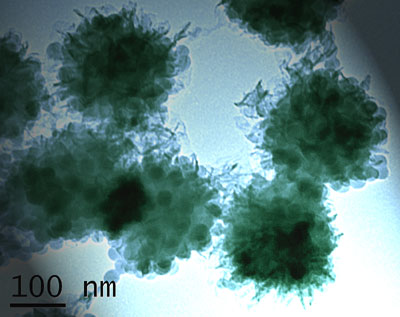
Peter Sadler gives the 2008-2009 Davison lecture at MIT
Peter Sadler was invited by the Massachusetts Institute of Technology (MIT, USA) to give the 2008-2009 Davison lecture in chemistry. His lecture was entitled: Using metal coordination chemistry to design new medicines.
The Davison lecture was named after prof. Alan Davison, an Englishman who invented cardiolite and who spend most of his career at MIT, becoming emeritus in 2005.
“Cardiolite® is now the leading cardiac imaging agent in the world. It is the only heart imaging agent FDA-approved to non-invasively evaluate the heart’s pumping ability (function) and gauge the amount of blood flow to the heart muscle itself (perfusion). Cardiolite® topped $2 billion (USD) in cumulative sales in 2004, and is the single largest royalty earner in the entire MIT portfolio, providing even more revenue than the royalties associated with Professor John Sheehan’s patents describing synthetic penicillin.”
Researchers find new chemical key that could unlock hundreds of new antibiotics
Chemistry researchers at The University of Warwick and the John Innes Centre, have found a novel signalling molecule that could be a key that will open up hundreds of new antibiotics unlocking them from the DNA of the Streptomyces family of bacteria.
With bacterial resistance growing researchers are keen to uncover as many new antibiotics as possible. Some of the Streptomyces bacteria are already used industrially to produce current antibiotics and researchers have developed approaches to find and exploit new pathways for antibiotic production in the genome of the Streptomyces family. For many years it was thought that the relatively unstable butyrolactone compounds represented by "A-factor" were the only real signal for stimulating such pathways of possible antibiotic production but the Warwick and John Innes teams have now found a much more stable group of compounds that may have the potential to produce at least one new antibiotic compound from up to 50% of the 1000 or so known Streptomyces family of bacteria.
Warwick Chemistry is aiming for the top
Warwick Chemistry is rapidly becoming one of the best chemistry departments in the UK, as indicated by their current ranking of UK chemistry departments by the Times 2009 Good University guide
Warwick Chemistry is heating up in becoming the top place in the UK to study chemistry with large investments in scientific infrastructure, for example £70 million under Science City in energy, translational medicine, and materials, thereby creating an impressive atmosphere for scientific research and education.
This great environment continuously attracts many world-leading scientists to move from other top institutions, such as prof. Peter Sadler (FRS, transfer from Edinburgh, now Chair of Warwick Chemistry), Tim Jones (transfer from London Imperial), prof Peter O'Conner (Boston University, USA), Rachel O'Reilly (Cambridge University), and Giovanni Costantini (Max Planck Institute for Solid State Research, Germany).
Warwick Chemistry is currently recruiting about 120 undergraduates a year offering them world class education by enthusiastic scientists from its 5 research disciplines. Warwick Chemistry will continue to invest and expand its portfolio over the next few years with the ambition to be one of the top 3 in the UK.
World-class academics transfer to Warwick Chemistry
Wills group part of £5M consortium to look at hydrogen for green energy
Professor Wills is a member of a 14 member consortium of academics in 13 universities which has recently been awarded a grant of ca. £5m over 4 years from EPSRC (EP/G01244X/1) to support research into the development of hydrogen as an energy vector. The programme will include research programmes into chemical and electrical generation of hydrogen using sustainable methods, as well as the integration of these processes into the overall hydrogen cycle, the conversion of hydrogen and by products into feedstocks and fuels, and the study of the socio-econmic implications of the hydrogen energy economy. Scientists in the consortium span departments from right across engineering, physical and social sciences. In addition to Warwick these are StAndrews, Newcastle, Oxford, Cambridge, Birmingham, Heriot-Watt, Brunel, Leeds, Imperial College, Manchester, Cardiff and Strathclyde. An important component of the work of the group, which will be known as the 'SUPERGEN: Delivery of S ustainable Hydrogen' consortium will be to increase the public profile of hydrogen energy research through Knowledge Transfer and outreach events.
further details please contact Martin Wills (M.Wills@warwick.ac.uk) or John Irvine (jtsi@st-and,ac.uk)
Century old rule of Chemistry overturned - major implications for drug delivery
A new study by research chemists at the University of Warwick has challenged a century old rule of pharmacology that defined how quickly key chemicals can pass across cell walls. The new observations of the Warwick researchers suggest that the real transport rates could be up to a hundred times slower than predicted by the century old "Overton’s Rule". This could have major implications for the development and testing of many future drugs.
Overton’s rule says that the easier it is for a chemical to dissolve in a lipid (fat) the easier and faster it will be transported into a cell. The Rule was first outlined in the 1890s by Ernst Overton of the University of Zürich. He declared that substances that dissolve in lipids pass more easily into a cell than those that dissolve in water. He then set forth an equation that predicted how fast that diffusion would happen. One of the key parameters in that equation is K which defines the lipophilicity (oil-liking nature) of the chemical. The higher the value of K, the faster the predicted cell permeation rate. For over a century, medicinal chemists have used this relationship to shape their studies and clinical trials.
Tim Jones' team part of £2.5M grant on spintronics
Commonly used industrial dyes hold the key to advancing the new science of 'spintronics', say researchers working on a new a £2.5 million study.
Spintronics holds out the possibility of a range of future applications, such as quantum computing, which aims to deliver secure, low-power computers capable of processing much larger quantities of data than is currently possible. Scientists believe that sensitive new biosensors able to analyse blood or urine samples rapidly and accurately could also be developed as a result of this work.
The new Basic Technology grant awarded by the Engineering and Physical Sciences Research Council will support research into the magnetic properties of metal atoms found in industrial dyes such as Metal Phthalocyanine (MPc), a blue dye used in clothing. The team from the London Centre for Nanotechnology - a joint venture between Imperial College London and University College London - and the University of Warwick believes that finding ways to control and exploit these molecules will allow spintronics to be applied in new ways.
Nanotube production leaps from sooty mess in test tube to ready formed chemical microsensors
|

Warwick Chemistry hosts UK Polymer Community
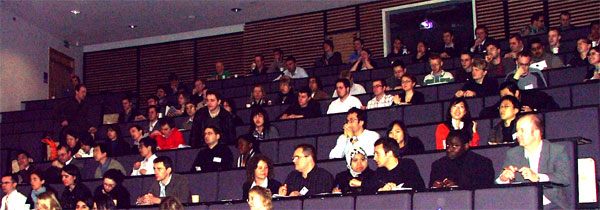
The Macro Group UK met at Warwick Chemistry for their annual Frontiers in Science Meeting in Combination with the Young Persons Research Meeting.
148 delegates from all over the UK were attending the conference which made it the one of the largest and most successful meetings the Macro Group UK ever had of this type.
Dave Haddleton, Chair of the Macro Group UK said: "To have approximately 130 polymer chemistry students from all over the UK having such a great time scientifically and socially is fantastic for UK polymer chemistry and also for Warwick Chemistry and the University"
Chair organiser of the conference was assistant professor Andrew Dove from Warwick Chemistry.
Patrick Colver, a final year PhD student in Stefan Bon's group was one of the winners of the best poster prize.
Photos of the meeting can be found here