
hp-01-image
The Academic Profile pages use a standard School of Engineering template to give a degree of consistency for all our staff profiles. The template is intended to be easy to use and reasonably flexible. The are some standard content blocks to filled in:
Left hand side
Right hand side
Plus there are four additional blocks available for use on the left hand side and two on the right hand side. The display order of the content blocks cannot be changed.
The content in any block can be updated through the "Edit" button; any blocks that do not contain a minimum amount of content will be hidden on the profile page. Please do not change the Title of any content block as this will break the link to the Profile page.
If these blocks are too restrictive for the content you wish to publish, then you have Edit permission for your own profile and can create any number of standard Sitebuilder sub-pages. Just make sure not to create the sub-pages beneath this "hp-content" page -- create them below your main profile page so that they can be seen in the menu.
Associate Professor
V dot Degirmenci at warwick dot ac dot uk
+44 (0) 24 7652 3385
I lead a research group working on porous functional materials — zeolites, metal-organic frameworks (MOFs), and MOF-derived carbons — for energy storage and sustainable chemical conversion. My particular approach is to watch these materials while they work: using in-situ and operando techniques (e.g. synchrotron XAFS and tomography) to see how a catalyst or electrode actually behaves under real operating conditions, not just before and after.
My current focus is battery materials: MOF-derived carbon electrocatalysts and single-atom catalysts for zinc-air batteries, sustainable PVDF-free binders for lithium-ion batteries, and operando synchrotron imaging of battery failure mechanisms such as dendrite growth. I'm also developing a new route to grow oriented MOF thin films directly onto electrode surfaces by inkjet printing — a technique not yet applied to batteries — as a route to precisely engineered electrode coatings.
This builds on 20 years working across heterogeneous catalysis and biomass valorisation, where I developed methods (in-situ EXAFS at ESRF, solid-state NMR, in-situ FT-IR & Raman) and custom reactor and cell designs that I still use today.
My group also runs a parallel, more exploratory strand in bioinspired engineering: studying the surface structures of pangolins, crocodiles, and big cats to redesign tyre and tread patterns for planetary rovers and low-compaction agricultural vehicles.
I welcome enquiries from prospective PhD students and from research partners looking for expertise in porous materials synthesis, battery materials, or operando/in-situ characterisation.
School of Engineering
F3.24
Friday, 10:00-12:00 during the term time or by appointment.
School of Engineering, University of Warwick, Library Road, Coventry, CV4 7AL, UK.
- MOF-derived carbons and single-atom catalysts for zinc-air battery electrodes
- Sustainable, PVDF-free polymer binders for lithium-ion (NMC/LFP) batteries
- Operando synchrotron characterisation of battery failure (dendrite formation, catalyst degradation) via XAFS, tomography and micro-diffraction
- Surface-anchored MOF (SURMOF) thin films grown by inkjet printing, for battery and sensor electrodes
- Hierarchical zeolites and MOFs as catalysts for biomass conversion (glucose to HMF/FDCA)
- Custom in-situ/operando reactor and cell design for spectroscopy under real reaction conditions
- Bioinspired surface design (from pangolin, crocodile and large-cat morphology) for planetary-rover (e.g. Mars rover) and low-compaction agricultural tyres
I teach across renewable energy and energy storage. I teach Renewable Energy (IL914), compulsory for the MSc in Humanitarian Engineering, and contribute to Energy and Sustainability, an optional fourth-year module. From 2026-2027, I will also be teaching a new optional fourth-year module, Batteries and Fuel Cells, reflecting my group's research focus on battery materials.
Systematic modification of UiO‐66 metal‐organic frameworks for glucose conversion into 5‐hydroxymethyl furfural in water, ChemCatChem 13, 2021, 2517-2529, 2021. full textLink opens in a new window
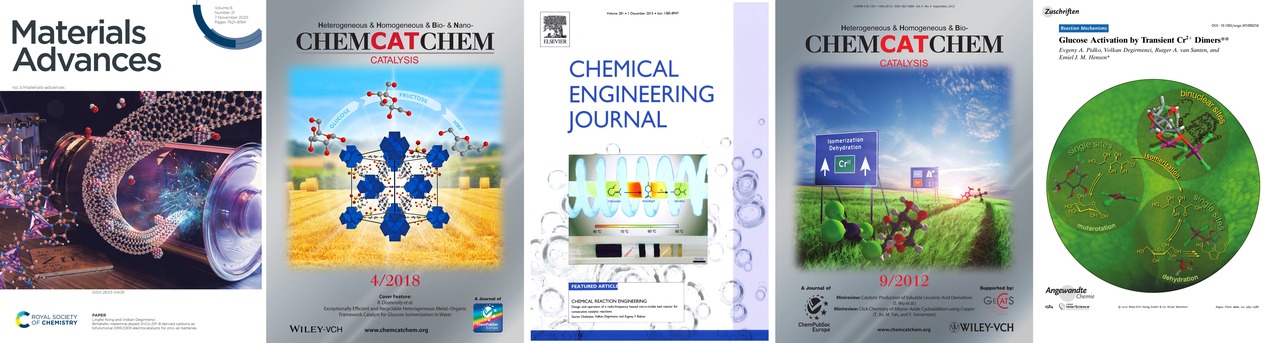
Exceptionally Efficient and Recyclable Heterogeneous Metal–Organic Framework Catalyst for Glucose Isomerization in Water, ChemCatChem 10, 2018, 651-651. full text & front cover
Full list of publications can be reached here.Link opens in a new window
I am looking for PhD students interested in battery materials, porous solid catalysts, or in-situ/operando characterisation. Current and recent projects include zinc-air battery electrocatalysts, sustainable lithium-ion binders, MOF thin-film electrodes, and synchrotron studies of battery degradation. Chemical, mechanical, materials, or chemistry backgrounds are all welcome — get in touch to discuss.
Last updated: September 2026