
Physics Department News
It rains on the Sun! The dynamics of cool condensation in the solar corona.
Coronal rain are cool dense condensations that form in coronal loops and are the manifestation of catastrophic cooling linked to thermal instability. In as series of recent studies Petra Kohutova & Erwin Verwichte (CFSA) investigated the dynamics of coronal rain.
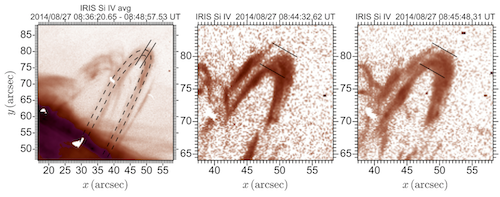
We analysed observations from space-born solar instruments on board IRIS, Hinode and SDO and identified transverse oscillatory motions in the rain. By comparing these with our theoretical model, we were able to deduce for the first time the fraction of the coronal loop mass condensing to form rain. This provides insight into the physical nature of the thermal instability, heating and mass cycle in the solar corona.
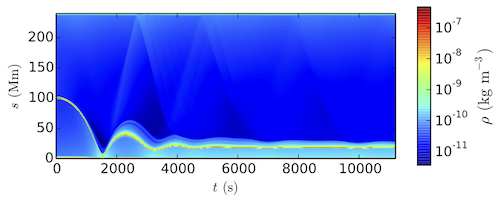
Furthermore, we numerically simulated the dynamics of coronal rain using Warwick’s nonlinear MHD code LareXd, to explain why coronal rain is seen to fall sub-ballistically. We found that the motion of condensations is strongly affected by the pressure of the hot coronal loop plasma below it with maximum rain velocities matching recent coronal rain observations. Interestingly, high coronal magnetic fields or low condensation masses can lead to rain bouncing back upwards, resulting in a damped oscillatory motion along the loop. This is caused by the pressure gradient and magnetic tension forces such that the dense condensation acts as a piston.
For further information, see:
- Verwichte, E. & Kohutova, P., Astron. Astrophys. 601, L2 (2017)
- Kohutova, P. & Verwichte, E., Astron. Astrophys. 602 A23 (2017)