
Physics Department News
MicroBooNE experiment publishes in Nature
An international collaboration of scientists, including Warwick physicists Drs. John Marshall, Andy Chappell and Ryan Cross, have shown that a fourth type of neutrino can't explain anomalous results from earlier neutrino experiments.
In a paper published in Nature, the MicroBooNE collaboration has announced that they have found no evidence for a single sterile neutrino, a hypothesised type of neutrino that does not interact via the weak force experienced by the three known active neutrinos. Theorists had previously proposed such a neutrino could explain anomalous results from past experiments, but MicroBooNE has been able to rule this explanation out with 95% certainty.
Warwick group quote: "With this result providing a strong exclusion of the single sterile neutrino hypothesis, we'll now be looking at the ongoing Short-Baseline Neutrino programme to explore alternative models to explain the anomalies, and look forward to the Deep Underground Neutrino Experiment to perform important tests of our existing three neutrino paradigm”
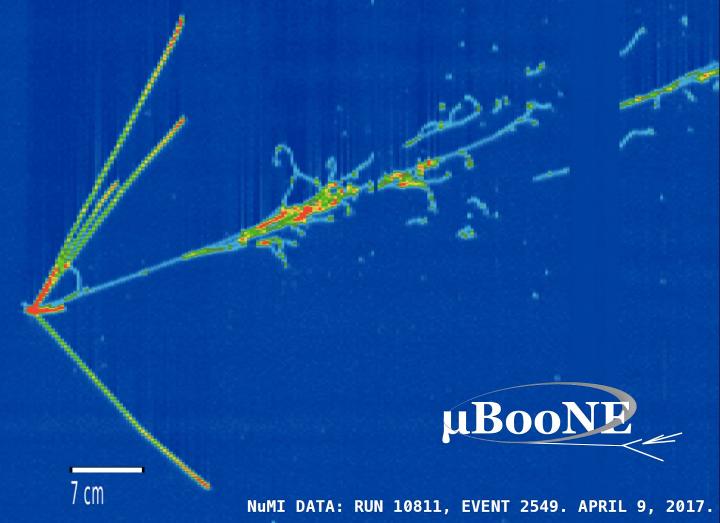
Image shows a neutrino interaction in the MicroBooNE detector, produced by the NuMI beam. A number of charged particles emerge from the initial interaction point, producing several track-like deposits and an electromagnetic shower cascade.
Read the full press release from Fermilab.Link opens in a new window