
Physics Department News

Christmas Lecture a roaring success!
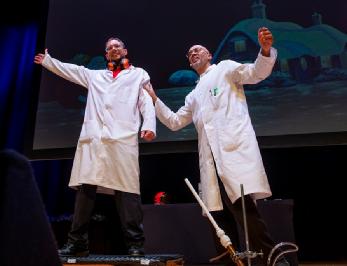 The first Warwick Christmas Lecture of 2019 featured talks and live experiments by Physics academic James Lloyd-Hughes and our technical staff Paul McCarroll and Alan Burton. The audience of over 1100 enjoyed a fun and informative Christmas Lecture, including the Arts Centre's loudest ever explosion (deliberate and controlled).
The second Christmas Lecture included talks by Rachel Edwards and Ally Caldecote, featuring several paddling pools of non-Newtonian fluids.
Uprooting defects to enable high-performance III–V optoelectronic devices on silicon
A new defect elimination strategy in highly mismatched heteroepitaxy is demonstrated to achieve ultra-low dislocation density using a highly scalable process.
Checking the outputs of quantum computers
As the first generation of quantum computers are now reaching the point where they can answer such otherwise impossible questions, it is necessary to consider how the answers of these early devices can be confirmed correct. The full power of quantum computing includes a wide range of problems for which this is not possible, instead demanding new techniques to test quantum computers. A new test has now been proposed by Samuele, Theodoros, and Animesh (Quantum Information Science) which can be used to make sure the quantum computer is working correctly without using excessive additional resources while still testing the entire quantum computer. Published in the New Journal of Physics, this protocol uses circuits which have the same form as the desired circuit but are formulated to give known outcomes. Based on the accuracy of these circuits they are able to place a statistical bound on how close the distribution the quantum computer gives is to the correct distribution.