
Physics Department News
First planet found by NGTS - it's a monster!
New research, led by Dan Bayliss and Peter Wheatley, has identified an unusual planet NGTS-1b - the largest planet compared to the size of its companion star ever discovered in the universe.
Dan Bayliss, lead author of the research, commented: "The discovery of NGTS-1b was a complete surprise to us - such massive planets were not thought to exist around such small stars. This is the first exoplanet we have found with our new NGTS facility and we are already challenging the received wisdom of how planets form."
Peter Wheatley added, “Having worked for almost a decade to develop NGTS, it is thrilling to see it picking out new and unexpected types of planets."
Pettifer Prize 2017
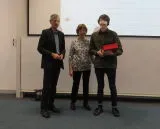
The Pettifer Prize is presented annually to the Physics student with the best overall performance in first year examinations, and it honours the memory of Dr Robert Pettifer, who joined the department in 1972 until his retirement due to ill-health in 2007.
The prize was presented by David Leadley and also by Robert’s wife, Mary Pettifer.
The winner this year was Nicholas Metcalfe.
More information on the prize can be found at https://www2.warwick.ac.uk/fac/sci/physics/current/teach/prizes/pettifer/
Gold origin confirmed with first ever neutron star gravitational wave sighting
Gold’s origin in the Universe has finally been confirmed, after a gravitational wave source was seen and heard for the first time ever by an international collaboration of researchers, with astronomers at the University of Warwick playing a leading role.
Mid-infrared light emission > 3 um wavelength from tensile strained GeSn microdisks
Direct bandgap photoluminescence in the 3–5 um wavelength window is demonstrated from GeSn microdisks, suggesting that GeSn alloys are well suited for mid-infrared integrated gas sensors on Si chips.