
Physics Department News
WATE Winners 2012/13 announced
The winners of the Warwick Awards for Teaching Excellence 2012/13 have been announced. The WATE awards recognise and celebrate excellence in teaching and support for learning at Warwick. Winners each receive £5,000 to further enhance their practice and will receive their awards at the Summer Degree Congregation.
Andy Howes is a Commendee.
For more information please visit http://www2.warwick.ac.uk/insite/news/intnews2/13_announced
Physics Employer Event Wednesday May 1st 2013
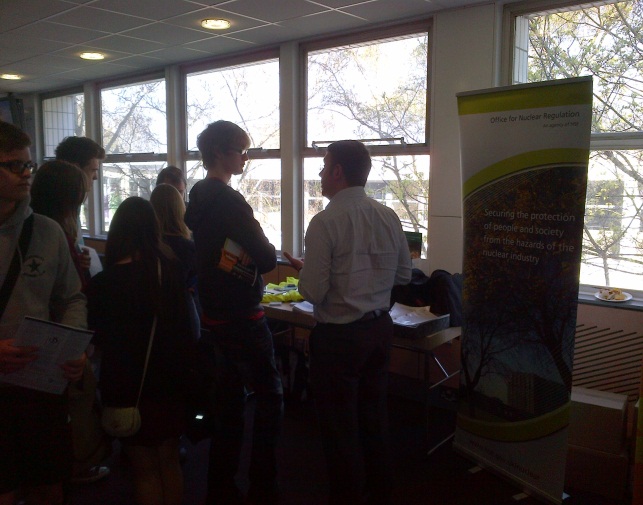
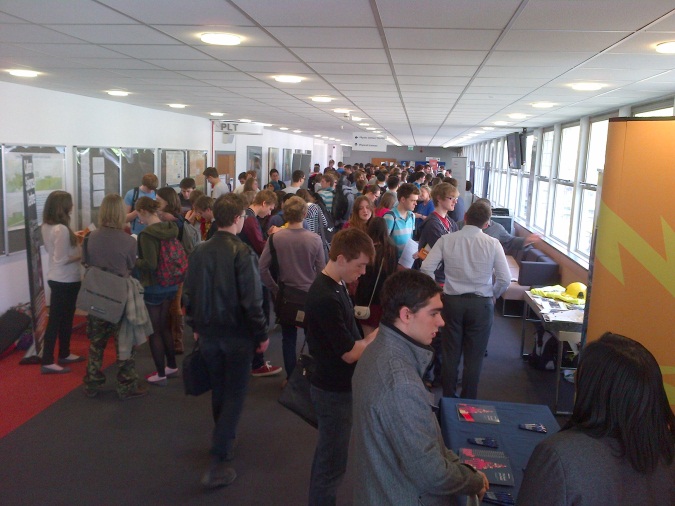
Over one hundred and ninety students and thirteen recruiters attended an employer event for physics students in the PLT concourse on Wednesday, May 1st. The event was planned in response to feedback from students who wanted an event tailored specifically to the needs of physicists.
It was good to see students from all years present, with a particularly encouraging turn out from first years. The Student Careers & Skills Service advocates early career planning, part of which involves understanding the options available – these students will hopefully now have an increased awareness of the type of graduate employers looking to recruit physicists.
There was wide sector representation with employers from the energy sector, finance, software, technology, teaching, meteorology, patent law and medical physics. Several of the recruiters commented on the interest, enthusiasm and potential of many of the students they spoke to during the event. Student feedback was also very positive:-
“…good opportunity to investigate possible career paths…lots of advice and very informative discussions…helpful that it was aimed at physicists rather than a general careers fair…it was the first time I’ve come to a careers event and it was quite eye-opening.”
All of the recruiters expressed an interest in attending similar events in the future and many offered to deliver skills sessions – an effective way to build their profile and foster employer engagement in the department. This can only prove beneficial to the career prospects of physics students by alerting them to a wider range of opportunities.
If you have any comments on the event or any suggestions regarding the type of event you would like to see delivered in the physics department in the future, please email the careers consultant, Ray Ryan (r.ryan@warwick.ac.uk)
Marin Alexe receives Wolfson Research Merit Award
Professor Marin Alexe from Warwick's Department of Physics, has received a Wolfson Research Merit Award form the Royal Society. For more information, please see the news article http://www2.warwick.ac.uk/insite/news/intnews2/marin_alexe_receives/
Physics and the economy
In 2012, the EPS commissioned an independent economic analysis from the Centre for Economics and Business Research (Cebr) on the importance of physics to the economies of Europe. The report, using statistics available in the public domain through Eurostat, covers 29 European countries – the EU27 countries, plus Norway and Switzerland. Under examination is the 4-year period 2007-2010, 2010 being the most recent year for which official data are simultaneously available for all these countries.