
Physics Department News
Higgs Boson-like Particle Found
Today, July 4th 2012, researchers at the Large Hadron Collider (LHC) at CERN have made an historic announcement: a particle consistent with the much-sought-after Higgs boson has been found. Edinburgh Professor Peter Higgs first proposed the existence of the so-called "God Particle" almost 50 years ago - here Warwick physicists help to explain the significance of this new discovery.
Hubble Space Telescope
The Warwick astronomy group has been very successful in the latest round of time allocation on the Hubble Space Telescope. Boris Gaensicke, Andrew Levan, Danny Steeghs and Peter Wheatley will be leading six programs on HST in the forthcoming Cycle 20, including one of the five large programs that were awarded. Their projects were facing an over-subscription of six.
Physics Welcomes Professor Don Pollacco
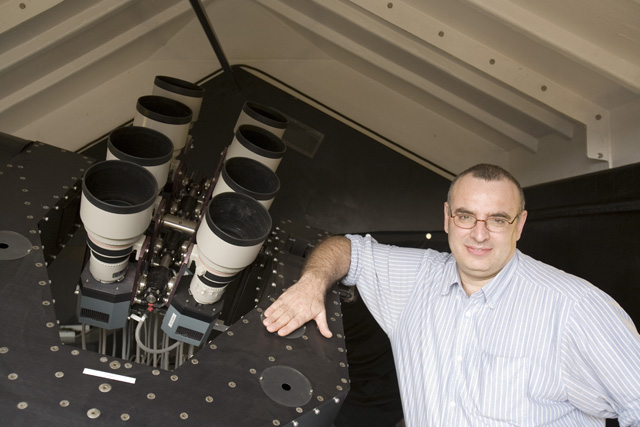
We are delighted to announce that Prof Don Pollacco will be joining our Astronomy and Astrophysics Group from September 2012. Don is a world leader in the search for planets around distant stars. He played a crucial role in developing the SuperWASP project, which has found more than a third of all known transiting planets and was awarded the Royal Astronomical Society Group Achievement Award in 2010. Don recently took part in NASA's Senior Review of its astrophysics space missions, and has been heavily involved in an advisory capacity with both the Science and Technology Facilities Council (STFC) and UK Space Agency (UKSpA) for many years. Don is also co-PI of the Next Generation Transit Survey
(NGTS) and leads the exoplanet science programme of the proposed European Space Agency mission PLATO. These new missions are targeted at finding Earth-like planets and enabling detailed studies of their atmospheres.