
Physics Colloquium 28th October 2026 - Prof C. Patrick Royall
Welcome
Please join us for a Physics Colloquium with Prof C. Patrick (Paddy) Royall from ESPCI Paris.
How to attend
The colloquium will be held in-person. Coffee/tea and biscuits will be provided.
L3 at 15:30 on 28th October 202 on the Science Concourse (see campus map).
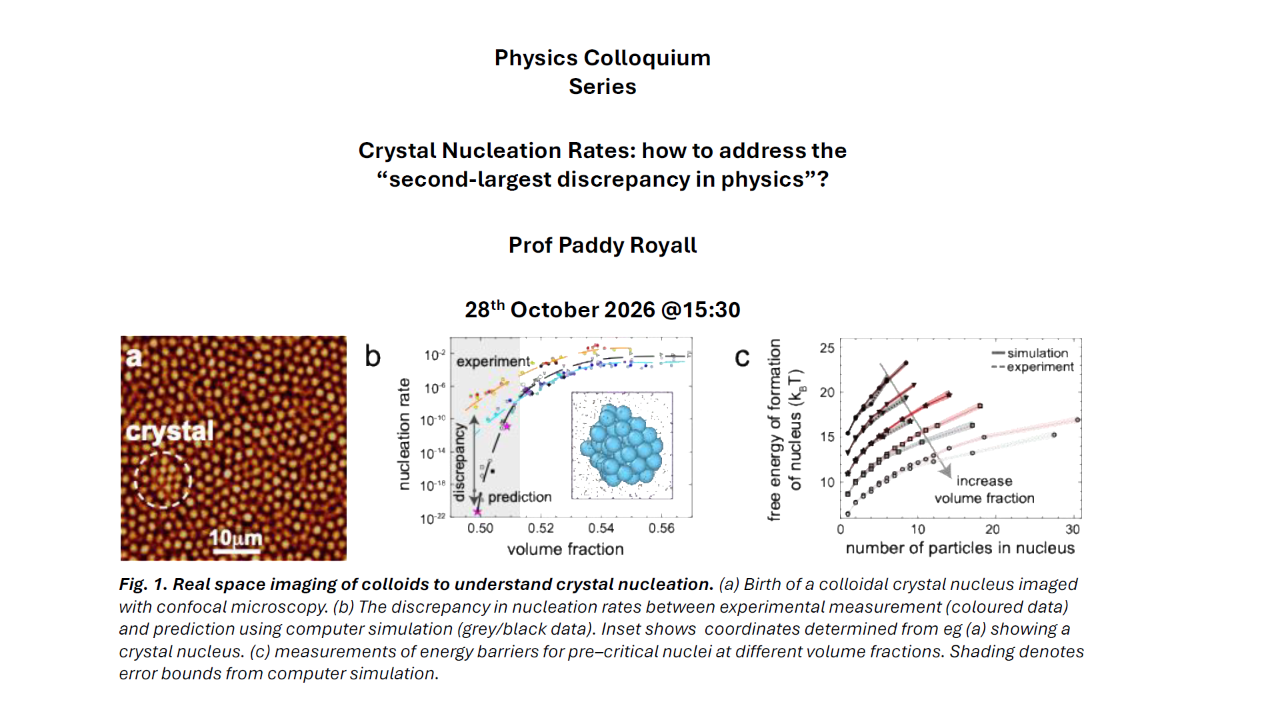
Crystallisation is among the most familiar physical phenomena of everyday life. One would imagine that it has been long understood. And yet there remain many basic unanswered questions, not least what is the rate of formation of crystal nuclei? This is important from manufacturing to climate change modelling. And although the key theory, classical nucleation theory was developed around a century ago, it is all but impossible to predict the nucleation rate for common materials such as water.
In such general problems, model systems play a crucial role, as a benchmark of theory and computer simulation [1,2,3]. Alas, the most studied material, colloidal hard spheres, exhibits a wild disagreement between experiment and numerical prediction of 20 orders of magnitude, which has been termed “the second-largest discrepancy in physics” (Fig. 1b). [1]. Since the relevant experimental work was carried out in the last millennium, we expect that developments, such as particle-resolved studies using microscopy may shed light on this phenomenon (Fig. 1a,b). With careful matching of state point between experiments and simulation, we find agreement for the energy barriers to form pre-critical nuclei (Fig. 1c) [4]. We further shed light on the origins of the hard sphere nucleation discrepancy.
[1] Royall CP et al, Rev. Mod. Phys. 96 045003 (2024).
[2] Taffs J. and Royall CP, Nature Commun. 7 13225 (2016).
[3] Gispen W, Coli GM.,van Damme R, Royall CP and Dijkstra M, ACS Nano 17 8807–8814 (2023).
[4] Kürten L, Castagnède A, Smallenburg F, Royall CP, Science Advances 12, eaec8906 (2026).