
Present and future of Sonification
Where is it currently at?
At present, there is a wide range of research into sonification and it's various uses, and some applications of it are already being pursued by large organisations. Sonification has recently emerged as a reasonable alternative for representing data, as it is important to recognise that us, as humans, have more than one sense and that sight might not be the only way to analyse information. This is significantly important for those with visual impairments, who often have improved hearing to compensate, therefore using audio to present data provides a useful alternative. The most prominent example of sonification at the moment is NASA’s use of it to translate images captured by the Hubble telescope into sound. Examples and explanations of this can be found on NASA's Sonification Webpage.Link opens in a new window
Here is just one example of sonification from NASA:
Ongoing Research
Aside from the current use of sonification at NASA, the majority of research is currently focusing on medical uses.
IVF Sonification
A study from 2025 examines the use of sonification for enhancing the experience of In Vitro Fertilization (IVF) for expectant parents. The research from this paper suggests that IVF sonification can help improve the "experience of viewing these crucial developmental moments" for parents and also establishes stronger connections between the parent and child in early stages of the process.
The study highlights that whilst sonification of IVF imagery can be used for medical and diagnostic purposes, the aim of the research is to create a more "meaningful experience for parents" which can aid the experience and understanding of the imagery. It is also stated that 87% of expectant mothers in a survey preferred the use of sonification during their IVF process, providing more enjoyment and understanding, compared to silent imagery.
The sonification of the IVF videos have been worked on and designed with composers, technologists and IVF clinicians in order to create music from the imagery to meet certain requirements:
- The music should emphasise key moments in the development of the embryo
- The tone of the music should be "warm and optimistic"
- The music should complement the IVF imagery and not distract from it
The study focuses on the "rhythm of embryonic cell divisions" because it is considered an important stage in the development and can be difficult to track for expectant parents. The audio has been developed to contain "musically sophisticated" elements to describe the division of the cells. The paper explains in more detail how these requirements are obtained and and how each component of the music is generated for a more enhanced musical experience.
For further reading and more information about this study you can view the paper.
Human Brain Sonification
Another study from 2025 explores using sonification to analyse the human brain. The goal of the study was to "provide an intuitive and effective auditory representation of complex higher-order statistics". The majority of current sonification only focuses on one dimension, however the brain is three dimensional, so this paper focuses on multi-dimensional sonification. This was done by exploring bispectrum signals derived from magnetic resonance imaging (MRI) data.
The paper suggests that if studied further, sonification of the human brain can aid providing a diagnosis, specifically for early signs of dementia. This can also be useful for people with visual impairments, providing a higher level of analysis.
The study approaches the sonification of the music by assigning specific musical notes to different variations in the bispectrum signal, as seen below:
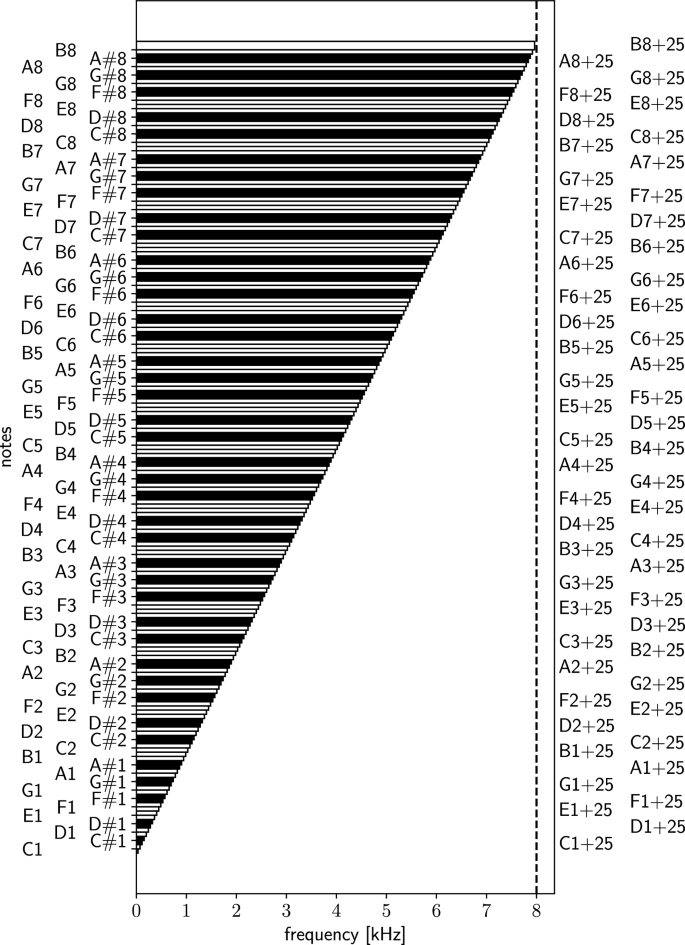
These notes span eight octaves to account for the very different range in bispectrum signals for different age groups. Using such a large range, and including semi-tones and even quarter-tones, this ensures the sound produced accurately represents the bispectrum variation.
For further information and more detail on how higher-order sonification is implemented you can view the paper.