Calendar of events

Fri 20 Jan, '23- |
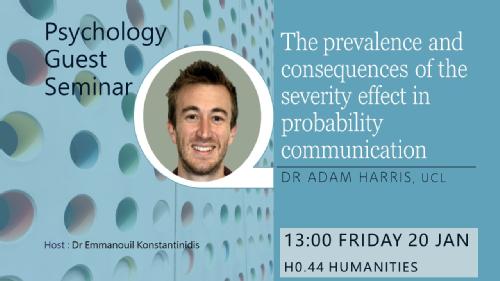
Guest Speaker: "The prevalence & consequences of the severity effect in probability communication", Dr Adam Harris, UCLH0.44 HumanitiesSpeaker: Dr Adam Harris, UCL Title: THE PREVALENCE & CONSEQUENCES OF THE SEVERITY EFFECT IN PROBABILITY COMMUNICATION Abstract:: Effective decision making relies on reliable assessment of probabilities (‘will this talk be stimulating?’). Frequently, we receive clues to these probabilities from expert sources, be they professionals (e.g., weather forecasters) or colleagues (e.g., those who have seen me talk before). Probabilities can be communicated in different formats, including verbal (‘it is likely that it will rain tomorrow’). Such verbal communications are susceptible to a variety of pragmatic influences, and in the current talk we focus on the Severity Effect, whereby numeric interpretations of verbal probability expressions (VPEs) are higher for more severe events. We extend this research by demonstrating that professional weather scientists provide higher verbal probability expressions for severe impacts with the same numerical probabilities as non-severe impacts, in a hypothetical weather warning task. Finally, probability estimates are seen to increase across ‘rounds’ of a communication chain study, where VPEs are translated to numbers and vice versa, across seven rounds. The research has implications for likely amplification of perceived risks. Host: Dr Emmanouil Konstantinidis For Teams Link, contact: Catherine Johnstone
See archive of Previous speakers here |
|
Tue 24 Jan, '23- |
Student Green Champions Network RelaunchOC0.01 OculusStudent Green Champions Network RelaunchThe University’s Sustainability Team is relaunching the Student Green Champions Network, a community of students who recognise and embrace that sustainability is at the heart of their future whatever career path they choose to take as it is becoming more and more important to every aspect of our lives. Green Champions have the opportunity to develop transferrable skills, meet like-minded people, see more of campus and the surrounding area, learn more about how the University operates and how decisions are made. To join the Psychology Department Green team see details here and contact Catherine Johnstone c.j.johnstone@warwick.ac.uk |
|
Tue 24 Jan, '23- |
PGR Welcome Walks JanuaryOutside the Arts Centre by the bus exchange |
|
Wed 25 Jan, '23- |
Internal Seminar: "Nature and nurture: Social and neonatal risk profiles in very preterm born children and developmental outcomes early childhood" Dr Sabrina TwilhaarH0.44 - in person onlyTitle: Nature and nurture: Social and neonatal risk profiles in very preterm born children and developmental outcomes early childhood Speaker: Dr Sabrina Twilhaar Internal seminar organiser: Dr Mikhail Spektor |
|
Thu 26 Jan, '23- |
Early-Stage Researcher Induction Module: Welcome and Orientation Book for series of 5 Teams sessions |
|
Thu 26 Jan, '23- |
Recycle your Bike SaleOutside Humanities BuildingRecycle Your Cycle Bike SaleRecycle your Bike returns from 12pm on the 26th of January. If you’d like to buy a used cycle, come to the University Road (outside Humanities B). All staff and students are welcome! |
|
Thu 26 Jan, '23- |
InReach10x Seminar James PoskettOC1.01 OculusInReach10x Seminar - James Poskett2:15pm - 3:15pm, Thu, 26 Jan '23 Export as iCalendar Location: Oculus OC1.01 Talk by James Poskett (Warwick History Department) The Global Origins of Modern Science Where did modern science come from? Until recently, most historians agreed that the origins of modern science could be located in Europe, sometime between 1500 and 1700. In this talk, based on the latest scholarship, I present a very different account. Beginning in the fifteenth century and moving right through to the present, I make the case for the global origins of modern science, exploring the ways in which Africa, America, Asia and the Pacific fit into the story. The history of modern science, I argue, needs to be understood as part of a history of global cultural exchange. In making this argument, I uncover the forgotten contributions of scientists from around the world, whilst also making the ethical, political, and intellectual case a critical engagement with the legacies of the history in the world of science today. ——————————————— Sign up for his talk hereLink opens in a new window. (Although a sign up is not strictly essential, it helps us plan better) Mohan K. Balasubramanian Director Institute of Advanced Study |
|
Mon 30 Jan, '23- |
Grant WritingH1.49Although grant writing may seem a distant prospect for those currently still studying, having an idea about the whole process may be rather important when you come to take up your first job post-graduation. For some graduates the best way to find a first post-doctoral position is to 'write your own job', producing at least a draft grant application that will permit you, often in collaboration with a more experienced academic, to find gainful academic employment once you finish your studies. Many post-doctoral supervisors will ask for your assistance when writing future grants too - and will be more likely to employ you in the first place if you show some knowledge of this process. And for longer-term academic positions it is rare for employers not to ask about grant potential during the interview stage. In this session Claire from our research services will provide an introduction to the process of grant writing and provide useful tips for those just embarking on this process. |
|
Tue 31 Jan, '23- |
Picture a Scientist Screening for FSEM staff and studentsL3 Science ConcoursePicture a Scientist Screening: Tuesday 31 January, 09:30-10:30 (L3, Science Concourse) All staff and students from across the SEM faculty are welcome to join Physics at a screening of ‘Picture a Scientist’ at 09:30-10:30 on Tuesday 31 January in L3 on the Science Concourse. For more information, please follow this linkLink opens in a new window. With thanks to Chemistry for sharing the film. |
|
Tue 31 Jan, '23- |
The role of AI in Eldercare, Professor Alex MihailidisOC0.01 Oculus |
|
Wed 1 Feb, '23 - Tue 28 Feb, '23All-day |
LGBTQ+ History MonthRuns from Wednesday, February 01 to Tuesday, February 28. |
|
Wed 1 Feb, '23- |
Postgraduate Study Progression event UG finalistsChancellors Suite, Rootes buildingAn event where Psychology will have a stand aimed at current Warwick UG finalists looking to progress onto a PGT programme and PGT students looking to progress onto a PGR programme. Livia Lita Faculty Recruitment Officer (Faculty of Social Sciences) Marketing and Student Recruitment |
|
Wed 1 Feb, '23- |
Warwick R User GroupOn-line - sign upWarwick R User Group: Wed, Feb 1, 5-6pm, online
The next meeting of the Warwick R User Group will take place online, Wednesday, February 1, 5-6pm.
Speaker: Ellen Zapata-Webborn (Senior Research Fellow in Data Science and End Use Energy Demand, UCL Energy Institute)
Title: Using Predictive Modelling to Study the Impact of COVID-19 on Energy Consumption
Abstract: How did COVID-19 affect household energy consumption in the UK? How did changes continue or change in the 2 years since the start of lockdown 1? How have different types of households been affected differently? To answer these questions, we developed elastic net regression and neural network models to predict what would have happened in the absence of the pandemic and compared these ‘counterfactuals’ with observed electricity and gas consumption in several hundred households. The analysis was all done in R, with packages data.table, caret, glmnet, and xgboost doing most of the heavy lifting. In this talk I’ll describe our approaches, the challenges we faced along the way, and what we found out.
You can sign up for the event and get the meeting link on the meetup page:
https://www.meetup.com/warwickrug/events/290999481/Link opens in a new window |
|
Fri 3 Feb, '23 |
Women and Mental IllnessPost-War Britain |
|
Sat 4 Feb, '23- |
Cycle Assist: Exploring the Disability Cycling MovementHumanities Building |
|
Mon 6 Feb, '23- |
Impact talk: Rob Hollingworth open to Researchers and PGRsH1.49The evaluation of the impact of research forms a significant percentage of the way in which academic departments are now evaluated, not only in the UK but in many other countries too. As a result, increasing attention has been paid to understanding what may (and may not) be considered 'impactful research', and some of the ways in which at least some of a department's work can have a wide and deep impact on society. This is important to understand even for those still studying because, as with grant writing, the potential impact of your work may often be explored during job interviews and can be sometimes important in getting an academic position. Many major grants too nowadays have an element of 'impact' too, further underlying the importance of this understanding. In this session Rob from our research services will introduce the concept of impact, what it is (and is not) and how you might consider the future impact of your own doctoral research. |
|
Tue 7 Feb, '23 |
Science Precinct DesignScience Precinct Design Day – 7th FebruaryBetween 10am and 4pm on the 7th February, please come and informally speak to our architects, BDP, as well some of the STEM GC leadership team for the second Science Precinct Design Day.
|
|
Tue 7 Feb, '23- |
Forum for Leaders of Inclusive Cultures The Impact of Discrimination and ExclusionOnline - registerForum for Leaders of Inclusive Cultures - The Impact of Discrimination and Exclusion Tuesday 7 February 2023, 3.30-4.30pm, online. Discrimination and exclusion have a very real, multifaceted, and significant impact on employee’s health, wellbeing, and ability to perform at work. Research shows that these behaviours have impacts both physiologically (e.g., increased blood pressure, cortisol, and heart rate) and psychologically (e.g., speak up less, less decisive, less likely to share their needs and request help, reduced ability to set, persist with, and achieve goals). How can employers combat discrimination and exclusion in their workplace, and promote positive cultures that support employee wellbeing and productivity? Join us for this free event where our panel will discuss these topics, their experiences, and the work of their organisations to build truly diverse and inclusive cultures. Find more information and register to attend here. Michaela Hodges. | 🔊 Hear my name (part of the Say My Name project). | She/Her (Make the Pronouns Pledge). Social Inclusion Officer. |
|
Wed 8 Feb, '23- |
Artificial Intelligence (AI) and the future of educationOnline or Teaching Grid - registration necessaryLDCU TEAL Forum: Artificial Intelligence (AI) and the future of education Join us online or in-person on Wednesday 8th Feb 3-4pm for an informative and thought-provoking panel discussion on Artificial Intelligence (AI) and its likely impact on the future of education. Our panel of Warwick colleagues will share their insights and thoughts on the latest developments in AI tools such as ChatGPT, Dall-E, etc. as well as their own research and investigations. The panel will consist of: Lee Griffin (WMG) Jonty Leese and Abigail Ball (CTE) Dr Martyn Parker (Statistics) Dr Isabel Fischer (WBS) This is an opportunity for you to engage in a dialogue and exchange ideas with your colleagues on the potential implications of AI for assessment and education in general. This session is being offered as a hybrid meeting with an option to join in-person or online. Register below to secure your place at this panel discussion meeting. |
|
Wed 8 Feb, '23- |
Guest speaker: The Psychological consequences of residential mobility in emerging adulthoodS1.69 Social StudiesDr Michaela Gummerum is hosting a talk today 15:30 S1.69 Social Sciences on The Psychological consequences of residential mobility in emerging adulthood. Speaker: Cansu Yilmaz, Andolu University, Turkey.
 |
|
Wed 15 Feb, '23- |
Postponed to 17 May: Language & Learning SeminarTeams - email for link |
|
Thu 16 Feb, '23- |
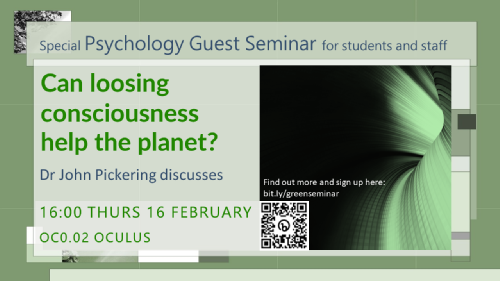
Guest talk for staff and students: "Can loosing consciousness help the planet?" Dr John Pickering PLEASE SIGN UPOC0.02 Oculus tbcSpeaker: Dr John Pickering Can loosing consciousness help the planet? Undergraduate Students are very welcome to attend this talk. Please complete this quick form to allow us to anticipate numbers. Host: Professor Derrick Watson The abstract: There has been a return of interest in panpsychism, the idea that consciousness is as ubiquitous as matter and energy. This is a radical break with the mechanistic worldview psychology has inherited from the nineteenth century. The break is much needed, as the values implicit in that worldview have helped create the ecological crisis we now face. Following the work of A. N. Whitehead, David Bohm and Charles Sanders Peirce, a different worldview will be proposed. In it, causes and signs are identical and consciousness exists at ranges well beyond that of human experience. The aim of the proposal is to recover some of the ecological sensitivities found in pre-scientific traditions. If you would like to attend this talk, please complete the very quick attendance form here.
See archive of Previous speakers here |
|
Mon 20 Feb, '23- |
The Media: Careers talk open to researchers and PhD attendeesH1.49Psychologists are frequently featured in the media, and this can, of course, be both a good and bad thing. Just because you have only completed half of your first preliminary pilot study does not guarantee that your small conference presentation will not gain media traction, and it is therefore to know about the media process, how to interact with the media, the tricks of press releases, and some of the things to say (and not say) when that friendly hack approaches... Communication officer Bron Mills, now at Warwick but previously at the BBC and ITV, will impart her experience and wisdom. |
|
Tue 28 Feb, '23- |
PhD Welcome EventRegister - in person or online
Run by Doctoral College |
|
Wed 1 Mar, '23 |
UG Offer holder dayBy invitation only. Queries to Psychology@warwick.ac.uk |
|
Wed 1 Mar, '23- |
Language & Learning Seminar: “Beyond Accuracy: towards a more equitable approach to assessing heritage bilinguals’ competency.” Magdalena Grose-HodgeTeams - email for linkSpeaker: Magdalena Grose-HodgeUniversity of Birmingham, Research Associate Magda is a PhD Researcher in Linguistics at University of Birmingham, and a member of the Linguistic Lab at Friedrich-Alexander Universitat “LangCogFAU”. She is interested in individual differences, Heritage Language Acquisition and Bilingualism. Title: Beyond Accuracy: towards a more equitable approach to assessing heritage bilinguals’ competency.” Abstract: Heritage Language Speakers' abilities have often been assessed looking into accuracy and in relation to a monolingual standard (deficit approach). This contrasts greatly with approaches taken in the field of second language assessment. Our aim was to check whether monolinguals and heritage bilinguals' abilities are as different as many studies in the field of Heritage Language Acquisition would suggest. We applied a more equitable approach to studying the population in order to check whether the results would be similar to those commonly presented in HL literature. In this study we borrow the CAF (Complexity, Accuracy, Fluency) Framework from the field of second language acquisition and apply it to analyse speech samples of school age heritage bilinguals and monolinguals. As accuracy has been overemphasised, we focus on fluency and complexity. The results confirm that we should move away from viewing heritage speakers as failed monolinguals and advocate for a more balanced approach to studying the population. Contact for Teams link: Mingtong LiLink opens in a new window
|
|
Wed 1 Mar, '23- |
Phd Support Group - all welcomeH1.02 HumanitiesA couple people who have used the Research Experience pool of participants will be coming, so this might be a good opportunity to bring questions regarding that if you have any. Contact for queries: Lucas Castillo Marti |
|
Fri 3 Mar, '23- |
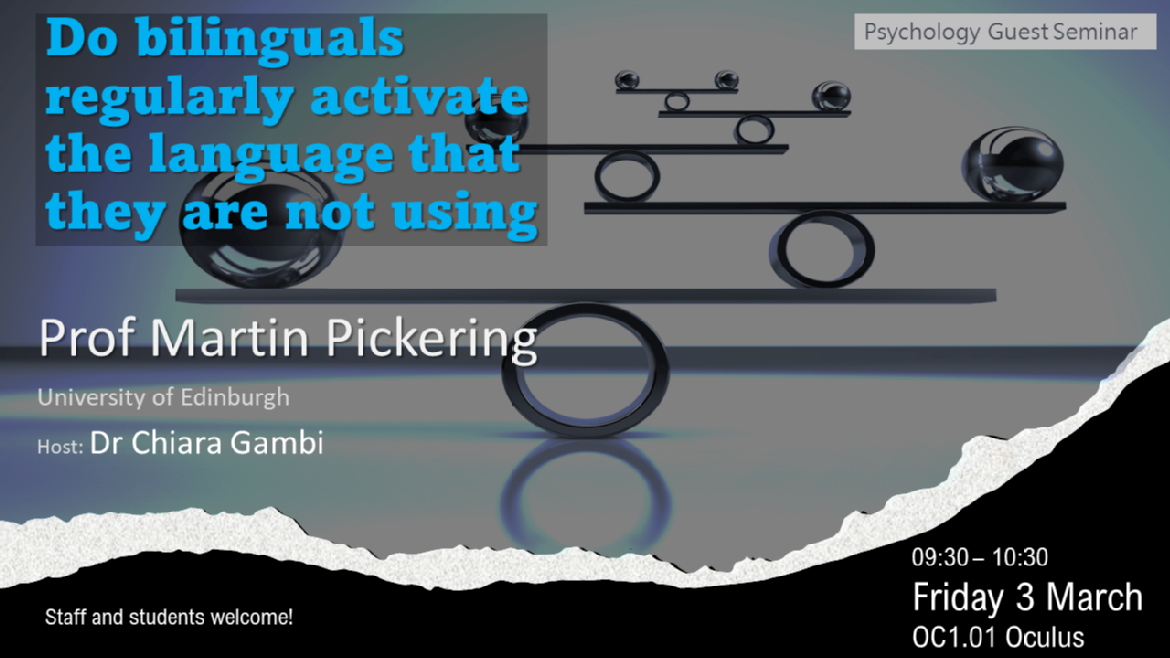
Guest Speaker: "Do bilinguals regularly activate the language that they are not using?" Professor Martin Pickering, University of Edinburgh - Note new time and venueOC1.01 OculusSpeaker: Professor Martin Pickering Title: Do bilinguals regularly activate the language that they are not using? Host: Dr Chiara Gambi Abstract: Almost all researchers claim that bilinguals access both of their languages, even when they are just comprehending or producing one of them. In this talk, we critically review the range of evidence used to support this claim and argue that it is compatible with an alternative (selective) account in which bilinguals consider only the language they are currently using. For example, we suggest that studies showing priming between unrelated words whose translations are related can be explained by transfer during learning, and studies suggesting that cognates are facilitated in comparison to non-cognates can be explained by facilitated acquisition. We also consider a range of other phenomena from comprehension and production that do not necessarily support language non-selectivity. We argue that such learning may occur during early acquisition and then simply be turned off, or it may continue as a consequence of language use in a two-language mode. We discuss the implications of the account for bilingual language use more generally. This is joint work with Rob Hartsuiker (Ghent). Teams link to view talk live available from Catherine Johnstone
See archive of Previous speakers here |
|
Mon 6 Mar, '23 - Sun 12 Mar, '23All-day |
GREEN WEEK 2023Runs from Monday, March 06 to Sunday, March 12. Green Week 2023Green Week will be taking place from Monday 6th March until Sunday 12th March. It is an annual partnership between Coventry University, the University of Warwick and our Student Unions. The aim of the week is to raise awareness of sustainability and what’s going on in the area, as well as to provide information on how everyone can make a difference and get involved. Events will be taking place in person and online to allow for more people to attend. Sessions are currently being finalised but are likely to include:
To reach as many people as possible we encourage everyone to get involved. If you are part of a society, a sports team, a Green Action Team or a local community group it would be great if you could run your own. Please contact sustainability@warwick.ac.uk if you’d like to get involved and have ideas we could discuss further. Keep an eye out on our social media pages and the official page of Green Week for updates. |
|
Wed 8 Mar, '23- |
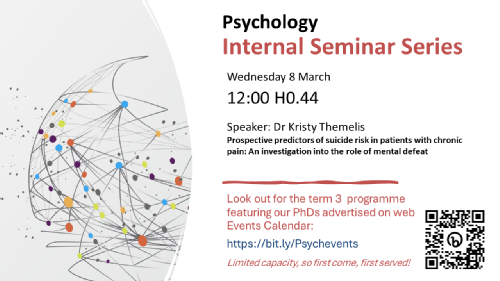
Internal Seminar: Prospective predictors of suicide risk in patients with chronic pain, Dr Kristy ThemelisSpeaker: Dr Kristy Themelis Title: Prospective predictors of suicide risk in patients with chronic pain: An investigation into the role of mental defeat Co-ordinator: Dr Mikhail Spektor
|
|