
Coin Finds from the Basilica Aemilia
Discovery and provenance of the coins
This project focused on c. 2,600 coins found in the Basilica Aemilia on the Forum Romanum in Rome, during the excavations conducted by the German Archaeological Institute from 1899 to the 1930s. Unlike a lot of 467 other coins, they had never before been studied and were forgotten until 2009 when they were rediscovered in a wooden box in the Antiquarium on the Forum (Antiquario Forense).
Most coins belong to the late antique destruction layer of the basilica. This stratum was 6 to 10 centimeters thick and consisted of ashes including lumps of coins. It covered the marble floor of the Augustan restauration, with many coins stuck melted on the floor. The original Basilica Aemilia is one of the big basilicae surrounding the central area of the Forum. Erected in 179 BCE according to Livy (40.51.4–5) it belongs to a building program designed to monumentalise that area from the late fourth century BCE, culminating with the construction of the aforementioned basilicae in the first half of the second century BCE.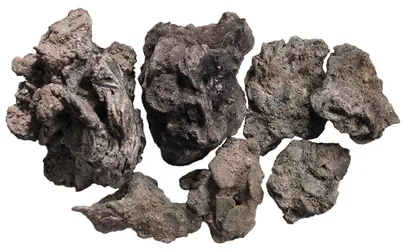
Lumps of coins and ashes from the destruction layer of the Basilica Aemilia ofn the Forum Romanum.
The archaeology of the coins and the history of Rome
The destruction of the building was related to the destruction of Rome led by the Visigoth king Alaric, in August 410CE, on the basis of a coin of Priscus Attalus of 409CE which was identified among 467 known coins. The date of 410 then became canonical, and, if correct, would constitute one of the very rare examples of archaeological evidence attesting to the conflicts during the so-called barbarian migrations in Late Antiquity.
The functions of the building
Over the centuries the building had many functions, such as banking and for jurisdictional purposes. Traces of corroded and burnt metal on the marble floor point to moneychangers’ tables (trapezae) placed between the columns along the central nave. On the marble floor, in equal distances between the tables, engraved lines of board games were found. Because of their number and regular spread on the floor, the Basilica Aemilia has also been identified as a gambling house.
Research questions
The recent discovery of the c. 2,600 multiplies the hitherto known number of coins and is of great significance. The project aimed to:
• review and to refine the date of the destruction, especially with the coins found in conglomerated lumps of ash;
• better understand the nature of the building, especially in the context of banking;
• investigate the role of the mint of Rome;
• examine the coin circulation in Rome;
• assess the historical context at the time when the building collapsed.
The project and its actors
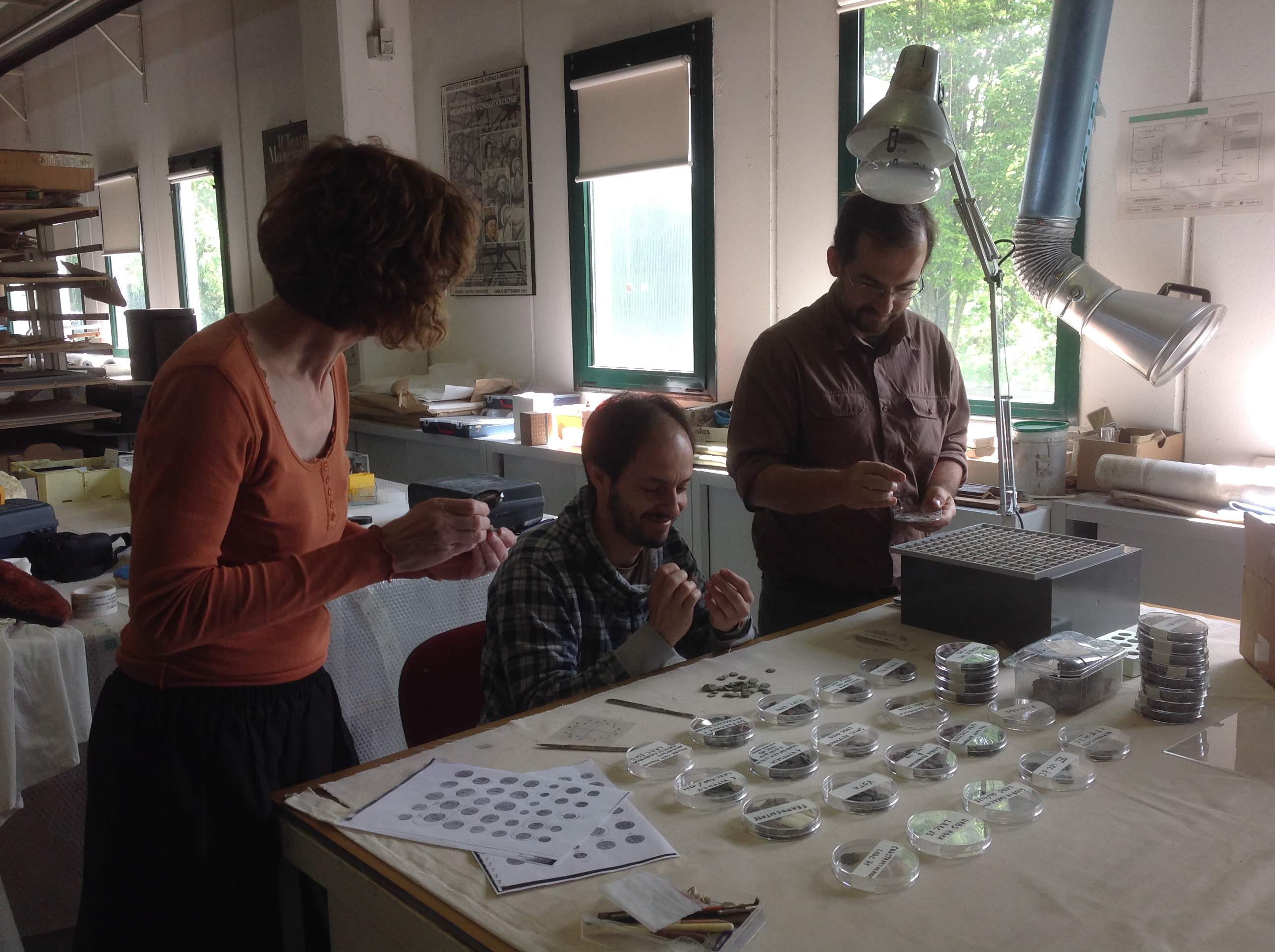
The coin project (2014-2016, cataloguing and final report concluded) was part of a wider project aiming to study the small finds from the Basilica Aemilia (Johannes Lipps, Tübingen and Philipp von Rummel, Berlin). Suzanne Frey-Kupper led the study of the numismatic finds; Samuele Ranucci, Perugia, worked jointly with her. Nicola Bruni, Spoleto, was entrusted with the restauration of the coins.
Funding
Deutsche Forschungsgemeinschaft (DFG).
Further reading
Ertel, C. and Freyberger, K.S. (2007)‚ ‘Nuove indagini sulla Basilica Aemilia nel Foro Romano. Storia architettonica, funzione e significato’, Archeologia Classica 58: 109–142.
Freyberger, K.S., Ertel, Ch., Lipps, J. and Bitterer, T. (2007)‚ ‘Neue Forschungen zur Basilia Aemilia auf dem Forum Romanum. Ein Vorbericht’, Römische Mitteilungen 58: pp. 493-552.
Freyberger, K.S. (2009) Das Forum Romanum. Spiegel der Stadtgeschichte des antiken Rom (Mainz: Philipp von Zabern): pp. 38-43, 72-74.
Frey-Kupper, S., Lipps, J. and Ranucci, ‘Le monete dallo strato di distruzione della Basilica Aemilia nel Foro Romano’, in Preatti del I Workshop Internazionale di Numismatica. Numismatica e Archeologia. Monete, Stratigrafie e Contesti. Dati da Confronto, ed. G. Pardini (Rome: Sapienza-Università di Roma): pp. 157-9.
Lipps, J. (2011) Die Basilica Aemilia am Forum Romanum. Der kaiserzeitliche Bau und seine Ornamentik (Palilia 24) (Wiesbaden: Reichert Verlag).
Reece, R. (1982) ‘A Collection of Coins from the Centre of Rome’, Papers of the British School at Rome 37: pp. 116–145.
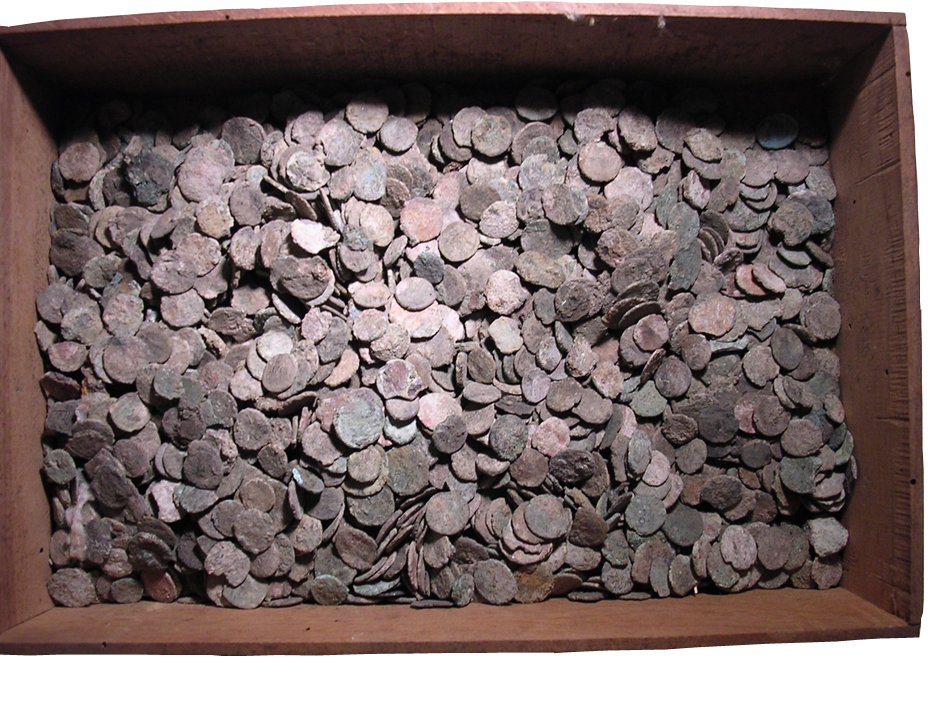 The coins in the wooden box at their rediscovery.
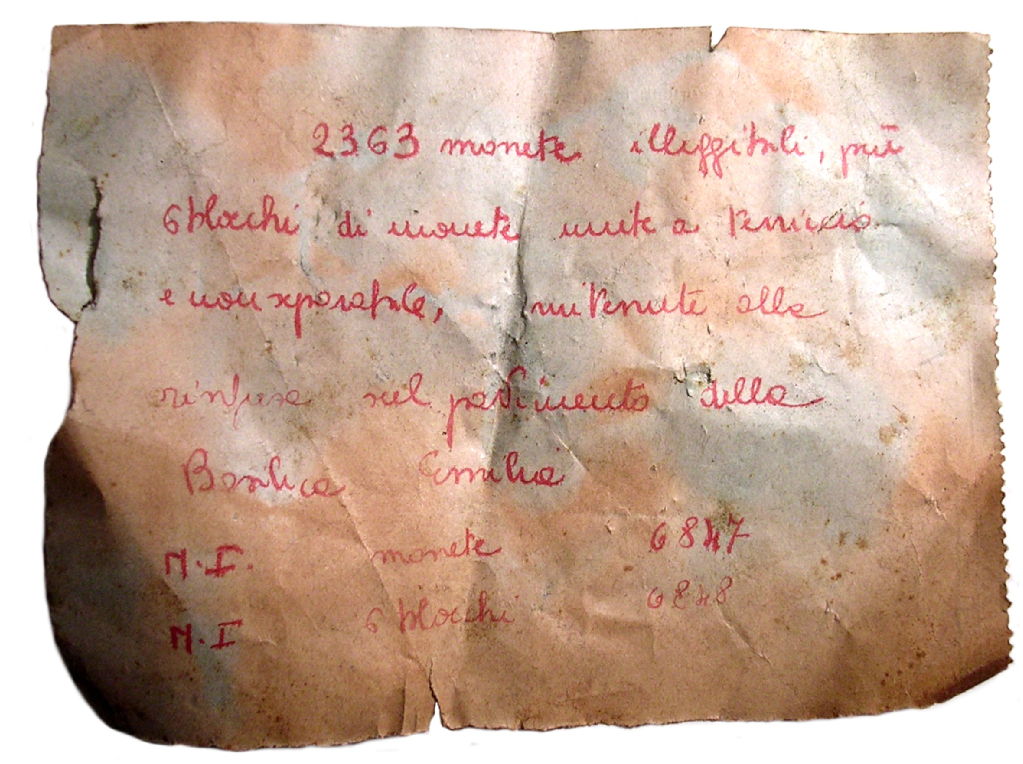
Label to the box above: '2363 illegible coins...'; to these the coins from the lumps are to be added.

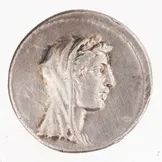
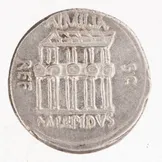
Denarius of M. (Aemilius) Lepidus,
61 BC, showing the Basilica Aemilia built by Lepidus' homonymous ancestor and his censor colleague in 179 BC.
RRC, p. 144, no. 419/3a.