
Lucindy Osei - Developing Greek Mythology Sessions for Schools
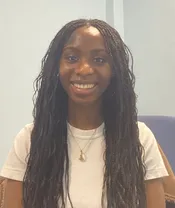 Lucindy Osei
Lucindy is a second year Classical Civilisation student here at Warwick.
As well as her work for the Warwick Classics Network, developing and delivering sessions on the ancient world to local schools, Lucindy also recently appeared in our production of the Oresteia where she made a very convincing Fury.
Lucindy is also part of a team of students currently developing a Departmental podcast (watch this space).
Developing the Sessions
Over the Christmas break, work on developing sessions on Greek myths for local schools began, and I came up with the ideas of ‘Mystery Bags.’ My proposal was to use a range of different items to act as clues to help students identify a moment from Greek mythology. Once students had worked this out, they would go on to have a class debate about the significance of their moment from that myth.
I volunteered to lead on this project as I wanted to help develop Greek myth sessions that were both creative and engaging. My goal was to provide students not only with the opportunity to learn something new, but also for them to learn from one another, for in this case each group would be reliant on their peers to explain the other parts of the myth which their mystery bag did not reveal.
Students often learn about debate through persuasive writing, but I wanted these sessions to be a chance for them to improve their oracy skills. The mystery bags would help to facilitate this, with items acting as prompts to help students develop their own lines of argument. I also wanted to design a session that could be adapted for all age groups and abilities while also providing a framework for teachers wishing to teach Greek myth from a Classics perspective.
At the start of the Spring term (January 2026), we created two new sessions on Greek myth: one on the character of Odysseus for a group of year 7 students and another on the representation of Medusa for a group of year 9 students.
With the help of other Classics students, Megan Strange (first year), Skye Kelly (finalist), Neve Goodwin (second year), Mary Kehoe (first year), Joe Smith (second year) and Grace Rushton (second year), a group was formed to begin working on the contents for the bags and debate questions.
The final debate titles we decided upon were:
‘Where is Odysseus most determined to return home?’ and ‘Medusa is accused of being a monster- guilty or innocent.’
These questions would allow for the year 7 session to take on an assembly-style of debate with a focus on the theme of nostos (homecoming), whilst the year 9 session would take on a more court-style debate with an emphasis on rhetoric.
Creating the Resources
Creating new resources for the school sessions was a significant responsibility but this was feasible and achieved through the group's hard work and collaboration.
We wanted items for the mystery bags to be tactile and reusable, encountering both ancient and modern views that could act as conversation starters amongst students. The dedication to this saw the creation of over 30 items (many made from scratch), with quotes, photos and PowerPoints, all made over the course of 3 weeks. I would like to say a huge thank you and well done to everyone involved, and to Paige Swain (finalist) who supported the digital side of resource creation and helped to provide additional materials of handouts and planning sheets.

(Above) Contents of the 'mystery bags' set out and ready for packing
Delivering the Sessions
On 10th February 2026 we visited Lyng Hall, a local school in Coventry to deliver these new sessions.
The first was the session on Odysseus, which saw year 7 students display fantastic recall on the Odyssey, a strong grasp on the Greek concept of nostos [returning home], and also of the ancient Greek assembly. In groups, students worked well to figure out what mythic 'moment' they had and plan and deliver their lines of argument. In deciding ‘Where is Odysseus most determined to return home?’- a tie was reached between Book 6 of the Odyssey, where Odysseus finds himself among the Phaeacians, and Book 5 with his time on the island of Calypso. When the final arguments were presented, the winner was the group with the Calypso bag!

In the second session, this group of year 9s had already written debates on Pandora and had strong background knowledge on Medusa. Therefore, to challenge them, we presented a blend of both Roman and Greek representations of Medusa, and students were also encouraged to put forward lines of argument not neccessarily in line with their own opinions - a very tricky and useful skill to navigate and develop. However, the final verdict was almost unanimous, with 29 pupils finding Medusa innocent, and just one finding her guilty.
Lots were cast (below left) using our home-made moulded lots (below right), in true Athenian democratic fashion.

I have really enjoyed the opportunity to lead on creating something new for WCN but also being able to work with other Classics students across different year groups. Thank you to Paul Grigsby for supporting us all throughout this process and the encouragement to make the development of these sessions a student-led experience. I hope these sessions on Greek myth will continue to grow to produce more mystery bags and new ideas.
Student Feedback
Lyng Hall School Student Newsletter February 2026
Kai (7RK)
My presentation was about the Phaikcians, the 13th stop in Odysseus’ journey home. The main thing I enjoyed about the Greek Mythology Workshop was the fact that I got to present

Student Feedback
Lyng Hall School Student Newsletter February 2026
It’s All Greek to Me: Women in Mythology by Temitope Akinmoladun
Students from Warwick University recently came to our school to teach us more about Greek mythology, and it was an experience that really brought the ancient stories to life.
We explored the myths in an interactive and engaging way. We focused especially on the story of Medusa, explaining her story, the curse placed upon her, and how her story has been told differently over time. Their enthusiasm made the lessons exciting, and it felt more like a workshop than a regular class.
One of the most interesting parts of the session was our debate whether Medusa was a villain or a victim. Some of us argued that she was a monster, who turned people to stone, and therefore should be seen as a villain. Others pointed out that, in many versions of the myth, she was cursed unfairly and had suffered greatly, which made her more of a victim. Listening to different perspectives challenged our original opinions and encouraged us to think more deeply about the story rather than accepting just one version.
The workshop helped us understand that myths can have more than one side. It also helped us work together, share ideas, and feel more confident in creating our own stories.