
Argument essay
The second assignment for the module is an essay of 2000 words maximum (exclusive of footnotes and bibliography).
The principal aim of this exercise is for you to demonstrate that you can present and develop a historical argument.
HISTORICAL ARGUMENT
If you look at our marking criteriaLink opens in a new window you will see that a key question for us is 'does the work give a persuasive answer to the question, with good use of evidence?' A first class answer will offer a compelling or comprehensive answer to the question, expertly and skillfully supported by evidence, that is also knowledgeable and well structured.
The department's essay writing checklist has this to say about argument or analysis:
Have you made an argument or is the essay simply relating what happened?
Is your argument logical, coherent and clear?
Are you contradicting yourself?
Are you using appropriate evidence to back up each part of your argument?
Are you aware of counter-arguments?
Have you combined evidence and ideas from several different sources at each stage of the argument, or are you merely summarising what your sources say one by one?
Moreover, building on the first assessment in which you honed your historiographical skills, you will also want to show that you can place your argument in a historiographical context ie. summarise and evaluate the work of (and perhaps debates among) historians. Often the introduction to the essay is a good place to do this, but you can also thread such analysis throughout.
QUESTIONS
For your essay question, you should choose one of the listed 'General questions' (not the 'Primary source questions') from any of the weeks of the module, with the exception of week 1, term 1.
You are not restricted to topics that we have already studied at the time you are writing the essay, though you should bear in mind that it may be more challenging to tackle a topic area that has not already been covered in lectures and seminars. It is permissible to set your own question for the essay, but if you decide to do so you must clear this with your seminar tutor first.
SOURCES
This essay is based on secondary sources, not primary sources. You should consult at least six items – books (or chapters from books), journal articles, or essays from edited collections – and list these in your bibliography.
You might want to start with the survey 'Recommended Reading' suggested for the weekly seminars, since this is often taken from textbooks, reference works, companions, and general histories and these will give you good overviews of the topic. You might then choose some additional, more specialised, items from the 'Further Reading' section, to deepen your analysis of certain themes or arguments that you are highlighting (and you will also find more 'survey' type literature there too). Sometimes the selection of more specialist reading requires a little 'grazing' of the literature to assess what is going to be the most useful to you. The suggested reading (including the further reading) for each weekly seminar provides sufficient resources for answering any of the seminar/essay questions.
You are not restricted to consulting only these works, but if you draw on additional materials try to ensure that they are relevant and appropriate (are they, for example, cited as important points of reference in the footnotes of another of your books or articles?). Nearly all our further and recommended reading is available digitally, so try not to rely on general items on the web (Wikipedia, Encylopaedia Britannica etc) and certainly don't use AI to write the essay.
If you decide to include online material, stop to think about how trustworthy or reliable it is likely to be, and whether it will have undergone any kind of vetting or review before being published on the internet.
Note that when you are using a digitised version of a book or article – ie, an electronic copy with the same pagination as the corresponding print version – this does not count as a website or internet resource. It is not necessary to give a URL, and it can be cited exactly as if you had consulted a paper copy.
ESSAY WRITING AND REFERENCING
There is no exact or universal ‘template’ for a good history essay, but it should always involve assessment and evaluation, rather than just narrative or description. The student handbook contains some useful guidance on essay writing and referencing. Do please read this carefully.
In addition to the argument and conclusions of the essay, its presentation is really important. Historians follow an agreed set of conventions about how to put forward and reference their work; adhering to these shows precision and professionalism, and an ability to participate effectively in a wider scholarly conversation. Some of this may seem a little convoluted at first, but the ability to present written work appropriately is a skill you will be using constantly throughout your undergraduate career.
The department requires you to follow a recognised scholarly citation style, such as that of the Modern Humanities Research Association (MHRA) or the Chicago Manual of Style, and links to these are provided. The important things are that you do not simply make up your own citation conventions, and that you are consistent throughout the essay. References should be given as footnotes, rather than as in-text citations, and there should be a bibliography provided at the end of the essay. The majority of published work in history follows MHRA, Chicago or another recognised style, so it can also be helpful to look closely at, and copy the style of, the footnotes and/or bibliography of books and articles you are consulting.
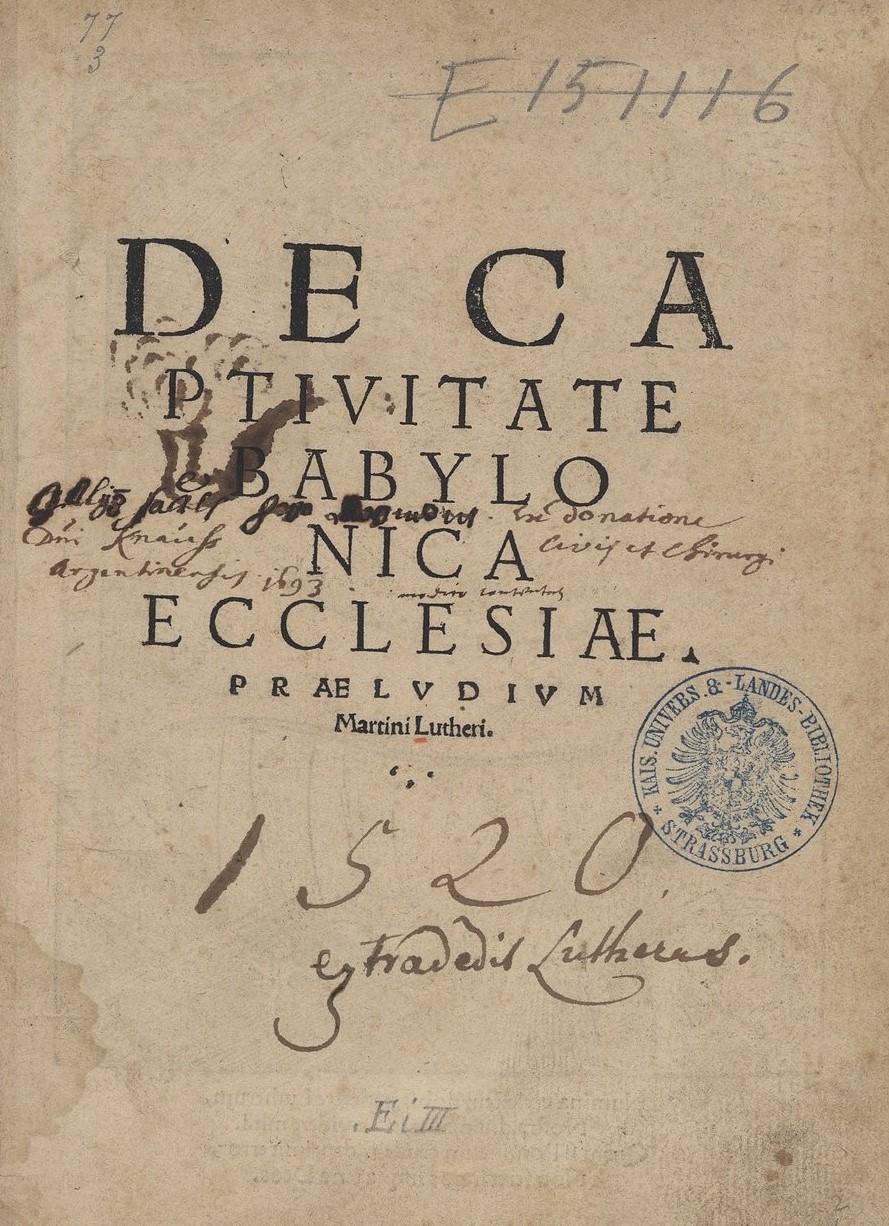
Martin Luther's 1520 book, On the Babylonian Capvitity of the Church, convinced many people that Christianity had been hopelessly compromised by the papacy.
The image shows a first edition of Luther's book digitised by the French National Library.