
Research project
The third (and most heavily weighted) of the assignments for Europe in the Making is a 3000 word research project, presented in essay-style format (ie. in continuous prose, with footnotes and bibliography).
This project draws on the regular collective work that seminar groups have done with different genres of early modern primary source.
The project also draws on your experience with the first two assignments. These got you thinking about how historians build an argument around primary sources (the historiographical review) and how you can construct an argument of your own (the argument essay).
This is also a forward-looking project. It anticipates the independent, source-based research that are at the heart of the second-year module Historical Research and of the final-year dissertation.
PRIMARY SOURCES
What distinguishes this from the argument essay is that the research project is intended to be a critical engagement with primary sources. The emphasis is placed on the analysis of the primary sources used. The expectation is that you will engage with up to three primary sources, to be found either in edited and printed editions/sourcebooks, or in an online set of resources or database. Note that each seminar page on the website includes recommendations for electronic resources.
Identifying appropriate material for analysis may take a bit of time, and indeed is an integral part of the exercise itself. Your seminar tutor will also be available to offer advice about this. It is good to be ambitious, but at the same time it is important to be realistic about what is feasible and manageable.
Your project might be – these are indicative examples only – an evaluative discussion of the court documents relating to two or three witchcraft cases; a close analysis of three visual propaganda prints from the era of the Reformation; a cultural ‘reading’ of an early modern recipe book, almanac or political pamphlet; a comparative analysis of selected parts of a couple of European and indigenous accounts of the conquest of the Americas. There are very many possibilities.
LESSONS
The goal is not just a description of the primary sources. That's a good start, but the overall goal is draw wider lessons about early modern history. If your sources are Reformation prints, for example, they might tell us something about the evolution of Protestant doctrine, or about changing attitudes towards women, or about the distinctiveness of the English Reformation, or....
You are not expected to come up with a completely original lesson on your own. There is a wealth of existing scholarship on all the topics we have covered so far in the module. As well as the three primary sources, you should also consult at least five items of secondary literature relevant to your sources.
That said, you should try to avoid simply duplicating work that another historian has already done. You might look at a known source in more detail than before, or at three sources that have been studied separately but not together. You might take an insight from another historian and apply it to a new place, or a new period, or to a different social group. You might take two insights from different historians and apply them together. And so on.
Think carefully about the scope of your sources and interpretation. You only have three primary sources to work with, whereas most published articles are based on ten times as many as that. Moreover, most published articles are fairly modest in their conclusions. For example, they are more likely to cover witchcraft in a specific country in a specific century--or even in one town in one decade--rather than witchcraft across the whole of Europe across three centuries. Try to find a compact set of sources that illuminates a specific episode in history.
FORMAT
The format of this essay is broadly the same as for other essays. The department's usual marking criteria for written work apply, as does our guidance on essay writing and referencing.
That said, there are some specific points to bear in mind given the nature of this assignment:
The essay should have a title. This can take the form of an essay-style question, since it's often useful to have a target to aim at and easier to run an analytical argument in response to a question. The title could instead be thematic, eg. 'Monstrous births in Restoration pamphlets.'
You should discuss any methodological issues thrown up by your sources, in the introduction and/or conclusion. At a minimum, you should say why you choose these three sources in particular, among all the other hundreds/thousands of other sources on your topic. You should also say which genre of source they belong to (petition, trial document, philosophical treatise, etc). If applicable, you might also discuss gaps or biases in the source, tools you have used to analyse the source, schools or trends in historical research that you are following, or similar.
Don't forget to describe the content of the sources. Your reader may not have read your sources, and even if they have, they want to see your own summary of its content. Mention all relevant elements of the sources. If the source is an image, and the image has a caption, mention the caption. If it is a letter, and the letter has a signature and marginal notes, mention the signature and marginal notes.
Consider the context of the source as well as its content. The content of this webpage (for example) is the text you are reading. The context includes other webpages, the ETM module, the desk on which the text was written, the fact that the author was working to a deadline, etc. All these things are relevant to the interpretation of this webpage. Context is often hard to discover, but do try. If the context is unknown, say so. See the Jordanova quote at the top of this webpage.
Think about how you structure your analysis. It might at times be better to think about themes that run across your sources rather than treating each source in turn, or having a section that does this. At other times, a sequential treatment of sources can show change over time or emphasise differences.
Use the conclusion to discuss the limits of your project. You may conclude that the sources are intrinsically ambiguous, that they are not fully able to answer the questions you wished to put to them, or that additional or different sources, methods or techniques would be necessary to address the questions more effectively.
You may wish to include an appendix or appendices, in which key parts of the sources are reproduced. This is often most appropriate in the case of visual or pictorial sources, though it is also permissible to insert visual reproductions into the main text itself. Material in appendices does not form part of the word-count for the project.
The bibliography should be divided into sections for primary sources and secondary sources.
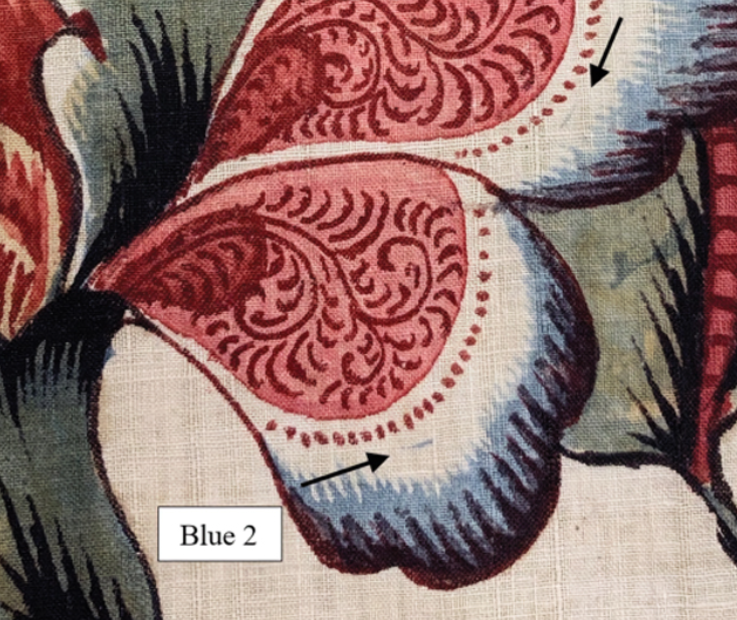
The image shows a large bedcover made in South India in the eighteenth century. The arrows point towards tiny brushstrokes. These show that the blue pigment was applied using a brush.
This--along with other evidence--contradicts the long-standing view that painting with indigo on cotton was technically impossible before the British use of arsenic in the 1730s.
Source: Alka Raman, 'Before Arsenic: Recovering a Forgotten Indian Technique of Painting with Indigo and its Implications for Knowledge Transfer', Technology and Culture 66, no. 2 (2025): 509-534, fig. 3.