
Arts Faculty News
"How did Sir Walter Raleigh invent the potato?” In this 10-Minute Talk, Rebecca Earle FBA takes up Philomena Cunk’s question to explore the global history of the potato and explain why we should care.
"How did Sir Walter Raleigh invent the potato?” In this 10-Minute Talk, Rebecca Earle FBA takes up Philomena Cunk’s question to explore the global history of the potato and explain why we should care. Speaker: Professor Rebecca Earle FBA
Universities of Warwick and Leeds secure prestigious national award for screen industries PhD programme
The University of Warwick and the University of Leeds have together secured one of only 10 prestigious Doctoral Focal Awards from the Arts and Humanities Research Council (AHRC), part of UK Research and Innovation (UKRI). The Award will fund 20 PhD scholarships focused on the creative economy, with a specific emphasis on sustainability and diversity in the screen industries.
Led at Warwick by Dr David Wright, Director of Graduate Studies in the Centre for Cultural and Media Policy Studies with Dr Sanjay Sharma (Centre for Interdisciplinary Methodologies) and overall by Professor Joanne Garde-Hansen, Head of the School of Media and Communication with Professor Anamik Saha (Professor of Race and Media) at Leeds, the Creative Bridges partnership will run from 2026 until 2033. It will train a new generation of interdisciplinary researcher-practitioners to work alongside – and within – the film, television, games and immersive media sectors.
As the screen industries increasingly look beyond London for talent, for research capacity and fresh perspectives, Creative Bridges draws on the established screen media clusters in Yorkshire and the Midlands to connect academic and industry expertise.
Through active collaborations with organisations from across the film, television, gaming and immersive media sectors, the programme will offer a model for how universities and creative industries can work together more effectively across both regional and disciplinary boundaries.
Throughout the programme there will be a specific focus on two of the sector’s most pressing challenges – sustainability and diversity. Aligning with the UK’s Modern Industrial Strategy (2025) that identifies the Creative Industries as one of eight sectors driving future growth, the programme highlights the need to expand and diversify the talent pipeline and spotlights projects that exemplify the drive to net zero.
Creative Bridges will provide partners and researchers in our regions with the space, time and resources to reflect on how to meet these ambitions. The programme also aims to build on AHRC’s investments in redefining doctoral training in the arts and humanities, producing researchers who can make an impact beyond academia.
Professor Rachel Moseley, Vice Provost and Chair of the Faculty of Arts at the University of Warwick, said: “Creative Bridges is a bold and timely reimagining of doctoral research in the arts and humanities. By connecting regions, sectors and disciplines, this partnership will enable doctoral students to engage directly with the pressing strategic challenges facing today’s screen industries, from building a more inclusive workforce to driving environmental sustainability.
With strong regional ties to the creative economy and deep links across industry, both Warwick and Leeds are well placed to support this shift. We are proud to be creating new opportunities for UK-based talent to work in collaboration with screen industry partners, contributing fresh thinking and vital research capacity where it’s most needed.”

Professor Joanne Garde-Hansen, Head of the School of Media and Communication at the University of Leeds said: “Creative Bridges is an exciting opportunity to connect two of the UK’s most dynamic creative regions – Yorkshire and the Midlands – and to co-create a future-facing research training environment with industry partners. Our goal is to rethink how we train researchers for, and with, the creative industries, and to ensure that the next generation of scholars are equipped to respond to the critical challenges of sustainability and diversity in screen culture.
“The award also responds directly to concerns raised by AHRC Executive Chair Professor Christopher Smith earlier this year about the lack of AHRC-funded PhDs focused on the creative industries. With Creative Bridges, Warwick and Leeds are not only addressing that gap – they are reasserting the vital role of arts and humanities research in shaping the future of screen-based cultures.”
Professor Andrew Thorpe, Executive Dean of the Faculty of Arts, Humanities and Cultures at the University of Leeds, said: "This award underlines the University’s commitment to working across disciplines and sectors to support research that makes a real-world difference, in this case contributing specifically to diversity and sustainability initiatives and to the UK’s creative sectors. The screen industries are a vital part of the UK’s creative economy, and I am delighted that this partnership will give Leeds-based researchers the opportunity to help shape their future."
The AHRC’S Professor Christopher Smith said: “Introducing Focal Awards allows us to support cohorts of students in centres for excellence for strategically valuable areas such as health and the creative economy. In the future this approach will allow us, in consultation with the sector, to provide support where it is needed to disciplines across the arts and humanities, vital skills and digital humanities. But the scope for individual projects is wide and autonomy for researchers remains as important as ever.
“The Focal Awards exemplify AHRC’s approach to doctoral training and our ambition for a sustainable portfolio providing support for training, investigator-led research, strategic direction and building the infrastructure necessary for people and ideas for the future of arts and humanities.”
Sonny Hanley, Director of ITV Academy, one of the partner organisations for Creative Bridges, said: “For ITV Academy, working with the Universities of Leeds and Warwick through Creative Bridges allows us to shape the questions and the challenges we would like the next generation of researchers to focus on. In a rapidly changing media environment, we can work collaboratively on diverse cutting-edge projects that will benefit who we are and what we do, and ensure we are ready for the future.”
Recruitment is due to begin in Autumn 2025.
ENDS
Notes to Editors
For more information please contact:
Ann Baylis, Media & Communications Officer
ann.baylis@warwick.ac.uk/ 07876 876 937
General and out of hours press office number +44 (0)7392 125605 (please call as emails are not checked out of office hours)
Community film project puts LGBTQIA+ end-of-life stories in the spotlight
A powerful new community film project from The University of Warwick is inviting LGBTQIA+ people in the Midlands with a terminal diagnosis, and those close to them, to share their stories on camera. The project is led by Michele Aaron, Professor of Film and Television Studies at The University of Warwick, who hopes the films can help make end-of-life care more inclusive.
Warwickshire LGBTQ+ people asked to share end of life stories - BBC News
ECLS PGR Awarded IASH Postdoctoral Digital Humanities Fellowship
Raad Khair Allah received an IASH Postdoctoral Digital Humanities Fellowship from the University of Edinburgh to work on Contemporary Arab Diasporas: Reimagining Nationhood in Arab Cultural and Digital Feminism, an interdisciplinary digital project that examines the literary and artistic contributions of Syrian and Palestinian women in the Western diaspora since the 1970s to nation-building.
By investigating how women leverage AI tools, such as Canva and Soundtrap, to create art, music, and literature that reflect their unique perspectives, her project highlights the interplay between transnational connections and their distinctive diaspora experience. It shows the relationship between the arts, technology, and society through showcasing how these elements interactively shape and influence nation-making narratives
By combining close readings with AI tools like Voyant Tools and Google Vision, the project reveals patterns and insights in cultural productions that traditional methods may overlook. This project will develop a searchable online database that serves as a comprehensive and accessible resource for researchers, educators, public engagement, and policymakers.
High Sheriff honours University of Warwick Professor
Nadine Holdsworth, Professor of Theatre and Performance at The University of Warwick, was presented with the High Sheriff’s award at a special ceremony last night (19 March), where her achievements were celebrated in style, alongside other worthy recipients from across the region.
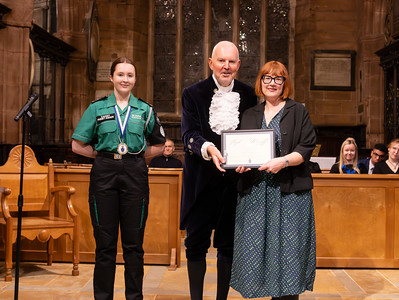
Nadine received the award in recognition of her unwavering commitment, empathy, and leadership on behalf of Coventry-based community theatre company Underground Lights, a group run for and by people experiencing homelessness, mental distress, or social isolation. The value of Nadine’s research impact achieved while working with global charity Arts & Homelessness International was also acclaimed, where she led local initiatives to platform the work of several artists experiencing homelessness, and foster confidence and community among people who have been marginalised within society.
Professor Nadine Holdsworth said: “I’m thrilled and honoured to receive this award. It is especially heartening to know that the creative organisations I work with value what I have been able to contribute by supporting and showcasing the wonderful work they do with people who have experienced often multiple disadvantages in society.”
At the awards ceremony, the High Sheriff spoke of how Nadine has been pivotal in creating a supportive, inclusive environment where disadvantaged people can engage in theatre and creative expression. He outlined how her work has made a lasting difference and embodies the true spirit of community service. Nadine was described as uniquely bridging the gap between high-level academia in one of the UK's top universities while also being a hands-on community changemaker.
Douglas Wright MBE, the West Midlands High Sheriff, said: “This event is a wonderful opportunity to honour Nadine’s hard work and commitment to making a difference in our community - congratulations on this well-deserved recognition. Nadine’s efforts inspire those around her, and we are excited to celebrate her accomplishments.”
Nadine’s work with the Coventry and Warwickshire community has been supported by the Warwick Institute of Engagement.