History of The Department of Chemistry
When the University of Warwick was founded in 1965, it was built on a bold vision: to be modern, interdisciplinary, and forward-thinking. Science was placed at the heart of this vision.
In fact, the University’s coat of arms reflects this commitment, featuring molecular and atomic symbols alongside traditional academic emblems, a clear statement that science was foundational to Warwick’s identity. The Atomic Symbols in the Shield represent the university’s focus on physics, chemistry, and natural sciences research and the DNA Helix Crest symbolizes molecular biology and genetics, highlighting contributions to life sciences and biotechnology.
Department Timeline
Early Years: Department of Molecular Sciences
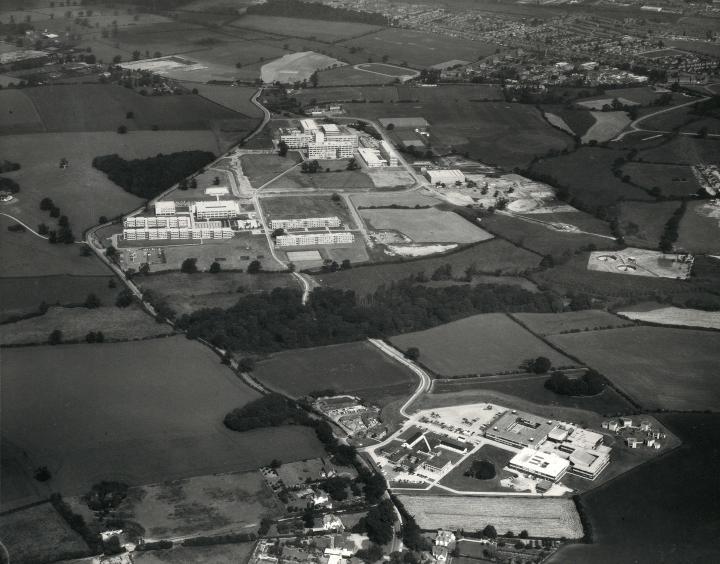
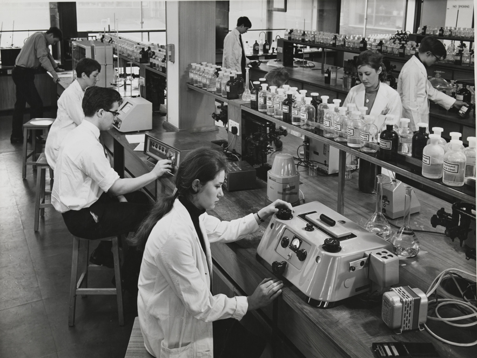
One of Warwick’s first academic buildings was purpose‑built for the Department of Molecular Sciences, reflecting the founders’ ambition for the University to champion cutting‑edge science from the very beginning.
The School of Molecular Sciences opened in October 1965 with a small but dynamic team of 12 academic staff, supported by postdoctoral and research fellows. Led by Professor Malcolm Clark and Professor Tom Waddington, the school embraced an interdisciplinary approach spanning chemistry, biochemistry and emerging molecular research.
The early team included John Cornforth FRS, who later became Sir John Cornforth following his knighthood in 1977. He served as Associate Professor in Molecular Sciences at the University of Warwick between 1965 and 1971. In 1975, he was awarded the Nobel Prize in Chemistry, shared with Vladimir Prelog, for his work on the stereochemistry of enzyme‑catalysed reactions. His scientific legacy continues to be recognised through the RSC Horizon Prize Sir John Warcup Cornforth, named in honour of Rita and John Cornforth, which celebrates excellence and innovation in chemical research.
Its first cohort of 30 undergraduates formed part of Warwick’s initial intake of just 450 students. By the late 1960s, the school had launched MSc programmes in Molecular Enzymology and Radio Frequency Spectroscopy, both recognised by the Science Research Council. Support from the SRC and a number of industry partners helped fund early research, while a major donation of scientific journals from Courtaulds Ltd enabled the formation of the Courtaulds Library in Molecular Sciences.