
News
Neutron Diffraction Research Highlight
Work carried out in Richard Walton’s group on the structures of polymorphs of gallium oxide has been selected as a highlight of ISIS science for 2013 in the ISIS Annual Review. ISIS is the UK’s neutron spallation source and was used to perform total neutron scattering experiments on the structures of various forms of Ga2O3 that were prepared in Warwick. The research was carried out by Helen Playford, then a PhD student and presently a postdoctoral scientist working at ISIS.
ISIS 2013 Annual Review:
http://www.isis.stfc.ac.uk/about-isis/annual-review/2013/isis-annual-review-201314637.html
"Structures of Uncharacterised Polymorphs of Gallium Oxide from Total Neutron Diffraction” H.Y. Playford, A. C. Hannon, E.R. Barney, and R.I. Walton, Chem. Eur. J. 19 (2013) 2803–2813
http://onlinelibrary.wiley.com/doi/10.1002/chem.201203359/abstract
Two new Centres for Doctoral Training
Warwick Chemistry has played a lead role in securing funding from the Engineering and Physical Sciences Research Council for 2 new Centres for Doctoral training, in Molecular Analytical Science and Diamond Science and Technology, as part of the recently announced UK's largest investment in postgraduate training in engineering and physical sciences. The Universities and Science Minister, David Willetts, announced the funding of over seventy new Centres for Doctoral Training (CDTs), spread across 24 UK universities on 22nd November.
For further information please visit:
http://onlinepressoffice.tnrcommunications.co.uk/universities-funding/video

Jones group publish on spray deposited PEDOT:PSS for ITO-free OPV devices
The Tim Jones group publish work in Applied Physics Letters on replacing ITO with solution processed highly conductive PEDOT:PSS for ITO-free small molecule OPV devices.
Waking up a silent metabolic pathway results in the discovery of new gamma-aminobutyrate (GABA)-derived ureas
Research, led by the Corre group, has exploited their insight into bacterial regulatory mechanisms that control natural product biosynthesis to inactivate a key transcriptional repressor gene. Consequently, a normally silent pathway was constitutively expressed in the mutant strain and novel natural products were produced, isolated and structurally characterised. This work, published as an open access edge article in Chemical Science, represents a powerful strategy for the discovery of new natural products by rational manipulation of pathway-specific regulatory elements.
Misread heart muscle gene a new clue to risk of sudden cardiac death
Scientists have discovered that a drug which increases the risk of sudden cardiac death interacts with mistranslated protein-coding genes present in heart muscle.
Alcoholic drinks perfect solvents for polymerisation
International researchers have gone through the contents of their liquor cabinets to see if alcoholic drinks make good solvents for single-electron transfer living radical polymerisation (SET-LRP). And the answer is an unequivocal yes!
First Chair of the National Chemical Database Service Advisory Board
The RSC has announced that Peter Scott will chair the group charged with overseeing the management, use, performance and strategy of the NCDS
Three new reports on the theory of organic semiconductors
Three new papers from the Troisi group on the theory of charge transport appear in high profile journals. Two of them study the relation between polymer structure and charge transport and appeared in Advanced Functional Materials and Journal of the American Chemical Society, focusing respectively on semicrystalline and amorphous polymeric semiconductors. A third one, in collaboration with the Cambridge University, explores the role of dynamic fluctuations on the electronic structure of molecular semiconducting crystals and appared in Nature Materials. Seen together these papers highlight the role of theory in understanding all classes of organic semiconducting materials.
Local Structural Characterisation book published
Richard Walton is co-editor of the latest volume of the Inorganic Materials Series published this week by Wiley, Local Structural Characterisation.
Anticancer metallohelices
Scott group researchers report in Chemical Science (Open Access) that some of their helical metal flexicate complexes have high activity and selectivity against a range of cancer cell lines including cisplatin-resistant strains. The mechanism involves arresting cells in the G2/mitosis phase, and DNA binding is not necessarily involved.
Motorised microscopic matchsticks move in water with sense of direction
The @BonLab at the University of Warwick has devised a new powerful and very versatile way of controlling the speed and direction of motion of microscopic structures in water using what they have dubbed chemically ‘motorised microscopic matchsticks’.
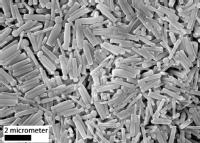
Before now most research seeking to influence the direction of motion of microscopic components have had to use outside influences such as a magnetic field or the application of light. The University of Warwick team have now found a way to do it by simply adding a chemical in a specific spot and then watching the microscopic matchstick particles move towards it, a phenomenon known as chemotaxis.
The research published in the journal Materials Horizons (RSC) in a paper entitled Chemotaxis of catalytic silica–manganese oxide “matchstick” particles 
 found that by adding a small amount of a catalyst to the head of a set microscopic rods, they could then cause the rods to be propelled towards the location of an appropriate ‘chemical fuel’ that was then added to a mixture.
For the purposes of this experiment the researchers placed silica–manganese oxide ‘heads’ on the matchstick material and introduced hydrogen peroxide as the chemical fuel in one particular place.
They placed the ‘matchsticks’ in a mixture alongside ordinary polymer microspheres.
When the hydrogen peroxide was added the microspheres continued to move in the direction of convection currents or under Brownian motion but the matchsticks were clearly rapidly propelled towards the chemical gradient where the hydrogen peroxide could be found.
The reaction was so strong that more than half of the matchstick particles did not reverse their orientation once over their 90 seconds of travel towards the hydrogen peroxide – even though they were contending with significant convection and Brownian rotation.
University of Warwick research chemical engineer Dr Stefan Bon who led the research said:
“We choose high aspect ratio rod-like particles as they are a favourable geometry for chemotactic swimmers, as seen for example in nature in the shapes of certain motile organisms”
“We placed the ‘engine’ that drives the self-propulsion as a matchstick head on the rods because having the engine in the ‘head’ of the rod helps us align the rod along the direction of travel, would also show the asymmetry perpendicular to the direction of self-propulsion, and at the same time it maintains rotational symmetry parallel to the plane of motion.
“Our approach is very versatile and should allow for future fabrication of micro-components of added complexity.
“The ability to direct motion of these colloidal structures can form a platform for advances in supracolloidal science, the self-assembly of small objects.
“It may even provide some insight into how rod shapes were selected for self-propelled microscopic shapes in the natural world.”
Notes for editors:
Dr Stefan Bon can be contacted on S.Bon@warwick.ac.ukor +44 (0)2476 574009 or + 44 (0)7736932205
Or you can contact Anna Blackaby, University of Warwick press officer, on +44 (0)2476 575910 or +44 (0) 7785 433155 ora.blackaby@warwick.ac.uk
The research has just been published in the journal “Materials Horizons” in a paper entitled Chemotaxis of catalytic silica–manganese oxide “matchstick” particles DOI: 10.1039/c3mh00003f
The authors wish to thank Peter W. Dunne, David Burnett, and Luke A. Rochford for help with XRD analysis. We thank EPSRC, Chemistry Innovation, and AkzoNobel for funding (ARM). Some of the equipment used was funded by West Midlands AM2 Science City initiative.
RSC Hot Article for Scott group
Optically pure heterobimetallic helicates from self-assembly and click strategies (or how to control chirality at linked metal centres)