
Habershon group research on automated algorithm discovery published in JACS
Habershon Group
research on automated algorithm discovery published in JACS
Quantum mechanics is the best theory that we have for describing how atoms, molecules and electrons behave during important chemical processes such as light harvesting, catalysis and energy transfer. But the predictive power of quantum chemistry comes with a cost - performing accurate quantum calculations often requires huge amounts of computing power and associated energy consumption. As a result, seeking new algorithms that could be more accurate or more compute-efficient than existing strategies is an important frontier challenge for the whole of the chemical sciences.
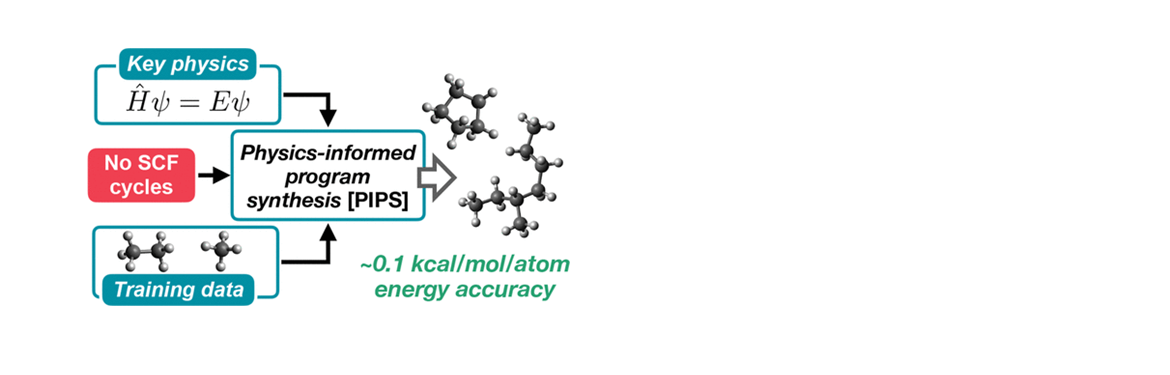
As a novel route to address this challenge, a new journal article published by the research group of Prof. Scott Habershon – with the help of an undergraduate MChem project student – shows how the concept of `program synthesis’ (or `self-writing’ computer code) can be used to identify and test entire new algorithms for solving the key equations of quantum mechanics.
The recent article published in J. Am. Chem. Soc. shows how new algorithms for solving quantum-mechanical equations can be generated by randomly `gluing together’ simpler function building blocks – a bit like constructing a house from Lego bricks. Each new algorithm can then be tested for accuracy in predicting the relative energies of simple molecules – with the winning algorithm being the most accurate.
Importantly, the Habershon group showed that the resulting `computer-discovered’ algorithms can reproduce the results of some of the standard workhorse quantum chemistry methods – like Hartree-Fock or Density Functional Theory – but come at a much lower computational running-cost. These results then open up an exciting future route to exploring more energy-efficient algorithms for accurately modeling molecular systems.
The published research – with former post-doctoral researcher Dr. Kyle Acheson as first author and former Warwick Chemistry undergraduate student Rastislav Turanyi as a co-author – had some of its roots in Rastislav’s final-year MChem project.
The published article is:
Automated Discovery of Algorithms for Molecular Electronic Structure Calculations Using Physics-Informed Program Synthesis, Kyle Acheson, Rastislav Turanyi and Scott Habershon, J. Am. Chem. Soc. 2026, 148, 11991–12000