
Recent Developments in the Patho-Physiological Molecular Clocks Lab
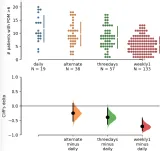
Frequency of the PROMs
|
|
In a collaboration led by Pasquale Innominato, we evaluate the impact of different frequencies for the evaluation of patient-reported outcomes (PRO) in cancer. PRO have proven relevant positive clinical impact on patients’ communication with healthcare professionals, decision-making for management, wellbeing and overall survival. However, the optimal frequency of PRO assessment has yet to be defined. Based on the assumption that more frequent sampling would enhance accuracy, we aimed at identifying the optimal sampling frequency that does not miss clinically relevant insight. Our analysis suggests that in patients receiving chemotherapy for advanced cancer, increasing the density of PRO collection enhances the accuracy of PRO assessment to a clinically meaningful extent. This is valid for both computation of averages symptom burden and for the recognition of episodes of severe symptom intensity. |
Coffee anyone?
 |
Most organisms with a nervous system have been shown to sleep. Why is not yet clear, but it is clear that the longer an organism stays awake the higher the need for sleep, ie. sleep pressure. However, the biological clock, also present in virtually all organisms, is modulating sleep need, eg. in people after a night without sleep, sleep pressure is (temporarily) reduced around sunrise courtesy of their circadian drive to become active at that time. Thus, sleep pressure and circadian rhythms influence each other.
Interestingly, caffeine, which is found in coffee and energy drinks promising wings, and one of the world’s most widely consumed psychoactive substances, is reducing sleep pressure by a known mechanism, but also impacting on the circadian clock. So far, the regulatory mechanisms for the interaction are at least partly unclear.
In this publication, we showed how adenosine A1/A2A receptor antagonists, such as caffeine, shift circadian rhythms and enhance the effects of light on the clock, providing a molecular link between sleep pressure and circadian rhythms. These insights have implications for therapeutic strategies for rhythm disorders. |
When it is dark enough, you can see the mice!
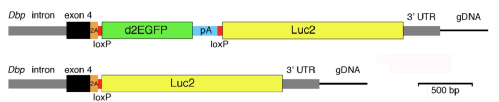 |
Led by Smith and driven by Lauren Garbutt at Warwick and US collaborators in the labs of Prof Weaver at UMass Med School as well as Prof Harrington at Smith College and Prof Davidson at Morehouse, the first Preprint about the novel tissue-specific Dbp reporter mice, and only 8 years after its inception. |
Endocrine Related Cancers review on what stop tumours ticking, how to determine it, and why it might be important
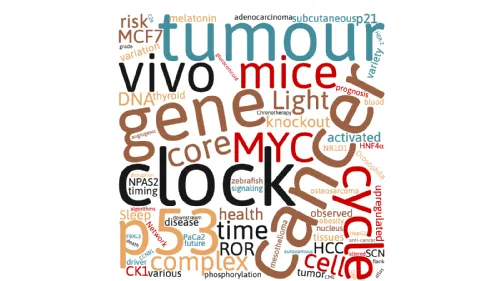
In a great joint effort by ARAP student Ewan Stephenson and MRC DTP student Laura Usselmann with Ewan's Singaporean co-supervisors David Virshup (DUKE-NUS) and Vinay Tergongar (A*STAR), we are providing an in depth look into clocks in tumours.
2-year post-doctoral position to work on tumour clocks
This position is associated with a three years CRUK funded Multidisciplinary Award jointly lead by Dr Robert Dallmann (WMS) and Professor David A. Rand (Maths) to determine if the circadian clock in cancer cells holds potential to predict cancer patient survival. The Research Fellow will be based in Biomedical Sciences Division of WMS and work in the new Inter-disciplinary Biomedical Research Building at the Gibbet Hill Campus Site of University of Warwick. However, you will also work in close collaboration with the project team of Mathematicians, Statisticians and Bioinformaticians.
Please do get in touch if you are interested and have further questions.
Email: r.dallmann (at) warwick.ac.uk