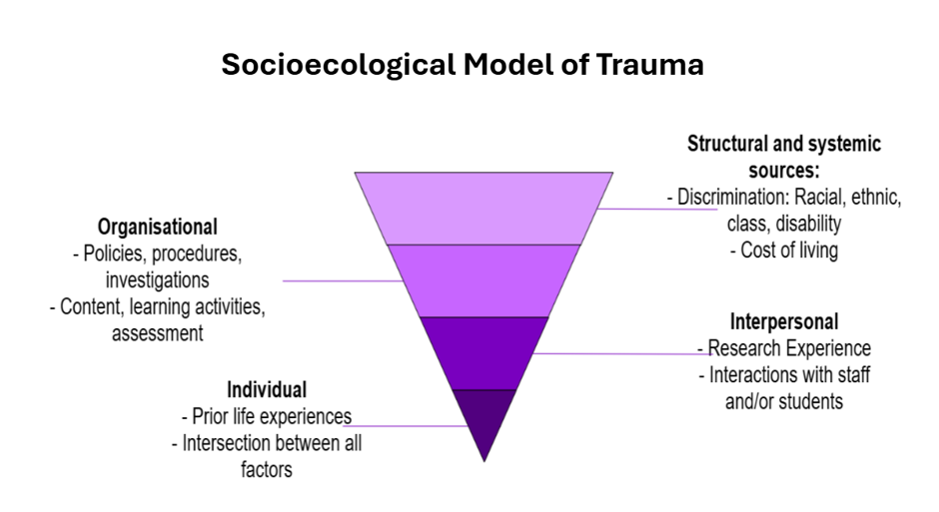
- Understandings of trauma have shifted from focusing mainly on extreme events such as war and abuse to recognising a wide range of experiences which can have varied impacts across individuals and contexts.
- Trauma is now understood to arise from a variety of experiences, including interpersonal harm, childhood adversity, and broader systemic and structural inequities.
- Frameworks such as SAMHSA’s 3Es, trauma types (acute, chronic, complex), ACEs, and the expanded “realms of ACEs” show that trauma is shaped by relational, environmental, and social factors.
Trauma was initially understood as exposure to extreme events such as war, disasters, or serious physical threat. Early editions of the Diagnostic and Statistical Manual of Mental Disorders (DSM-I and DSM-II; American Psychiatric Association [APA], 1952; 1968) described trauma-related reactions in relation to severe stressors, including experiences referred to as “shell shock” and “combat fatigue.” A significant shift occurred with the publication of the DSM-III in 1980 (APA, 1980), which formally introduced Post-Traumatic Stress Disorder (PTSD) and acknowledged that traumatic experiences could lead to enduring psychological impacts. Over time, understandings of trauma have broadened substantially, recognising that trauma extends beyond psychiatric diagnoses such as PTSD or acute stress disorder. Importantly, prevalence rates are clear that only a small proportion of people who experience trauma are diagnosed with PTSD or another type of trauma-related disorder [link to section on prevalence]. Notably, PTSD diagnostic criteria have been iteratively developed based largely on Western illness scripts and therefore may not be reflective of trauma experiences and post-traumatic features in other cultural contexts.
Contemporary understandings recognise that trauma can arise from single events, chronic interpersonal harm, childhood adversity, systemic discrimination, and ongoing social and structural inequities. Current conceptualisations also acknowledge that individuals may respond differently to similar events depending on factors such as developmental stage, relationships, cultural context, prior experiences, and access to support. As a result, the term “potentially traumatic event” is often used to recognise that while certain experiences may have the potential to result in trauma, the impacts of these events can vary across individuals and over time. These points should be borne in mind when interpreting prevalence data, as diagnostic frameworks or tools to measure prevalence may exclude other important source of trauma, affecting the accuracy of estimates.
A widely cited definition of trauma from the Substance Abuse and Mental Health Services Administration (SAMHSA, 2014) describes trauma as resulting from “an event, series of events, or set of circumstances that is experienced by an individual as physically or emotionally harmful or life-threatening and that has lasting adverse effects on the individual’s functioning and mental, physical, social, emotional, or spiritual wellbeing.” SAMHSA (2014) draws on the 3Es framework when defining trauma as the combination of the Event, Experience, and Effect. This means that trauma is not determined solely by the occurrence of a potentially traumatic event, but also by how the individual experiences the event and the lasting effects of the event on a person’s wellbeing.
Drawing on contemporary and broad understandings of trauma, potentially traumatic events can include physical, emotional, or sexual abuse, neglect or maltreatment, domestic and family violence, serious accidents or injuries, natural disasters, community violence, racism and discrimination, war and forced displacement, sudden loss or bereavement, bullying, medical trauma, and ongoing exposure to poverty, instability, or social exclusion. Within the literature, several categories are commonly used to describe different forms of trauma, including acute, chronic, and complex trauma:
- Acute trauma refers to exposure to a single distressing event, such as a serious accident, natural disaster, assault, or sudden loss.
- Chronic trauma involves repeated or ongoing exposure to distressing experiences, including family violence, emotional abuse, neglect, community violence, bullying, or persistent exposure to instability and threat.
- Complex trauma refers to repeated interpersonal trauma, often occurring during childhood and within caregiving relationships, including experiences such as abuse, neglect, domestic and family violence, or exploitation (Feriante & Sharma, 2023). The 11th revision of the International Classification of Diseases (ICD-11), published by the World Health Organization (WHO, 2019), introduced Complex Post-Traumatic Stress Disorder (CPTSD) as a distinct diagnostic category. CPTSD reflects the effects of complex traumatic experiences and is recognised as a separate diagnosis from PTSD.
More recently, the concepts of structural trauma and social trauma have emerged to describe trauma arising from systemic inequities and harmful social conditions. These forms of trauma may result from experiences such as racism, colonisation, discrimination, poverty, homelessness, forced displacement, and social exclusion. Relatedly, racial trauma and collective trauma experiences are increasingly recognised within the literature, referring to the psychological and emotional harms associated with racism, marginalisation, discrimination, and systemic oppression across individuals, communities, and generations (SAMHSA, 2023). SAMHSA (2023) presents the following framework for understanding the varied events that can constitute a traumatic experience.