
Old myths and a controversy based on denial
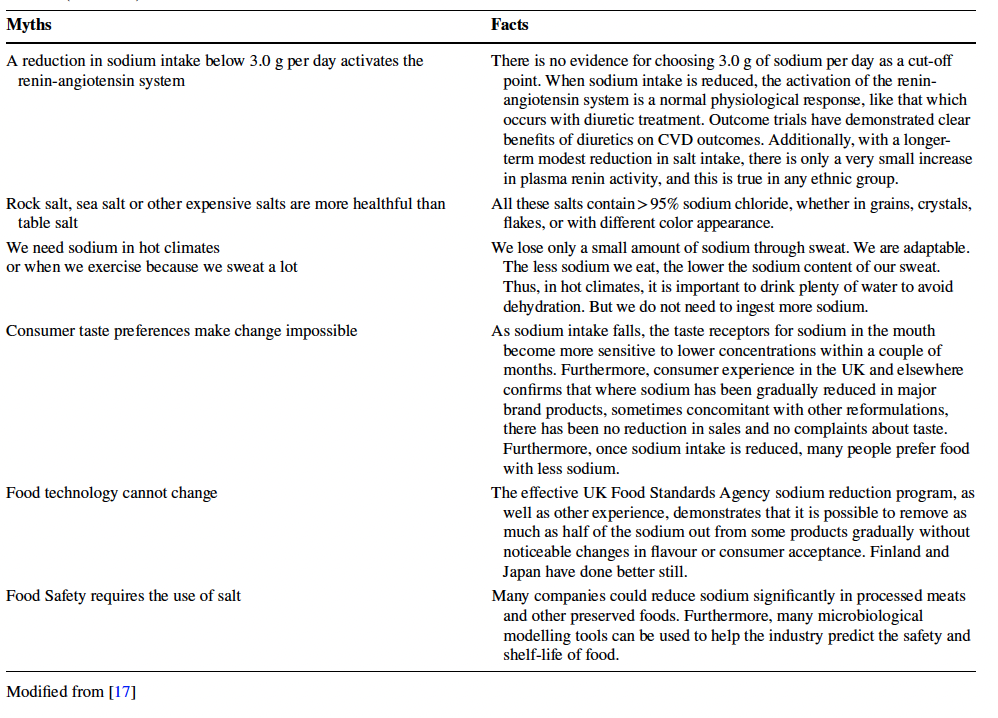
Mis-conceptions about salt (sodium) reduction: myths and facts
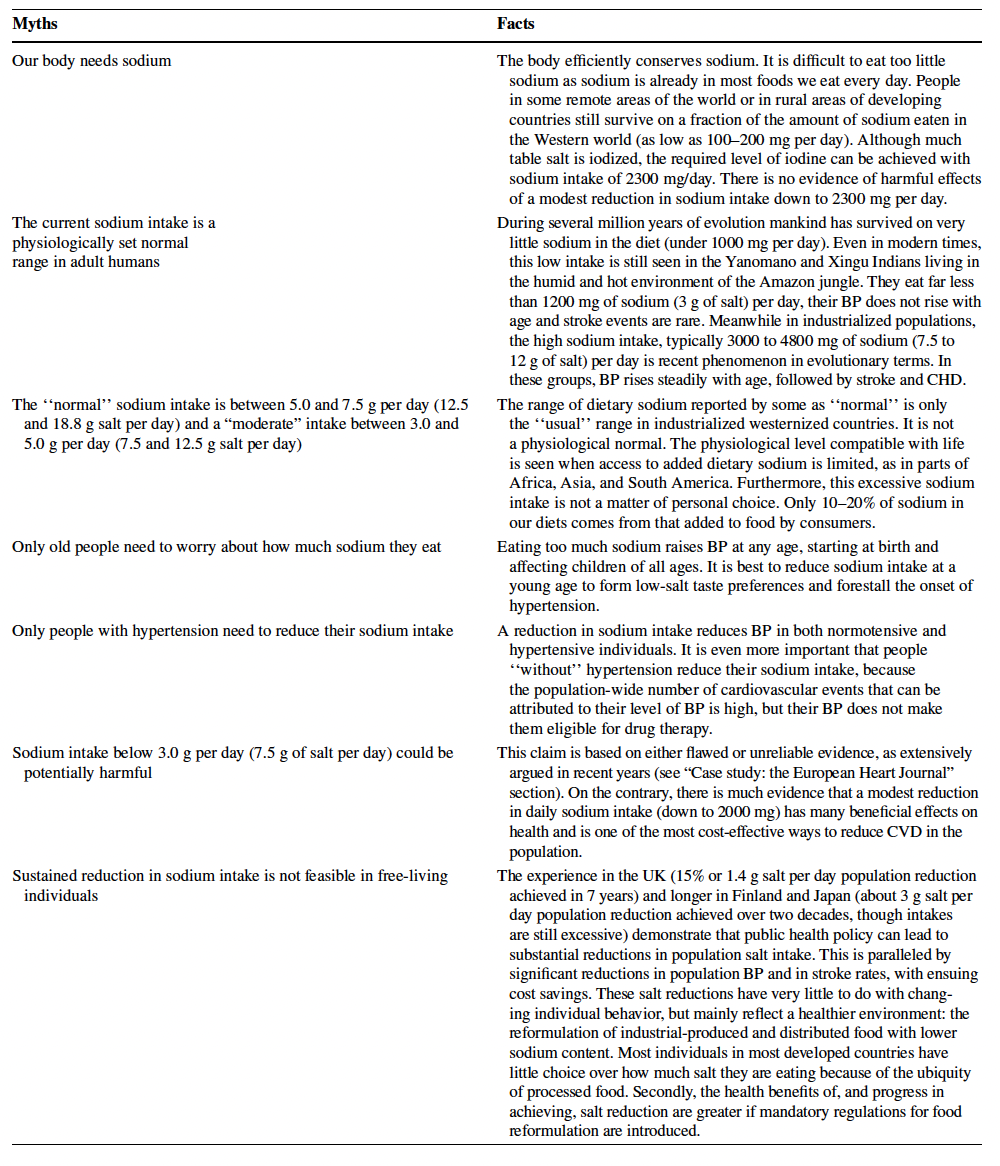
click on text to expand
Articles debunking the false claims based on flawed methods
A representative sample of articles (often not cited) highlighting the scientific flaws on which claims were based.
Campbell NRC & Cappuccio FP. Dietary salt and blood pressure: verdict is clear, so why any debate?Hypertension Journal 2016; 2(2): 57-59
Campbell NRC, He FJ, Tan M, et al. The International Consortium for Quality Research on Dietary Sodium/Salt (TRUE) position statement on the use of 24-hour, spot and short duration (<24-hours) timed urine collections to assess dietary sodium intake.J Clin Hypertens 2019; 21: 700-709
Campbell NRC, He FJ, McLean RM, Woodward M, MacGregor GA, Cappuccio FP. Dietary sodium and cardiovascular disease in China: concerns about the methods, conclusions, and evidence review.J Hypertens 2021; 39(7): 1466-1467. [letter]
Campbell NRC, He FJ, McLean RM, et al. Addressing inaccurate, scientifically unsupported and repeated statements and claims about reducing dietary sodium.J Hypertens 2022; 40: 1831-6
Campbell NRC, Cappuccio FP, McLean RM. Concerns about estimating the health impact of salt targets for foods. Hypertension 2022; April 22; [Comment].
Campbell NRC, Cappuccio FP, McLean RM, He FJ, MacGregor GA. Comment on Hogas et al. Salt, not always a cardiovascular enemy? A Mini-Review and modern perspective. Medicina 2023; 59(1): 51 [letter]
Campbell NRC & Cappuccio FP. The critical need for high quality research on dietary sodium. WHL Newsletter 2023; September 7; 16.
Campbell NRC, Cappuccio FP. Association between sodium excretion and all-cause mortality. Are the results reliable? BMC Cardiovascular 2026; in press
Campbell NRC, Cappuccio FP. Research on dietary sodium with invalid methods does not advance scientific understanding. Nutr Metab 2026; 23: 17https://doi.org/10.1186/s12986-025-01057-1
Campbell NRC, Guichon J, Cappuccio FP. Scientific and Ethical Concerns. Correspondence on “The Authors’ Reply” by Johnson et al. Heart 2026; Jan 19; (on-line)[letter]
Campbell NRC, Cappuccio FP. Flawed method of assessing dietary sodium makes health outcome associations unreliable. Medicine 2026; on-line (Jan 29).[letter]
Campbell NRC, Guichon J, Cappuccio FP. Dietary sodiuum reduction: concerns regarding systematic selection of evidence. Eur J Prev Cardiol2026; in press. DOI: 10.1093/eurjpc/zwag274 [letter]
Cappuccio FP. Salt and cardiovascular disease.Lancet2016; 388: 2112 [letter]
Cappuccio FP, Campbell NRC. Population dietary salt reduction and the risk of cardiovascular disease: a commentary on recent evidence. J Clin Hypertens 2017; 19(1): 4-5 [Commentary]
Cappuccio FP. Invited Commentary: Evaluating population salt reduction programs worldwide: the risk of cutting corners! Public Health Nutrition 2018; 21(12): 2161-3 [Editorial commentary]
Cappuccio FP, Beer M, Strazzullo P on behalf of the European Salt Action Network. Population dietary salt reduction and the risk of cardiovascular disease. A scientific statement from the European Salt Action Network. Nutr Metab Cardiovasc Dis2 019; 29: 107-114
Cappuccio FP, Sever PS on behalf of the British and Irish Hypertension Society. The importance of a valid assessment of salt intake in individuals and populations. A scientific statement of the British and Irish Hypertension Society. J Hum Hypertens 2019; 33: 345-348.
Cappuccio FP, D'Elia L, Rakovac I. Spot urine samples and estimation of population salt intake: the return of the phoenix?J Hypertens 2023; 41: 869-71
He FJ, Appel LJ, Cappuccio FP, de Wardener HE, MacGregor GA. Does reducing salt intake increase cardiovascular mortality? Kidney International 2011; 378: 380-2
Ji C, Miller MA, Venezia A, Strazzullo P & Cappuccio FP. Comparisons of spot vs 24-h urine samples for estimating salt intake: validation study in two independent population samples of adults in Britain and Italy.Nutr Metab Cardiovasc Dis 2014; 24: 140-7.
McLean RM, Song J, Wang C, et al. Formula-led methods using first morning fasting spot urine to assess usual salt intake: a secondary analysis of PURE study data. J Hypertens 2024; 42(11): 2003-10