
Physics Department News
Hundreds of Brownies become budding physicists at University of Warwick
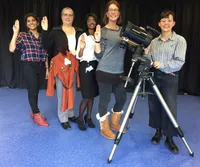
Staff and research students from the University of Warwick’s physics department welcomed hundreds of Brownies to campus at the weekend (13 and 14 October).
The seven to ten-year-olds, from across Coventry, Warwickshire, and Solihull, spent the weekend learning all about physical sciences. The girls also received a special badge designed by nine-year-old Coventry Brownie, Gracie-May Kelly.
Ally Caldecote, outreach officer for the University of Warwick’s physics department, said: “It was great to see the Brownies meeting inspiring physicists from the University of Warwick, enjoying exciting hands-on experiments and getting a real taste of what physics is like.
“We are still not seeing women equally represented in the numbers choosing degrees in physics or even at A level. This is something we are working to change as it is an important factor in the development of the subject.
“We want to inspire the next generation of young women in science. We hope that spending a day with us at Warwick fuelled the Brownies’ curiosity and will some of them to pursue a scientific career.”
Whilst on campus, the Brownies enjoyed a range of activities and experiments including coding, forces and astrophysics.
Jayne Oliver, Brownie adviser for Girlguiding Warwickshire, said: “The Brownies have had an amazing couple of days. They've learned about electricity & gravity through dance; exploded coke bottles, learned about the solar system, blown huge bubbles, studied UV lights and sent rockets around the Oculus building, all under the safe guidance of the wonderful physics staff and students at the University of Warwick. The girls were absolutely blown away by everything and we thank everyone for a truly memorable experience.”
The unique badge was designed by Gracie-May Kelly, a nine year old Brownie from 33rd Aldermans Green Brownies in Coventry. She, along with hundreds of other Brownies received hers from Warwick physicists at the weekend.
Gracie-May said: “I really enjoyed the science and physics day I went to with Brownies at Warwick University. My favourite part of the day was making a UV bracelet. We had to choose beads and we went outside to test it and all the beads changed different colours. It was so cool.
“Before we left we watched a lady do an experiment where she put a blown-up balloon into nitrogen and it all scrunched up and when she took it out, it blew back up again. It was really cool to watch. The day was so much fun and I learned so much about science.”
Nobel Prize in Physics 2018

Congratulations to Donna Strickland, Gerard Mourou and Arthur Ashkin on winning the 2018 Nobel Prize in Physics for ground-breaking inventions in the field of laser physics. Strickland and Mourou found a way to generate high-intensity, ultra-short optical pulses using chirped pulse amplification. Ashkin created optical tweezers that have had enormous impact on biological systems.
New WIHEA Fellow
Congratulations to Michael Pounds, who has been appointed as a fellow of the Warwick International Higher Education Academy from 2018/19.
A WIHEA Fellowship recognises and rewards outstanding achievements in learning and teaching.
Michael joins Gavin Bell as WIHEA representatives from Physics.
Fundamental quantum limits of optomechanical sensors
Dominic Branford and Animesh Datta, working in collaboration with Haixing Miao (University of Birmingham), have published a paper on the fundamental quantum limits of optomechanical sensors in Physical Review Letters (DOI: 10.1103/PhysRevLett.121.110505). Being able to measure very weak forces is central to many applications, such as the direct detection of gravitational waves and monitoring subterranean movement of magma in volancially-active areas. The strength of a force can be inferred through its effect of displacing a mass: the displacement can be sensed by illuminating it with a laser and observing the reflected light, a case of optomechanical sensing. In this work, Dominic, Haixing and Animesh study the best precision attainable by optomechanical sensors when multi-coloured light is used.