
International Workshop on Germanium Quantum Technologies
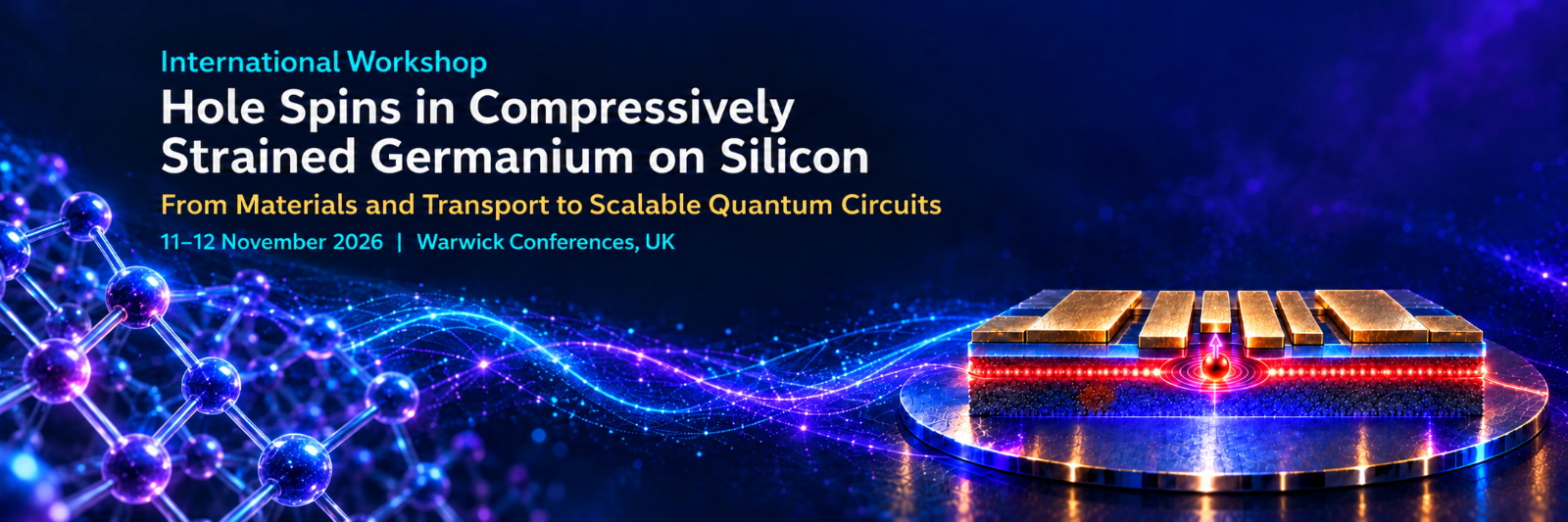
This workshop represents a defining moment in the emergence of compressively strained germanium on silicon (cs-GoS) as a scalable quantum technology platform. cs-GoS has moved beyond proof-of-principle materials science. It now demonstrates the essential ingredients of a scalable semiconductor quantum architecture: ultra-high-mobility two-dimensional hole system, electrically tuneable and inherently strong spin–orbit coupling, large and anisotropic g-factors, access to interaction-dominated regimes, and full compatibility with silicon processing infrastructure.
The central question is no longer whether cs-GoS can host spin qubits; it is how rapidly and effectively it can be transformed into a scalable circuit-level architecture.
This workshop is convened to consolidate the platform. It brings together leading figures in epitaxy, disorder control, mesoscopic transport, spin physics, qubit realisation, long-range coupling, nanofabrication, cryogenic control, and industrial integration. The objective is not incremental dissemination of results, but the deliberate alignment of the field around a coherent architectural vision. The workshop will rigorously benchmark cs-GoS against silicon and III–V approaches, critically examining its comparative advantages and limitations. It will assess the fundamental physical limits governing coherence and controllability, identify the principal materials, fabrication, and systems-level bottlenecks, and articulate the engineering milestones necessary to progress from small-scale demonstrations to architectures comprising thousands of qubits.
cs-GoS possesses a rare combination of physical advantages and technological compatibility. If strategically aligned, it offers a pathway to scalable, silicon-integrated quantum processors.This workshop, therefore, serves not simply as a scientific meeting, but as a declaration: cs-GoS is emerging as a coherent, internationally viable platform for scalable spin-based quantum circuits. Through extended lectures and structured, high-level discussion, the workshop is designed to articulate a shared roadmap for cs-GoS, from materials perfection to scalable quantum architectures. The ambition is clear: to establish cs-GoS not as one of many competing approaches, but as a coherent, internationally aligned platform capable of underpinning the next generation of silicon-compatible quantum processors.
Programme
Day 1: Materials, transport & spin physics foundations
08:45–09:15 Maksym Myronov (The University of Warwick, UK)
Welcome & vision
Session I – Materials platform & benchmarking
09:15–10:15 Maksym Myronov (The University of Warwick, UK)Link opens in a new window
Epitaxy and Ultra-High-Mobility Hole Systems in cs-GoS (45 min + 15 min discussion)
10:15–11:15 Alex Hamilton (UNSW, Australia)Link opens in a new window
Benchmarking cs-GoS Hole System Against Si and III–V Platforms (45 min + 15 min discussion)
11:15–11:45 Coffee
Session II – Transport & interaction Physics
11:45–12:45 Mike Pepper (UCL, UK)Link opens in a new window
Many-Body Physics and Hole Transport in Low-Dimensional Systems (45 min + 15 min discussion)
12:45–14:00 Lunch
Session III – Theory & Spin–Orbit Control
14:00–15:00 Sergei Studenikin (NRC Canada)
g-Factor Engineering and Spin Properties in cs-GoS (45 min + 15 min discussion)
15:00–16:00 Gloria Platero (ICMM CSIS, Spain)Link opens in a new window
Theory of Hole Spins and Electrical Spin Control (45 min + 15 min discussion)
16:00–16:30 Coffee
16:30–17:30 Sougato Bose (UCL, UK)Link opens in a new window
Long-Range Coupling Mechanisms for Solid-State Spin Qubits
17:30–18:30 Moderated Discussion (All Day 1 Speakers)
Theme: Limits to coherence, control and materials perfection
18:45 Dinner
Day 2: Qubits, fabrication & scalable architectures
Session IV – Realising Hole Spin Qubits
09:00–10:00 TBC (France)
Gate-Defined Hole Spin Qubits in cs-GoS
10:00–11:00 TBC (Japan)
Semiconductor Spin Qubit Architectures and Scaling
11:00–11:30 Coffee
Session V – Fabrication & Quantum Circuits
11:30–12:30 Nikolay Petkov (MTU, Ireland)Link opens in a new window
Nanofabrication Strategies for Scalable Spin Qubit Circuits
12:30–13:30 Leonid Rokhinson (Purdue University, USA)Link opens in a new window
Quantum Circuits and Hybrid Architectures in Semiconductor Platforms
13:30–14:30 Lunch
Session V – Emerging Directions & Topology
14:30–15:30 Greg Mazur (UCSB, USA)Link opens in a new window
Emerging and Topological Phenomena in cs-GoS
15:30–16:00 Coffee
Session VI – Industrial Scaling & Control Infrastructure
16:00–17:00 Frederico Martins (Quantrolox, UK)Link opens in a new window
High-Fidelity Control and Cryogenic Electronics for Spin Qubit Platforms
17:00–18:00 Charles Smith (University of Cambridge / Link opens in a new windowHitachi Cambridge LaboratoryLink opens in a new window, UK)Link opens in a new window
An update on the quantum computing research at the Hitachi Cambridge Laboratory
18:00–18:45 Final Strategic Panel (All Speakers)
Theme: From 10 Qubits to 10,000 — What Must Be Solved in Materials, Devices and Control?
18:45 Dinner