
PhD Opportunities
PhD Projects
Every year at least one studentship is available for a suitably qualified applicant to join our Group. Early applications for places are strongly encouraged. Details of the projects currently available are given below. For more details of the kind of work carried out by the students in our Group please refer to the PhD current research projects page.
PhD Project Titles - (Note, any funding is only likely to be available for UK nationals)
Nanosculpting antiferromagnets to explore novel electronic transport
PhD opportunity · University of Warwick · Department of Physics · Starting October 2027
Supervisor: Dr Max Birch · Royal Society University Research Fellow
Superconductivity and Magnetism Group · Nanosculpted Quantum Materials
Electronic functionality from unconventional antiferromagnets
Can we sculpt antiferromagnetic materials into devices to reveal new physics and control their emergent behaviour? Antiferromagnets contain ordered magnetic moments that typically cancel one another. However, certain unconventional antiferromagnets exhibit electronic responses associated with broken time-reversal symmetry (TRS) (usually associated with ferromagnets), opening possibilities for new spintronic devices.
This experimental PhD project explores two families of these materials. In noncollinear antiferromagnets [1,2], intricate arrangements of magnetic moments can form magnetic multipole structures, such as octupoles, that activate unexpected behaviour despite a near-zero net magnetisation (Fig. 1a). In altermagnets [3,4], the interplay between antiparallel magnetic spins and their crystal environments produces an electronic spin splitting that changes with direction in momentum space (Fig. 1b). These materials offer opportunities to connect fundamental questions about magnetic symmetry with electronic device functionality.
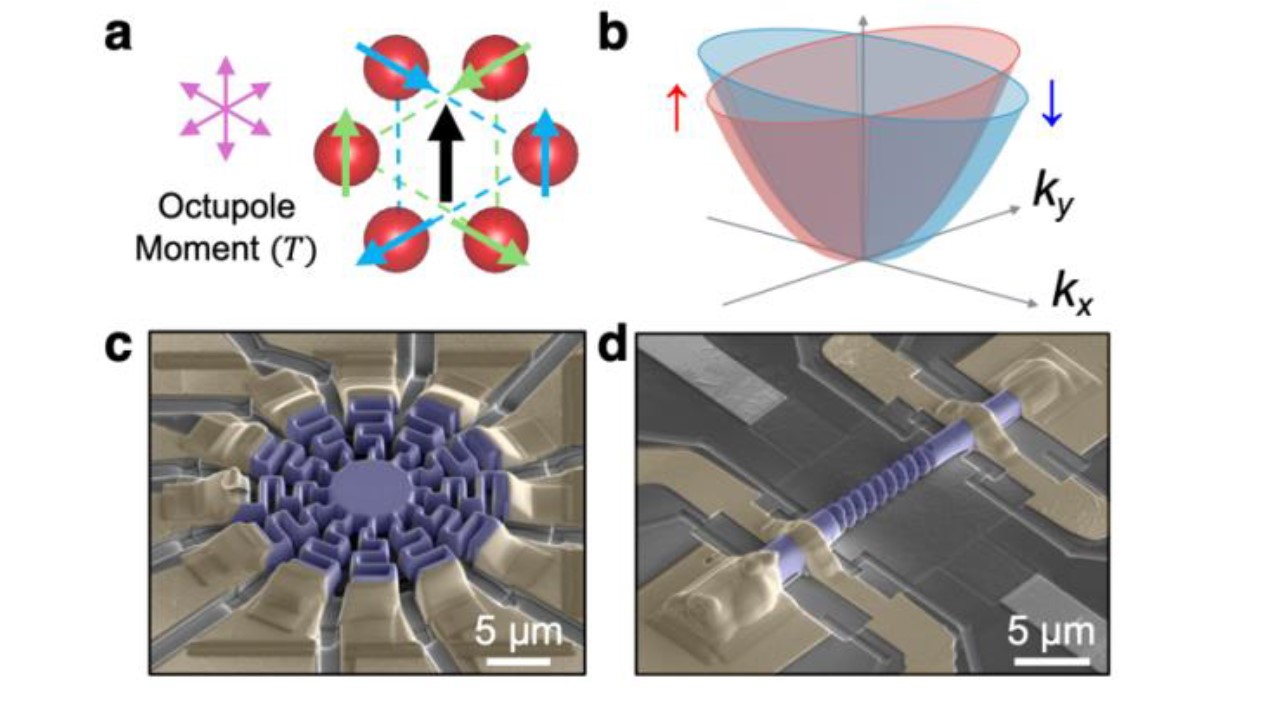
Figure 1
Sculpting materials into intricate devices
You will use focused ion beam (FIB) fabrication to create intricate microscopic devices directly from furnace-grown crystalline materials (examples in Fig. 1c,d). By designing their geometry, electrodes and mechanical structures, we can probe and influence material behaviour in ways that conventional samples cannot readily accommodate. The project will use this freedom to ask creative experimental questions. Can we realise and electrically probe metastable TRS-breaking antiferromagnetic states? Can we create antiferromagnetic diode responses, where the device resistance depends on current direction? Can mechanical deformation control the antiferromagnetic order and its transport signatures? The specific experiments will develop with the results and your interests, with opportunities to design your own devices and pursue unexpected discoveries.
Training and research environment
You will receive direct training from Dr Max Birch, who specialises in FIB fabrication of quantum-material devices [5-9], and develop expertise in electrical transport measurements, including nonlinear measurements using lock-in amplifiers. You will learn how to turn a new idea into an experiment, uncover the physics behind the results, and use that understanding to control the material’s behaviour. Within Warwick’s Superconductivity and Magnetism Group, you will have access to cryomagnet systems and opportunities to collaborate with crystal growers. The core fabrication and measurement facilities are expected to be ready before you arrive, with opportunities to develop new experimental capabilities as the project progresses. International connections offer potential collaborations in Japan, the USA and Germany, and opportunities to use synchrotron x-ray and neutron facilities where relevant to the project.
Who we are looking for
We are looking for someone who enjoys experimental physics, working with their hands and finding creative solutions to practical problems. Fabricating these devices involves carefully sculpting and assembling microscopic structures inside the focused ion beam instrument with a micromanipulator, rewarding patience and attention to detail. In return, the flexibility of the approach provides extreme freedom to design new devices and experiments, turning imaginative scientific questions into structures you can investigate. You do not need previous focused ion beam experience: specialist training and guidance will be provided.
If you are interested, please contact Dr Max Birch and/or Prof. Geetha Balakrishnan to discuss the project.
Email: maximilian.birch@riken.jpLink opens in a new window · Group information: nanosculpt.github.ioLink opens in a new window · Apply: hereLink opens in a new window
Email: g.balakrishnan@warwick.ac.uk
[1] S. Nakatsuji, et al. Nature 527, 212–215 (2015). DOILink opens in a new window. [2] B. H. Rimmler, B. Pal and S. S. P. Parkin, Nat. Rev. Mater. 10, 109–127 (2025). DOILink opens in a new window. [3] L. Šmejkal, J. Sinova and T. Jungwirth, Phys. Rev. X 12, 040501 (2022). DOILink opens in a new window. [4] C. Song et al., Nat. Rev. Mater. 10, 473–485 (2025). DOILink opens in a new window. [5] M. T. Birch et al., Nat. Commun. 11, 1726 (2020). DOILink opens in a new window. [6] M. T. Birch et al., Nat. Commun. 13, 3630 (2022). DOI. [7] M. T. Birch et al., Nature 633, 554–559 (2024). DOILink opens in a new window. [8] M. T. Birch et al., Nat. Nanotechnol. 21, 352–358 (2026). DOILink opens in a new window. [9] M. T. Birch et al., PRB 114, 094409 (2026). DOILink opens in a new window.

Making an Application - How to Apply
Click here for more details of the formal application procedures, the relevant application forms and a postgraduate prospectus. N.B. This information is mounted on the Physics Department web pages outside this Superconductivity and Magnetism site.
MSc Research Projects
We always have places available for suitably qualified self-funded students who would like to work towards an MSc. For more details of the kind of work carried out by the students in our Group please refer to the current postgraduate research projects page.
MSc Project Titles
We do not have any MSc projects currently available. Prospective applicants are encouraged to contact the supervisor they are interested in working with in the first instance.
Making an Application - How to Apply
Click here for more details of the formal application procedures, the relevant application forms and a postgraduate prospectus. Note, this information is mounted on the Physics Department web pages outside this Superconductivity and Magnetism site.
Useful Links
You may like to view the Warwick University Human Resources OfficeLink opens in a new window web page with a listing of all the jobs that are currently available here at the University.
Current vacancies at universities throughout the U.K. are listed on the jobs.ac.ukLink opens in a new window web site.
PhD projects
Click here to see a more details of the PhD projects available here in the Physics Department at Warwick.
International PhD Funding Opportunities
Warwick offers a number of competitive scholarships for international postgraduate students. Prospective applicants are encouraged to contact the supervisor they are interested in working with in the first instance.