
WMG News - Latest news from WMG
WMG hat-trick at University Awards!
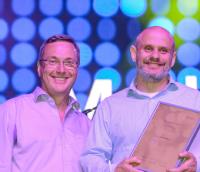
Congratulations to the brilliant Lucy Inman and Professor Mark Williams who both won a prestigious University Award last night.
 Lucy, who is Teaching and Learning Officer in the WMG Full-time Master's office won the top prize in the Service Excellence category.
The judges said: “Lucy leads by example, bringing a calm and thoughtful approach to problems, working to resolve things to ensure the best possible outcome for students, and also putting measures in place to ensure it doesn’t repeat, or to mitigate the impact where matters
are likely to repeat."
Professor Mark Williams, who heads up the Metrology area at WMG, received the Research Contribution Award. “Through a passion for  knowledge and a nose for a great mystery, Mark is inspiring hundreds of people and answering age-old questions. He is a credit to Warwick and a
perfect example of what can be achieved when people leave the confines of their main
area of research."
WMG’s involvement in the University’s Family Day was also recognised at the Awards, with the team scooping highly commended in the Community Contribution Award category.
The Warwick University Awards recognise outstanding individuals and teams from across the University. After the award ceremony staff enjoyed a special summer party with a festival theme including live music from Scouting for Girls.
Lord Bhattacharyya honoured by Beijing City University
 The President of Beijing City University (BCU) Liu Lin held a special memorial event, to celebrate the life of the late Lord Kumar Bhattacharyya, on Friday (21 June).
There was a special tree planted in his honour with Lady Bhattacharyya, and Professor David Mullins, Acting Head of WMG both present. David who worked closely with Professor Lord Bhattacharyya for over 20 years, also spoke at the event.
President Liu explained: “We have planted this tree to commemorate the late Lord Bhattacharyya. This tree symbolises the friendship between BCU and WMG, as well as the personal relationship which, like this tree, will last forever.”
Lady Bhattacharyya said: “It’s no exaggeration to say that Kumar loved China. He visited over forty times, beginning in the early 1980s.
“He was intensely proud of his role in the growth of the Chinese economy over three decades, building training and research partnerships with some of China’s most innovative businesses.”
In 2018, Lord Bhattacharyya was recognised by the Chinese government and presented with a China Talent Visa (R), in recognition of his high-level expertise in manufacturing and inward investment and sustained interaction with the People’s Republic of China.
He was one of the first recipients globally of the newly introduced R Visas for foreign talents awarded by the Chinese government, and was awarded with a ten-year visa. This follows Professor Lord Bhattacharyya receiving two prestigious awards from China – the Great Wall Friendship Award, from Beijing Municipal Government, and the Chinese Government Friendship Award, the premier national award, presented by the Vice-Premier at a special ceremony in Beijing on the occasion of the National Day.
The Chinese government, with this visa showed its sincerity towards global talent. It is awarded to foreign high-level personnel, and much-needed highly talented people, whose skills are in urgent demand to help the development of the economy and society of China.
Speaking at the event Lady Bhattacharyya, said: “It is fitting that today, we honour Kumar by planting a tree - a tree that will take root here in Beijing City University, and grow for years to come, giving life and comfort and shade to future generations, and watching over their progress.
“I hope that this tree will stand as a living reminder of Kumar’s faith in China, his belief in your people, and his hope for a clean, green, healthy, and prosperous future for us all.”
Celebrating International Women in Engineering Day
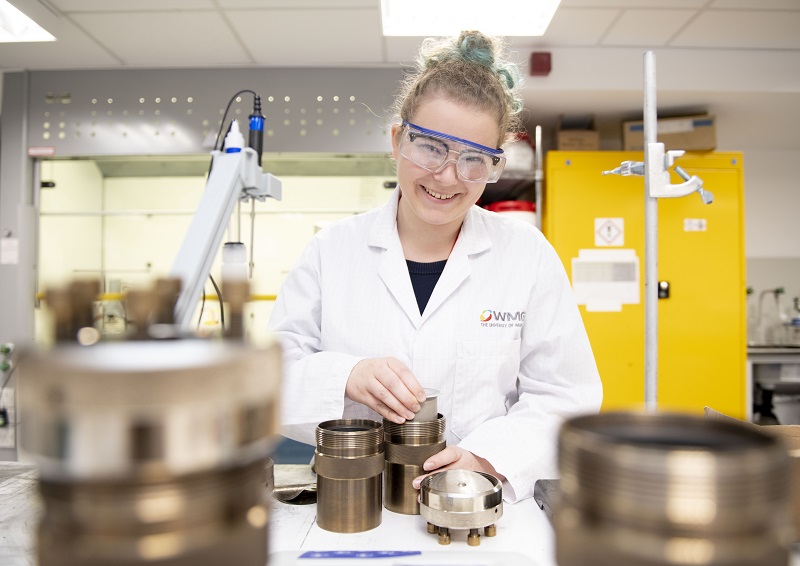 WMG is pleased to be helping the #TransformTheFuture campaign supporting International Women in Engineering Day this Sunday (23 June).
International Women in Engineering Day is an awareness campaign to raise the profile of women in engineering, and focuses attention on the amazing career opportunities available to girls in the industry.
In June, there will be a number of special events at WMG. On 25th June, Chemical Engineer Dr Katie Sizeland will be giving a talk to staff and students and sharing her career highlights and passion for science.
Katie is a Research Programme Manager at ANSTO investigating the nanostructure and mechanical properties of collagen using advanced imaging techniques and synchrotron-based small angle X-ray scattering (SAXS). She is one of only a few female X-ray scientists.
Inspiring young engineers
On 28th June, 58 girls from the WMG Academy for Young Engineers in Coventry and Solihull will be visiting WMG and taking part in a ‘People Like Me Session’ – “a WISE initiative and revolutionary approach to engaging girls with careers in Science, Technology, Engineering and Maths (STEM)”.
The day will be supported by some of WMG’s own inspiring women Eve Wheeler-Jones, Puja Unadkat, Jennie Murray, Lydia Adigun, Beth Haynes and Anisha Patel who will share their experiences of working in STEM.
WMG Women in STEM
At WMG there is a community of women working in STEM from teaching and technicians to researchers and project managers.
Professor Jan Godsell, who is a Chartered Engineer and Member of the IMechE; and has been appointed to advise the UK government on manufacturing policy as a member of the Department of Business, Innovation and Skills' Manufacturing Advisory Group, shares her career advice:
“Think big and grab the opportunities you are given. When I was in the sixth form I had the opportunity to attend an Insight programme to encourage Women into Engineering at Brunel University, which confirmed to me what I wanted to do. I’d also say keep your options open – going down the Mechanical Engineering route gave me very varied experiences.”
You can find out more about some of our inspiring women in STEM here.
WMG and Birmingham Hospitals launch new degree for new NHS role
 WMG at the University of Warwick has launched an exciting new fusion science degree, accredited by the National School of Healthcare Science as part of Health Education England, and is designed specifically to train people for a brand new, and first of its kind health role within the NHS - Digital Healthcare Scientist.
The BSc degree, which has been developed in partnership with University Hospitals Birmingham NHS Trust, will be open as both a full-time undergraduate course, and a Degree Apprenticeship.
Graduating students will be eligible to apply for membership of the Academy for Healthcare Sciences under the new heading of Digital Healthcare Science. This represents the formation of a new healthcare professional and a new branch within the Academy, the first for many years.
The course has been designed with the aim of augmenting the existing workforce in the NHS and breaking down silos, adopting a fusion science approach: taking into consideration aspects of digital science, academic and professional development, clinical decision making, physiological science and behavioural science. Students will learn in an integrated way, applying knowledge, and ensuring that no subject is taught in isolation from any other.
Four fusion sciences: Behavioural Science, Healthcare and Physiological Sciences, Digital Healthcare, and Shared Clinical Decision-making, will be interwoven throughout the programme giving students a breadth of scientific training.
Professor Ed Peile, from the University of Warwick comments:
“Rarely do patients and health service users have a single problem. They have multiple, often complex, problems affecting their health and wellbeing. Thus, the help they need is not confined to a single discipline. They need broad, holistic, scientific professionalism.
“The ‘Fusion Science’ approach developed here is specifically designed to ensure that the new Digital Healthcare Science workforce can meet these needs”.
Tim Jones, Executive Director of Workforce & Innovation at University Hospitals Birmingham NHS Trust comments:
“This is an exciting new degree which will help us train people for a significant new role in the NHS. University Hospitals Birmingham NHS Trust is also offering six full-time undergraduate students the opportunity for a paid summer vacation placement at the end of the first year of study.”
Berne Ferry, Head of the National School of Healthcare Science, adds:
“The National School of Healthcare Science has been closely involved in initiatives to develop a health workforce fit for the digital future. This includes the use of digital technologies and computer science in all areas of healthcare from artificial intelligence and bioinformatics to patient-focused apps and devices. We are delighted to see universities such as Warwick working quickly and responsively with the health service to develop exciting new programmes to meet these needs.”
The programme would suit students who are interested in medical and healthcare sciences, life sciences, data sciences or psychology. For more information on where to apply please call +44 (0) 2476 525724
ENDS
11 JUNE 2019
NOTES TO EDITORS
The programme would suit students who are interested in medical and healthcare sciences, life sciences, data sciences or psychology. For more information on where to apply please call +44 (0) 2476 525724
FOR FURTHER INFORMATION PLEASE CONTACT:
Alice Scott
Media Relations Manager – Science
University of Warwick
Tel: +44 (0) 2476 574 255 or +44 (0) 7920 531 221
E-mail: alice.j.scott@warwick.ac.uk
£22m battery and thermal energy facilities launch at the University of Warwick, for a cleaner greener future
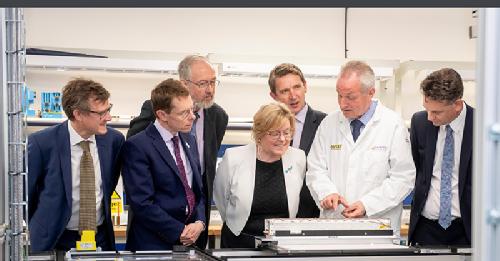 Two research centres for sustainable electrical and thermal energy technologies totalling £22m are launching at WMG, University of Warwick on the 10th June 2019. The funding from government via the Energy Research Accelerator (ERA) sees UK Government, industry and higher education work together to shape the future of the UK’s energy landscape.
The Energy Research Accelerator (ERA) is a £60m project funded by Innovate UK. ERA is working with UK government, industry and the higher education sector to undertake innovative research, develop the next generation of energy leaders, and demonstrate low carbon technologies that help shape the future of the UK’s energy landscape.
ERA consists of eight internationally renowned Midlands universities – which includes the University of Warwick, who are part of the Midlands Innovation partnership, together with the British Geological Survey.
Together they will explore the challenges of energy and electrification, with some of the thought leaders and innovators who are making changes in these areas. There will also be an opportunity to tour the new research facilities.
WMG’s Energy Innovation Centre is a world-class facility for battery research from materials and electrochemistry to application integration and recycling/reuse. The £20m ERA investment has enabled new equipment and facilities, which include laboratories, a dry room for cell assembly, characterisation at cell, module and pack levels, innovative charging infrastructure and second-life evaluation facilities. It will drive the development, and scale-up of new battery chemistries from concept through to proven traction batteries.
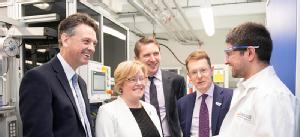 The School of Engineering’s Sustainable Thermal Energy Technologies group develops low carbon heating and cooling technologies. The £2m ERA funding has enabled the extension of the Thermal Properties Lab into five newly-refurbished test cells to accommodate additional equipment for analysing thermal properties of materials and the Thermal Technologies Lab has benefitted from new test equipment and control/data logging facilities.
Professor Pam Thomas, Pro-Vice-Chancellor for Research at the University of Warwick, comments:
“The University of Warwick continues to produce innovative research in battery development and thermal energy, the funding means we can help research ways to tackle global challenges in areas such as energy and sustainability to help climate change for the UK’s and the world’s future.”
Professor Martin Freer, Director of the Energy Research Accelerator, commented:
“Over the coming years we are going to see a step change in the motor industry from the combustion engine to battery powered vehicles. With this investment from ERA and Innovate UK, the Midlands will continue to take the lead in the research, development and commercialisation of new battery technologies.
“Our investment in the thermal labs here at Warwick is also significant, as the new facilities will enable researchers to work together with other ERA universities to develop innovative and efficient low carbon heating and cooling technologies.”
Andy Street, Mayor of the West Midlands comments:
“This world-leading research facility will further cement the West Midlands’ position at the cutting edge of innovation in technology and sustainability.
“The region is already at the forefront of the development of electric vehicle efficiency, and now the ERA’s funding will enable us to make better use of electrification to reduce emissions and improve transport, making a real difference to the lives of people living and working in the West Midlands.”
ENDS
10 JUNE 2019
NOTES TO EDITORS
This area of research is aligned with the Sustainability theme in our Research Strategy, which reflects our wider research into tackling global challenges in areas such as energy and sustainability climate change.
The Energy Research Accelerator (ERA)
ERA is a key programme within Midlands Innovation – a consortium of research intensive universities (universities of Aston, Birmingham, Cranfield, Keele, Leicester, Loughborough, Nottingham and Warwick), and the British Geological Survey (BGS), which has the overall aim of harnessing the Midlands’ combined research excellence and industry expertise to play a critical role in tackling some of the biggest challenges facing the UK.
Via Innovate UK, the government has committed an initial capital investment of £60m, and ERA has secured private sector co-investment of £120m. ERA’s initial priorities of Geo-Energy Systems, Integrated Energy Systems and Thermal Energy will help deliver the new technologies and behaviours that will open the avenues for its future development and demonstrate the transformative effect ERA can have across the energy spectrum.
FOR FURTHER INFORMATION PLEASE CONTACT:
Alice Scott
Media Relations Manager – Science
University of Warwick
Tel: +44 (0) 2476 574 255 or +44 (0) 7920 531 221
E-mail: alice.j.scott@warwick.ac.uk
The Confederation of Indian Industry (CII) hosts a memorial event for Professor Lord Kumar Bhattacharyya

The Confederation of Indian Industry (CII) is hosting a special memorial event in honour of Professor Lord Kumar Bhattacharyya and his contributions to Indian industry today (Friday 31 May).
The CII explains: “The unfortunate demise of Lord Bhattacharyya leaves a void in the Indian manufacturing scenario as he was closely associated with manufacturing excellence and leadership over the past several decades. The CII will deeply miss his guidance on this important area for national manufacturing competitiveness.”
Professor David Mullins, Acting Head of WMG, who worked closely with Professor Lord Bhattacharyya for over 20 years, will also be speaking at the event.
It will take place at the YB Chavan Centre in Mumbai from 5.30pm–7.00pm Mumbai time (12pm UK time).
You can watch a special video created by the CII, in honour of Lord Bhattacharyya, here.
VR headsets enable people of all abilities to experience life on-board unique tall ship
People with a range of abilities can use VR headsets to experience what it’s like on board one of the Jubilee Sailing Trust’s ships to encourage them to explore their ability 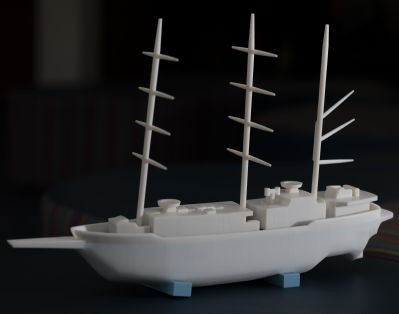 and participate in a life-changing voyage thanks to an app made by WMG student Tanin Aparimarn at the University of Warwick.
The Jubilee Sailing Trust want to encourage more mixed ability people to sail on their fully accessible tall ships, prompting WMG, University of Warwick student Tanin Aparimarn to make a 3D printed version of a ship, a VR experience and an app tour for mixed ability people to experience what it’s like on board.
The VR headset used is a simple cardboard one available to purchase for around £5 online, and enables the user to select an avatar either standing or at wheelchair level to look around the ship as you would in reality, demonstrating what it would be like on board the ship.
An app tour enables the avatar to move around the ship as they would wish, this way the user can experience what it would be like to move around the ship and experience the environment around them beforehand.
Tanin also made a 3D printed, scale version of the tall ship STS LORD NELSON that is 450mm long, complete with three masts and removable decks which allows a visually impaired user to get a tactile sense of where everything is on board.
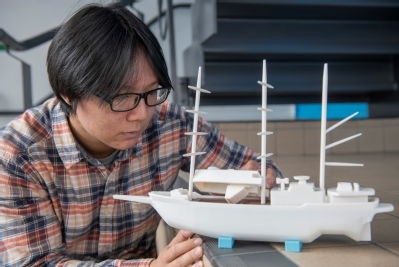 Tanin Aparimarn, from WMG at the University of Warwick comments:
“Using modern technologies such as VR and 3D printing will hopefully encourage more people to take up sailing with the Jubilee Sailing Trust, as now they’ve been able to experience what it would be like on board thanks to the VR experience and the app tour, and they can see what they ship would look like physically because of the 3D printed model.
“I hope that in the future all sorts of tourist destinations and attractions can use VR to encourage people to visit them, as VR offers a more interactive experience than looking at photos.”
Andy Spark, Head of Programmes from the Jubilee Sailing Trust comments:
“Tanin’s work is great. Many people with disabilities need to know that the accessibility on board our tall ships is suitable for their needs any and generally it’s not expected a large sailing ship would be!
“However, the JST is unique as it has two purpose designed and built tall ships to allow people of all abilities (including wheelchair users) to be able to sail on equal terms. The VR tours and the tactile model of the ship Tanin has created will greatly assist the JST to showcase its vessels to those that can gain so much from a voyage experience with us.”
ENDS
21 MAY 2019
NOTES TO EDITORS
High-res images available, credited to the University of Warwick, at:
https://warwick.ac.uk/services/communications/medialibrary/images/may2019/ship_15.jpg

https://warwick.ac.uk/services/communications/medialibrary/images/may2019/ts_1.jpg

https://warwick.ac.uk/services/communications/medialibrary/images/may2019/ts2.jpg

https://warwick.ac.uk/services/communications/medialibrary/images/may2019/ship_10.jpg

https://warwick.ac.uk/services/communications/medialibrary/images/may2019/ship_07.jpg

About WMG
WMG is a world leading research and education group and an academic department of the University of Warwick, established by Professor Lord Kumar Bhattacharyya in 1980 in order to reinvigorate UK manufacturing through the application of cutting edge research and effective knowledge transfer.
WMG has pioneered an international model for working with industry, commerce and public sectors and holds a unique position between academia and industry. The Group’s strength is to provide companies with the opportunity to gain a competitive edge by understanding a company’s strategy and working in partnership with them to create, through multidisciplinary research, ground-breaking products, processes and services.
Every year WMG provides education and training to schoolchildren through to senior executives. There is a growing part-time undergraduate programme for apprentices, as well as full-time undergraduates. The postgraduate programmes have over 2,000 students, in the UK and through centres in China, Singapore, Thailand, Malaysia and Cyprus
For more information visit www.wmg.warwick.ac.uk
About Jubilee Sailing Trust
The Jubilee Sailing Trust (JST) is a registered charity whose mission is to promote the integration of people of all abilities through the challenge and adventure of tall ship sailing aboard two very special ships, Lord Nelson and Tenacious. We have a unique mission, to give people of mixed abilities and circumstances the freedom to explore their ability, potential and place in the world through inclusive adventures at sea.
For more information visit www.jst.org.uk
For further information please contact:
Alice Scott
Media Relations Manager – Science
University of Warwick
Tel: +44 (0) 2476 574 255 or +44 (0) 7920 531 221
E-mail: alice.j.scott@warwick.ac.uk
Minister shown how WMG literally weaved design of Very Light Rail – Braided structure lightweight
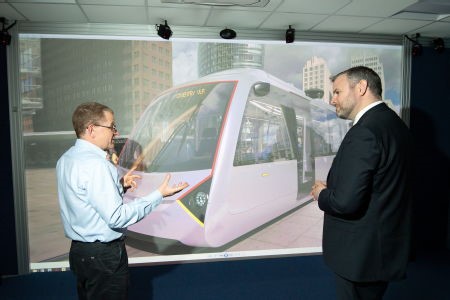 WMG, at the University of Warwick, has worked with partners, to create a new design of incredibly lightweight Very Light Rail (VLR) vehicle frame which is weaved, or braided, from carbon fibre composites into a series of tubes to create a first prototype demonstrator frame. Parliamentary Under Secretary of State and Minister for Business and Industry Andrew Stephenson became one of the very first people to see the new design, outside of the research partnership, on a visit to WMG on 16th May.
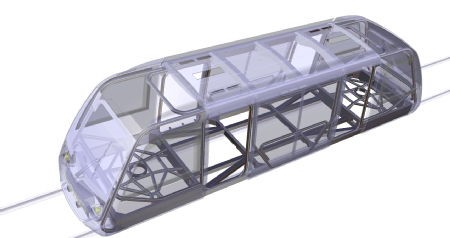 Working with the lightweight structural composite components company Far, and Transport Design International Ltd in Stratford upon Avon the demonstrator can be easily assembled by adhesive and simple welding.

Dr Darren Hughes Associate Professor in Materials and Manufacturing at WMG at the University of Warwick said:
“Our BRAINSTORM VLR research partnership has achieved significant weight-saving, allowing VLR services to accommodate more passengers while reducing the energy required to propel the vehicle and the weight stress it will place on its rails and road surface.”
“The technology also ensures that the vehicle is tough for a long life in service, easily repairable when accidents happen and strong enough to protect the passengers on board.”
The innovative highly efficient very light weight approach consists of an underlying tubular spaceframe chassis which provides the body shell. In the first demonstrator frame the partners have produced they were able to keep the beams the same outside diameter but their wall thickness is tailored to give the optimum performance depending on where it will be used. This keeps the tooling costs low and allows for all the joining to be standardised through a combination of welding and adhesive bonding.
If any significant damage is caused to any individual beam through an accidental impact each damaged beam can simply be entirely replaced with a new one. Best of all the thermoplastic material is inherently recyclable.
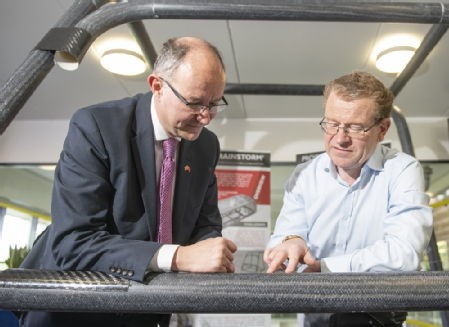 The whole moulding cycle has been shown to be capable of being reduced to less than five minutes, demonstrating the potential of this affordable process for high-volume applications. The braiding process is highly automated and with rates of over a mile a day of braided tubing.
This braiding method also allows for a wide range of materials to be used. Almost any fibres (carbon, glass and aramid) can be combined with a huge range of thermoplastics, from low cost Polypropylene to high end Polyether ether ketone (PEEK) to create a material that suits the given application
Lyndon Sanders Director and General Manager of Nottingham based lightweight structural composite components company Far said:
“The BRAINSTORM Project feels like a real step forward to the team at Far Composites. Being able to tap into the industry experience of TDI to hone the principle of a new type of body structure for mass transit applications was great. Add to that the collaborative working with Composites Braiding and WMG to turn that thinking into a physical demonstrator to show what it would be like in practice was really powerful. Now it’s more than a good idea, now it’s an eye opener for industry players who can see it, touch it and even pick it up.”
ENDS
20 MAY 2019
Note for Editors:
High-res images available, please credit The University of Warwick:
The design of the frame with some other sections attached
https://warwick.ac.uk/services/communications/medialibrary/images/april2019/frame-cb1-2.jpg

Dr Darren Hughes (right) showing Lyndon Sanders Director and General Manager of Far (left of picture) the braiding pattern on the frame
https://warwick.ac.uk/services/communications/medialibrary/images/april2019/train_2_jpeg.jpg

Dr Darren Hughes Associate Professor in Materials and Manufacturing at WMG at the University of Warwick (left) showing Parliamentary Under Secretary of State and Minister for Business and Industry Andrew Stephenson (right of picture) all the design stages of the VLR vehicle
https://warwick.ac.uk/services/communications/medialibrary/images/may2019/brainstorm_pic.jpg

The frame with less attached
https://warwick.ac.uk/services/communications/medialibrary/images/april2019/frame-cb5-1.jpg

Another view
https://warwick.ac.uk/services/communications/medialibrary/images/april2019/frame-cb2-1.jpg

A further view
https://warwick.ac.uk/services/communications/medialibrary/images/april2019/frame-cb9-1.jpg

The Full list of partners on the project are: WMG at the University of Warwick, the UK's Governments innovation agency Innovate UK, Far composites, Composite Braiding ,and Transport Design International Ltd in Stratford upon Avon
For further information please contact:
Alice Scott
Media Relations Manager – Science
University of Warwick
Tel: +44 (0) 2476 574 255 or +44 (0) 7920 531 221
E-mail: alice.j.scott@warwick.ac.uk
Andrew Stephenson makes his first official visit as Under Secretary of State at BEIS
Professor Dave Mullins, interim Head of WMG, was delighted to welcome Andrew Stephenson MP Parliamentary Under Secretary of State at the Department for Business, Energy and Industrial Strategy (BEIS) to WMG today (Thursday 16th May).
Andrew Stephenson MP was keen to hear more about our world-class research and meet the lead academics and research teams involved in collaborative R&D projects across the transport sector.
Andrew had a tour of a range of research facilities including our Energy Innovation Centre (EIC), National Automotive Innovation Centre (NAIC) and Centre for Imaging Metrology and Additive Technologies (CiMAT) facilities. He learned more about our battery technology, vehicle electrification projects, intelligent vehicles research and the Coventry Very Light Rail scheme.
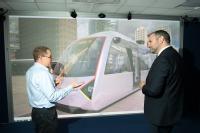
Professor Dave Mullins explained: “We are delighted to have hosted the first official visit of Andrew in his new role as the Under Secretary of State at BEIS and share with him how we are helping to deliver on the UK Government’s Industrial Strategy.”
Business and Industry Minister Andrew Stephenson said:
“The world-class research being delivered at WMG is evidence of our modern Industrial Strategy in action – driving innovation in applied science, technology and engineering to create good jobs and increase earning power.
“The West Midlands Local Industrial Strategy launched today - the first of its kind - is tailored to the specific challenges in the region, and sets an example for other regions to follow.”
The visit co-insided with the launch of the West Midlands Local Industrial Strategy, at the Advanced Propulsion Centre, on the University of Warwick campus. We’re honoured that West Midlands Combined Authority chose to dedicate the West Midlands Local Industrial Strategy to Professor Lord Bhattacharyya, founder of WMG. It is a poignant testament to Lord Bhattacharyya’s dedication to manufacturing, Coventry and to the West Midlands region.
Prior to the West Midlands Local Industrial Strategy launch, Andrew was at the UK Battery Industrialisation Centre site to announce a further £28m funding from the Industrial Strategy Challenge Fund for the development of the Centre. WMG, along with Coventry City Council and Coventry and Warwickshire Local Enterprise Partnership are leading the creation of this scale-up battery facility of the Faraday Battery Challenge.
Improving mental health in the workplace pilot is awarded £6.8m funding
 We are delighted to be partnering with project leads Coventry University and West Midlands Combined Authority (WMCA) in a major new mental health pilot.
The programme will involve the university co-leading a group of health professionals, academics and business leaders who have been awarded £6.8m by the Government to tackle poor mental health in the workplace.
At any one time, a sixth of the population in England aged 16 to 64 has a mental health problem¹, which costs employers between £33 billion and £42 billion a year in lost productivity².
Recognising the huge impact mental health issues have on employees’ wellbeing and employers’ productivity, the Midlands Engine Mental Health and Productivity Pilot has been created to break down the barriers to people suffering mental health problems and facilitate their return to work.
A partnership between the University of Warwick, Coventry University, West Midlands Combined Authority and supported by MIND, the pilot will be delivered by a multi-disciplinary group including:
- Seven universities in the West and East Midlands
- Occupational and clinical psychologists, psychiatrists, public health specialists, service delivery leaders, Public Health England and the NHS
- Small, medium and large businesses, policy makers, economists and nine Local Enterprise Partnerships (LEP) across the Midlands Engine region.
The collaborative approach and multi-channel engagement of all of the partners is essential for the pilot to complete a number of different work streams over the next three years.
The pilot will start by scoping data collection from health professionals and recruiting over 1,000 small, medium and large businesses to take part.
As the programme develops, measures will be employed that allow for the early identification of mental health problems, and provide a range of bespoke actions to provide support to those with difficulties and develop appropriate advisory mechanisms. The pilot will then deliver a model of how a mental health specialist can interface between businesses and mental health providers, as well as an online toolkit for mental health sufferers.
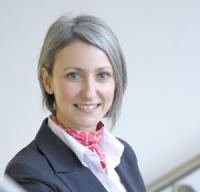 Professor Caroline Meyer, from WMG said: “I am delighted to be leading the University of Warwick arm of this Midlands Engine project. Working in close collaboration with our partners at Loughborough University and the Universities of Nottingham and Birmingham, we will gather and pilot interventions that we believe will make a huge difference to employees and employers across the whole region and further. A step change in activity is required to address poor mental health and help people to thrive at work.
“The workplace provides a unique opportunity to identify and support those people who might otherwise receive no intervention, as well as supporting those with existing problems. The result of this project will be tools that will enable us to do deliver these things.
Professor Guy Daly, Pro-Vice-Chancellor, Health and Life Sciences, said: “Over the next three years, the Midlands Engine Mental Health Productivity Pilot will engage with over 1,600 businesses, train 45,000 staff and offer a free online resource that aims to reach one million people.
“Together we will deliver a step change in the support offered to employers and employees, which will deliver better mental health, leading to higher levels of productivity across all types of organisations in the East and West Midlands.”
West Midlands Combined Authority (WMCA) Wellbeing Director Supt Sean Russell said: “We are delighted to have been given this opportunity to scale up our work and build on some of the existing Thrive initiatives which have been developing in the West Midlands over the last three years.
“We can also learn from the work undertaken by MIND nationally to promote a strong evidence-based delivery programme for the whole Midlands.”