
WMG News - Latest news from WMG
WMG partners with Triumph Motorcycles in electric motorcycle project
 Triumph Motorcycles has announced a new collaboration with UK industry experts, academic leaders including WMG at the University of Warwick, and Innovate UK, to develop specialist electric motorcycle technology which will provide significant input into potential future electric motorcycle offers from Triumph. This two-year project (TRIUMPH TE-1) also includes partnership work with Williams Advanced Engineering, and Integral Powertrain Ltd.
This new collaboration will combine Triumph’s globally-renowned motorcycle expertise with advanced automotive-based capabilities to generate technological innovation for future electric motorcycles.
“This new collaboration represents an exciting opportunity for Triumph and its partners to be leaders in the technology that will enable the electrification of motorcycles, which is driven by customers striving to reduce their environmental impact, combined with the desire for more economical transportation, and changing legislation,” said Nick Bloor, Triumph CEO. “Project Triumph TE-1 is one part of our electric motorcycle strategy, focused on delivering what riders want and expect from their Triumph, which is the perfect balance of handling, performance and usability.”
A unique collaboration between industry experts, academic leaders and Innovate UK
Project Triumph TE-1 now represents a ground-breaking collaboration between Triumph Motorcycles and the UK’s electrification experts, each of whom will create innovations in their own areas:
- Triumph Motorcycles will lead the project, providing advanced motorcycle chassis design and engineering expertise, manufacturing excellence and pioneering functional safety systems, as well as defining electric drivetrain power delivery characteristics.
- WMG, at the University of Warwick will provide electrification expertise, and the critical vision to drive innovation from R&D to commercial impact, through modelling and simulation based on future market needs.
- Williams Advanced Engineering will provide industry-leading lightweight battery design and integration capability, using its test and development facilities to deliver an innovative battery management system combined with vehicle control unit.
- Integral Powertrain Ltd’s e-Drive Division will lead the development of bespoke power-dense electric motors and a silicon carbide inverter, integrating both into a singular motor housing.
- Innovate UK, the government agency that promotes science and technology programmes expected to grow the UK economy, will support the partners and administer funds. This forms part of the BEIS modern funding strategy with the aim of creating a market-leading UK electric vehicle capability.
A two-year project focused on developing technical innovation and advanced electric motorcycle capabilities
The project will be organised into four main phases, with one of its key aims being increased systems integration. By developing individual components of automotive-based electric drivetrains and optimising them into innovative combined units, the project aims to deliver sophisticated electric motorcycle systems which reduce mass, complexity and package requirements.
Triumph Motorcycles will work alongside the partner organisations to accelerate joint expertise in the packaging and safety of batteries, optimum electric motor sizing and packaging, the integration of braking systems including regenerative braking, and advanced safety systems. The innovation and capabilities developed in these areas will input into Triumph’s future electric motorcycle strategy.
The Project Triumph TE-1 partnership, with the support of Innovate UK, is focused on facilitating the creation of:
- Electric motorcycle capability that meets the needs of customers seeking lower environmental impact transportation, delivering against the UK’s focus on reducing emissions
- Strong, commercially viable and sustainable partnerships with UK industry manufacturers and supply chains
- Expertise and capability within the UK workforce, creating jobs and a talent base that both ensures sustainable employment and drives the UK’s reputation and influence on the world stage.

Professor David Greenwood, Professor of Advanced Propulsion Systems at WMG, University of Warwick said: “Electric motorcycles will have a vital role to play in future transport across the globe - delivering reduced congestion and improved urban air quality as well as easing parking. They will also be great to ride, with copious, easily controlled torque delivered smoothly at all road speeds. WMG has experience of battery technology and vehicle electrification for road, rail, sea and air which it will bring to this exciting sector. Our expert team will lead the modelling and simulation work within the project, to ensure the vehicles are safe and efficient without compromise to dynamic performance.”
“The team at Williams Advanced Engineering is looking forward to applying our expertise in the electrification of transport with our partners,” said Craig Wilson, Managing Director of Williams Advanced Engineering. “Williams has powered a number of world-renowned electric vehicles already and this will be a significant further step in our work by taking that knowledge onto two wheels.”
“Integral Powertrain has always pushed the boundaries of e-drive technology working with clients to find the best solution to meet their exact requirements”, said Andrew Cross, Chief Technical Officer at Integral Powertrain Ltd. “This project will draw upon the extensive motor and EV experience gained over the past 20 years working with major OEMs and Tier 1 suppliers in the automotive and motorsport sectors. We are extremely pleased to be supporting Triumph Motorcycles with their future electrification strategy and in a project where we can apply our experience to engineer an extremely power dense, efficient and highly integrated motorcycle electric drive.”
Steve Sargent, Triumph’s Chief Product Officer said “Our future product strategy is focused on delivering the most suitable engine platforms for the changing landscape of customer needs, and we see a Triumph electric powertrain as a significant requirement alongside our signature twin and triple cylinder engines. As part of our electric motorcycle initiative, Project Triumph TE-1 represents an exciting collaboration that will provide valuable input into our future line-up. We are incredibly pleased to have the support of OLEV and Innovate UK, and to be working together with the UK’s electrification experts and academic leaders, in an endeavour that ultimately is focused on the future prosperity of British industry, and the future of motorcycling.”
New report tackles key issues for transport electrification
WMG has provided battery expertise and knowledge for a new report examining the UK Chemical Supply Chain for Battery Manufacture.
The report was launched last night with over 40 senior figures from across the Chemical, Battery and Automotive sectors along with Government officials in attendance.
The report, produced by E4 Tech, provides an in-depth assessment of the current capability to support the growth of a UK Battery Manufacturing Industry.
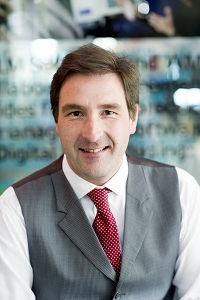 David Greenwood, Professor of Advanced Propulsion Systems at WMG explained: “Automotive batteries will halve in cost, double in energy density and see tenfold increases in manufacturing volumes before the end of the next decade. To do this we need advanced materials supplied in bulk and at very high quality. High value opportunities exist in cathode powders, anode powders, electrolytes, collector foils and separators, and the supply chain to provide them is in its infancy.”
Key findings
It is no secret that the UK ambition of the UK Government is to stimulate the supply chain so that the UK can attract a ‘Giga-factory’. This report engaged with those members of the supply chain who would support new production capacity.
Currently three fifths of a vehicle battery pack’s value is chemicals and materials. The report has found that the UK could capture a £4.8bn/year share of this by 2030. This is down to the strong foundation of UK-based companies already embedded within many global battery supply chains.
Through strategic Government support and collaboration between our Automotive and Chemical sector there is a real opportunity to expand these existing capabilities growing capacity to serve UK-built batteries as well as significant growth in exports, especially as EU battery production grows.
For battery cell manufacturing to be economically viable there is a need for local suppliers of many materials. However, the expectation is that battery chemistry will evolve over the next decade, so it is fundamental that the companies involved within this supply chain are primed for innovation and manufacturing investment. An increase in capability and capacity offers further export potential.
The Government has already invested £246M through the Faraday Battery Challenge which has delivered valuable assets like there UKBIC and provided invaluable opportunities for the chemical, battery and automotive sector to work together and learn from one another. In order to realise this 4.8bn supply chain opportunity, the Government will continue to have a critical role to play in supporting the strategic investments in the UK battery and battery materials sectors, whilst also continuing to provide targeted funding for CR&D that allows the UK chemical sector to co-develop battery technologies with its customers.
The full report can be found here
New forensic centre to support police investigating homicide
WMG at the University of Warwick has secured investment from West Midlands Police for the WMG Forensic Centre for Digital Scanning and 3D printing – a research hub supporting Homicide Investigation, where they can scan and reproduce 3D prints of injuries to bones to help in court testimonies.
The new WMG Forensic Centre for Digital Scanning and 3D printing – a research hub supporting Homicide Investigation has secured investment from West Midlands police to scan injuries and produce 3D print outs for use in expert testimonies.
The scans are 1000 times more detailed than hospital scans, and can detect microscopic injuries which could otherwise be missed by conventional medical CT scanners. 3D renderings are then produced of the injuries, and their age can be identified too. The renderings are used in court to during trials to provide visual context and support the Pathologist’s testimony.
Facilities at WMG, University of Warwick, have been used to provide expert witness testimony in over 100 Homicide cases by 13 different police forces across the UK. Cases include strangulation, stabbing, blunt force trauma and bone fractures.
A recent case study is the murder of 9-week-old baby Teri-Rae.
Researchers at WMG used the high resolution X-ray (micro-CT) scanner, to scan the toddler’s ribcage. They were able to detect microscopic injuries which could otherwise have been missed by medical CT scanners. The evidence produced helped reveal a total of eleven injuries of varying ages. 3D renderings of these injuries were shown during trial to support the bone specialist’s expert testimony.
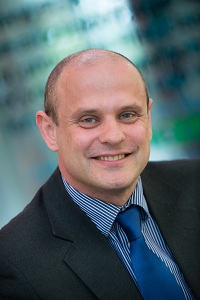 Professor Mark Williams of WMG comments:
“It is a real privilege to be able to support West Midlands Police and formalise our relationship through the establishment of a research centre. The opportunity to apply state-of-the technology to support Homicide investigation is very exciting.
"3D X-Ray scanners allowed us to identify multiple fractures to Teri-Rae’s ribs that had occurred over an extended period of time. The ability to produce highly detailed 3D images of these shocking injuries that could be presented at court helped establish the truth and show what had happened. It’s an honour for us to provide critical evidence in cases like this, and to be able to help the police investigate such an unfortunate tragedy.”
The technology itself has been used beyond the West Midlands, with police forces throughout the United Kingdom using the technology as part of their investigations.
Assistant Director Michelle Painter Head of Forensic Services for West Midlands Police comments:
“The strategic partnership with WMG has enabled police forensics to access state of the art technology to progress investigations. In addition to the homicide cases being delivered through the centre, we are pushing research boundaries; combining scientific skill, knowledge and history with innovative technology and presentation techniques.
“Additional PhD studies have commenced on dismemberment tools and we will soon be finalising further research projects including scanning fingerprint and footwear marks and assessing damaged digital devices for protected data sources. The research and partnership possibilities are endless and exciting!”
WMG technology has helped in previous cases, West Midlands Police Detective Superintendent Mark Payne comments:
“It’s a fantastic development in the field of forensics and, as we’ve proved in the few cases to date, can be crucial in helping us uncover the truth behind some of our most serious crimes.”
ENDS
30 APRIL 2019
NOTES TO EDITORS
Image available at:
https://warwick.ac.uk/services/communications/medialibrary/images/april2019/wmg_280219-89.jpg Caption: The scanning machine at WMG, University of Warwick. Credit to WMG, University of Warwick


Caption: Detective Superintendent Mark Payne (left) and Professor Mark Williams (right) at the facility. Credit: WMG, University of Warwick

Caption: Professor Mark Williams (left) and Detective Superintendent Mark Payne (right) look at a scan of a murder victim Credit: WMG, University of Warwick

Caption: Professor Mark Williams right shows Detective Superintendent Mark Payne (left) a 3d printed model of a murder victim’s Humerus Credit: WMG, University of Warwick
For further information please contact:
Alice Scott
Media Relations Manager – Science
University of Warwick
Tel: +44 (0) 2476 574 255 or +44 (0) 7920 531 221
E-mail: alice.j.scott@warwick.ac.uk
WMG welcomes Deputy CEO of NatWest Holdings
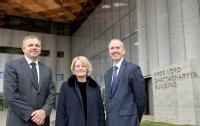 WMG was delighted to welcome Alison Rose, Deputy CEO of NatWest Holdings, to a special SME event at the Professor Lord Bhattacharyya Building at the University of Warwick.
Alison, and her colleague Richard Hill, Head of Automotive and Manufacturing at NatWest, joined CEO of WMG Centre High Value Manufacturing Catapult, Archie MacPherson to meet with a series of SMEs that NatWest and WMG are currently supporting on the ‘Create Test Launch’ (CTL) Programme.
The CTL Programme was launched in 2017, with WMG experts providing hands on advice and support with new product development.
The potential of the Programme was recognised by NatWest, who then partnered with WMG to subsidise ten clients through CTL.
At the event Alison, described as ‘the most influential woman in investment banking’, spoke with passion about the need to prioritise innovation in the boardroom and sparked a lively discussion. Key topics included the challenges of balancing operational pressures against the desire to innovate, the crucial role of good leadership, understanding the innovation process, and support for SMEs in an uncertain political and economic climate.
With 50,000 manufacturing clients nationally, NatWest is keen to promote innovation and leadership in industry. Following the visit, WMG will continue to work closely with NatWest to strengthen the UK manufacturing sector.
Dr Kogila Balakrishnan joins expert line-up at prestigious Chevening Conference
 Dr Kogila Balakrishnan Director of Client and Business Development at WMG, University of Warwick, Dr Kogila Balakrishnan, is on the expert panel on Friday (12th April) at the Chevening Conference 2019.

She joins senior academics from across the world, Chevening Alumni, and inspiring community leaders for Chevening’s 35th annual conference entitled ‘Pushing boundaries and shaping the future.’
Dr Balakrishnan, a Chevening Alumnus herself, will discuss, debate, and share ideas on pushing boundaries and the importance of building international networks, as well as those documented in her recent book ‘Technology Offsets in International Defence Procurement.’ The book is the first to focus on both the theory and practice of offsets, combining developmental economic theories, technology theories, business and management theories and international business practice.
Dr Balakrishnan is responsible for international business development, research in defence management and offsets as well as teaching at WMG. Her specific role is to develop and enhance education and research collaboration focused in Malaysia and South East Asia.
Find out more and book your place here.
PhD Students Gain Hands-On Battery Engineering Experience at WMG's Battery School
PhD students, and future battery engineers, from leading universities across the UK joined us for a special week-long Battery School at our Energy Innovation Centre, for the Faraday Institution, recently.
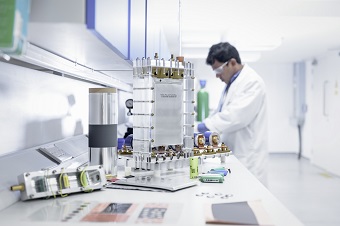 In our role as the Electrical Energy Storage APC Spoke, our battery experts facilitated a mix of lectures and practical sessions covering electrochemistry, applications, future technologies, manufacturing, safety, testing, forensics and battery end of life.
Fran Long, Education and Training Co-ordinator, at The Faraday Institution, said: “The WMG Battery School, at the University of Warwick, gave our PhD students a wonderful week of detailed theory and practice with an abundance of high quality lectures and ‘hands-on’ lab sessions.
“We would like to thank all of the WMG staff involved in making this such a valuable experience for the students. Encouraging the next generation of engineers into battery related careers, is extremely important for the UK’s electrification sector.”
The Faraday Institution is the UK’s independent institute for electrochemical energy storage science and technology, supporting research, training, and analysis. It brings together scientists and industry partners on research projects to reduce battery cost, weight, and volume; to improve performance and reliability; and to develop whole-life strategies from mining to recycling to second use.
The Battery School is part of the Faraday Battery Challenge, along with the UK Battery Industrialisation Centre (of which WMG was part of the winning consortium).
Find out more about our Energy Innovation Centre here.
High-resolution scanning helps secure guilty verdict against child’s mother
Researchers from WMG at The University of Warwick, have used a high resolution X-ray (micro-CT) scanner, a novel 3D imaging technology more commonly employed in industry and materials research, to scan 9 week old Teri-Rae’s rib cage.
The scans images with one thousand times of the detail of a hospital scanner, meaning they were able to detect 2 more microscopic injuries which could otherwise have been missed by conventional medical CT scanners.
The evidence produced helped reveal a total of ten injuries of varying ages. 3D renderings of these injuries were shown during trial to provide visual context and support the bone specialist’s expert testimony.
This secured a guilty verdict for the charge of manslaughter for Teri-Rae’s mother Abigail Palmer, who has been sentenced today - 4th April 2019.
The work was conducted as part of an ongoing research partnership between Warwick University and West Midlands Police which uses such scanning technologies to support homicide investigations.
Professor Mark Williams of WMG at the University of Warwick comments:
“State-of-the-art 3D scanning technology allowed us to identify multiple fractures to Teri-Rae’s ribs that had occurred over an extended period of time.
“The ability to produce highly detailed 3D images of these shocking injuries that could be presented at court helped establish the truth and show what had happened. It’s an honour for us to provide critical evidence to this case, and to be able to help the police investigate such an unfortunate tragedy.”
West Midlands Police Sergeant Mick Byron from the Child Abuse Investigation Team, comments:
“We were able to show that Teri-Rae suffered 10 rib fractures over a four to 12 hour period between 3am and 11am on 2 January.
“Palmer had been at a pub for six hours on New Year’s Day but claimed to have drank mainly squash, not alcohol, as that would have breached a condition of the Child Protection Plan she was bound by.
“We don’t believe her… and neither did the jury. We suspect she came home drunk, was awoken by her baby in the night and inflicted these terrible images in response to Teri-Rae’s crying.
“Palmer admitted the baby was never out of her sight and never mishandled by anyone else; she offered no plausible accidental explanation for her daughter’s injuries. There was no indication Teri-Rae suffered a bone fragility condition and she was not independently mobile enough to have injured herself.
“Significant force is required to cause rib fractures in a baby… the presence of rib fractures in a baby of this age is indicative of abusive, deliberately inflicted, injury. This was a truly heart-breaking case to investigate, that a little baby’s life was taken by the one person who should have been protecting her.”
New technique to make transparent polythene films as strong as aluminium that could be used in impact resistant glazing, windscreens, and displays
Research led by Professor Ton Peijs of WMG at the University of Warwick and Professor Cees Bastiaansen at Queen Mary University of London, has devised a processing technique that can create transparent polythene film that can be stronger as aluminium but at a fraction of the weight, and which could be used use in glazing, windscreens, visors and displays in ways that add strength and resilience while reducing weight.
In a new research paper entitled “Glass-like transparent high strength polyethylene films by tuning drawing temperature.” Published online today - 1st April 2019 - in the Journal Polymer, the authors show that after carefully selecting the type polythene and by tuning the temperature during the creation of oriented polythene films a balance can be created that produces a highly useful and lightweight transparent material with a significant strength and resilience approaching, and in some ways, exceeding that of metals.
Previously anyone looking to replace heavy and often brittle glasses with a transparent plastic have looked at conventional transparent plastics like polycarbonate (PC) and poly(methylmethacrylate) (PMMA) both of which possess relatively unsatisfactory mechanical performance compared to an engineering material like aluminium.
Current methods of creating high strength plastic films such as hot-drawing of high-density polyethylene (HDPE) can lead to materials that can compete or even out-perform traditional engineering materials like metals.
“The microstructure of polymers before drawing very much resembles that of a bowl of cooked spaghetti or noodles, while after stretching or drawing the molecules become aligned in a way similar to that of uncooked spaghetti, meaning that they can carry more load” explains Yunyin Lin, a PhD student in Professors Peijs and Bastiaansen’s team.
However, drawn polythene materials normally have an opaque appearance due to defects and voids introduced by the drawing process, limiting applications where both mechanical properties and optical transparency are required.
Some success has recently been achieved by using highly specific additives in hot-drawn HDPE materials that can then produce 90% transparency while giving high strength. However, the research team led by Professors Peijs and Bastiaansen have now developed a new post-manufacturing technique for HDPE that endows strength and resilience while preserving transparency without using additives.
The researchers took HDPE polythene sheets and drew out these sheets at a range of temperatures below the melting temperature of HDPE. By tuning the drawing temperature they could achieve a transparency of 90% in the visible range. However, the best balance between strength and transparency was achieved at drawing temperatures between 90 and 110 degrees centigrade.
Professor Ton Peijs of WMG at the University of Warwick said:
“We expect greater polymer chain mobility at these high drawing temperatures to be responsible for creating fewer defects in the drawn films, resulting in less light scattering by defects and therefore a higher clarity”
The highly transparent films possess a maximum resilience or Young’s Modulus of 27 GPa and a maximum tensile strength of 800 MPa along the drawing direction, both of which are more than 10 times higher than those of PC and PMMA plastics. For comparison, aluminium has a Young’s Modulus of 69 GPa and aerospace grade aluminium alloy can have tensile strengths up to around 500 MPa. However, polythene has a density of less than 1000 kg/m3 while aluminium has a density of around 2700 kg/m3, meaning that on weight basis these high strength transparent polymer films can outperform such metals.
Professor Ton Peijs in WMG at the University of Warwick concludes that:
“Our results showed that a wide processing window ranging from 90 °C to 110 °C can be used to tailor the required balance between optical and mechanical performance. It is anticipated that these lightweight, low-cost, highly transparent, high strength and high stiffness HDPE films can be used in laminates and laminated composites, replacing or strengthening traditional inorganic or polymeric glass for applications in automotive glazing, buildings, windshields, visors, displays etc.”
Coventry Cathedral hosts family, friends, and leading figures from business, politics, & education in service of thanksgiving for the life of Professor Lord Bhattacharyya
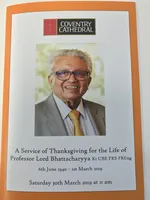 At 11am on Saturday 30th of March 2019, Coventry Cathedral enabled hundreds of people to gather for a special service of thanksgiving for the life of Freeman of the City of Coventry and Founding Chairman of WMG, at the University of Warwick, Professor Lord Bhattacharyya CBE FRS FREng (Born 6th June 1940 – Died 1st March 2019).
The Right Reverend Dr Christopher Cocksworth, the Bishop of Coventry, and Coventry Cathedral Precentor and Sub-Dean the Reverend Canon David Stone welcomed Lady Bridie Bhattacharyya, Lord and Lady Bhattacharyya’s three daughters Anita, Tina and Malini, and the Lord-Lieutenant for the West Midlands and his wife Mrs Diana Crabtree, and Lord and Lady Mayoress of Coventry, as well as the rest of the congregation to the Cathedral.
The Bishop gave the address from the pulpit and the service included a number of touching tributes to the life of Professor Lord Bhattacharyya. These were led by a tribute by Miss Tina Bhattacharyya, on behalf of the family.
Other tributes were given by:
- Former Prime Minister, The Right Honourable Gordon Brown
- Councillor Abdul Khan, Deputy Leader of Coventry City Council
- Mr Ratan Tata GBE, Chairman Emeritus of Tata Sons, and Chairman of Tata Trusts. (Ratan Tata and Professor Lord Bhattacharyya were both made Honorary Freemen of the City of Coventry at the same ceremony in 2015).
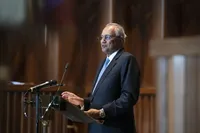
- Mr Venu Srinivasan, Chairman and Managing Director, TVS Motor Company
- The Right Honourable the Lord Baker of Dorking CH PC, Chairman of the Baker Dearing Educational Trust, and former Home Secretary and Secretary of State for Education
- Mr Chandrajit Banerjee, Director General of the Confederation of Indian Industry
- Dr John Ferrie CBE FREng, Member of the Council of the University of Warwick
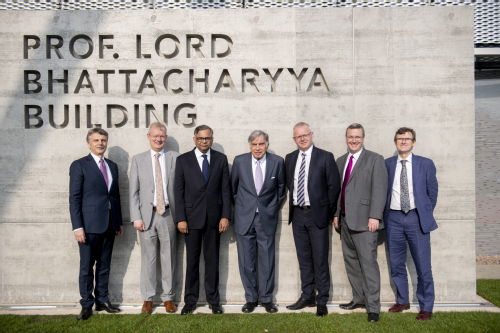
Later, that same day, the University of Warwick formally unveiled a plinth outside the new £150 million building on the University campus hosting the National  Automotive Innovation Centre, which now proudly bears the name “The Prof. Lord Bhattacharyya Building”.
Further information:
- Lord Bhattacharyya’s family and the University of Warwick would like to thank the Bishop of Coventry, Coventry Cathedral, Coventry City Council, the West Midlands Combined Authority, and National Express West Midlands for their help in arranging the service of thanksgiving.
- There have been a great many tributes made by a wide range of leading figures to the life of Professor Lord Bhattacharyya since his passing on 1st March 2019.
You can see many of those tributes here: https://warwick.ac.uk/fac/sci/wmg/about/chairman/obituary/tributes/ and you can find an obituary published by WMG and the University here https://warwick.ac.uk/fac/sci/wmg/about/chairman/obituary/ - The following charity donation page for the National Society for the Prevention of Cruelty to Children has been set up for those who would like to make a contribution in memory of Lord Bhattacharyya: www.justgiving.com/fundraising/professorlordkumarbhattacharyya
- Lord Bhattacharyya served for four decades at Warwick, founding and leading the WMG. To commemorate his life's work, The Professor Lord Bhattacharyya Memorial Fund will create opportunities for young people to thrive, by supporting projects he was passionate about. It will provide funds to enrich the experiences of students at the University of Warwick and the two WMG Academies he was so proud of. In this way, he will continue to play a role in shaping how young people develop the practical and problem solving skills that transform their lives and have a lasting impact on the local and global economy. To contribute to the fund please visit www.warwick.ac.uk/BhattacharyyaFund
Earliest known Mariner’s Astrolabe research published today to go in Guinness Book of Records
Guinness World Records have independently certified an astrolabe excavated from the wreck site of a Portuguese Armada Ship that was part of Vasco da Gama’s second voyage to India in 1502-1503 as the oldest in the world, and have separately certified a ship’s bell (dated 1498) recovered from the same wreck site also as the oldest in the world.
A gunmetal disc excavated from the wreck site of a Portuguese Armada Ship and identified as a mariner’s astrolabe – and the earliest known example - by engineers at WMG, University of Warwick is to be published in the The International Journal of Nautical Archaeology
The astrolabe was discovered by David L. Mearns of Blue Water Recoveries Ltd, who directed the three-year archaeological project in collaboration with Oman’s Ministry of Heritage and Culture
It has been named the Sodré astrolabe after the commander of the ship in which it was found: Vicente Sodré was the maternal uncle of Vasco da Gama and died when his ship, the Esmeralda, wrecked on the remote Omani Island of Al Hallaniyah in 1503.
It will be listed in the Guinness Book of World Records as the oldest mariner’s astrolabe from as early as 1496
The scientific process of verifying the disc as an astrolabe by laser imaging is described in a paper published today by Mearns and Jason Warnett and Mark Williams of WMG at the University of Warwick in The International Journal of Nautical Archaeology.
The Sodré astrolabe which has made it into the Guinness Book of World Records is believed to have been made between 1496 and 1501 and is unique in comparison to all other mariner’s astrolabes.
Mariner’s Astrolabes were used for navigating at sea by early explorers, most notably the Portuguese and Spanish.
They are considered to be the rarest and most prized of artefacts to be found on ancient shipwrecks and only 104 examples are known to exist in the world.
They were first used at sea on a Portuguese voyage down the west coast of Africa in 1481. Thereafter, astrolabes were relied on for navigation during the most important explorations of the late 15th century, including those led by Bartolomeu Dias, Christopher Columbus and Vasco da Gama.
It is the only solid disk type astrolabe with a verifiable provenance and the only specimen decorated with a national symbol: the royal coat of arms of Portugal.
As the earliest verifiable mariner’s astrolabe it fills a chronological gap in the development of these iconic instruments and is believed to be a transitional instrument between the classic planispheric astrolabe and the open-wheel type astrolabe that came into use sometime before 1517.
The thin 175 mm diameter disk weighing 344 grams was analysed by a team from WMG who travelled to Muscat, Oman in November 2016 to collect laser scans of a selection of the most important artefacts recovered from the wreck site.
Using a portable 7-axis Nikon laser scanner, capable of collecting over 50,000 points per second at an accuracy of 60 microns, a 3D virtual model of the artefact was created. Analysis of the results revealed a series of 18 scale marks spaced at uniform intervals along the limb of the disk.
Further analysis by WMG engineers showed that the spacing of the scale marks was equivalent to 5-degree intervals. This was critical evidence that allowed independent experts at Texas A&M University to include the disk in their global inventory as the earliest known mariner’s astrolabe discovered to date.
Prof Mark Williams from WMG, University of Warwick comments:
“Using this 3D scanning technology has enabled us to confirm the identity of the earliest known astrolabe, from this historians and scientists can determine more about history and how ships navigated.
Technology like this betters our understanding of how the disc would have worked back in the 15th century. Using technology normally applied within engineering projects to help shed insight into such a valuable artefact was a real privilege”
David Mearns of Blue Water Recoveries Ltd comments:
“Without the laser scanning work performed by WMG we would never have known that the scale marks, which were invisible to the naked eye, existed. Their analysis proved beyond doubt that the disk was a mariner’s astrolabe. This has allowed us to confidently place the Sodré astrolabe in its correct chronological position and propose it to be an important transitional instrument.”