
WMG News - Latest news from WMG
Students wanted to help develop new Master’s module
 We’re on the lookout for three local students to help develop our new Play: Pedagogy Theory and Practice module, ready for launch in September 2018.
Mairi Macintyre, the Principal Teaching Fellow leading the programme explains: “With our colleagues at Warwick Business School and the Learning and Development Centre, we successfully applied for funding from the Institute for Advanced Teaching and Learning (IATL) at Warwick to develop the new module in a partnership with Design Museum London and Royal Holloway University of London plus international colleague at Leiden University in the Netherlands and Monash University in Melbourne, Australia.”
“We’ve now set up a special steering group with all the partners, and are looking to recruit three creative students to join us to help bring the module to life. Students will be paid for their time and will need to commit half a day a week for a 10 week period. Depending on our progress it may also lead to a summer internship.
“Play is, all too often, best viewed as ‘just for kids,’ but it has a big part to play in higher education too. Its theoretical home lies somewhere between philosophical and pedagogical and its application spans all disciplines. If we can successfully develop it for higher education it can be transferred into industry driving creativity and innovation.”
Young engineers build own electric kit car with WMG
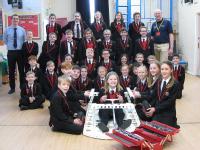 WMG at the University of Warwick will be lending a hand to budding young engineers from The Richard Crosse C of E Primary School in Kings Bromley, Staffordshire, in their quest to build and race their very own electric kit car.
Class five at Richard Crosse won a competition run by the Advanced Propulsion Centre (APC) to become one of eight schools presented with a Greenpower Goblin kit car.
Each winning school is partnered with an APC Spoke - in this case WMG, who will offer guidance and support to the students.
The children, aged 9-11, have been given an electric kit car to design, build and race - guided by their teachers and WMG mentors. Once complete, the children will compete against each other in a regional Greenpower IET Formula Goblin race in summer 2018.
Formula Goblin has been set up with help from the Greenpower Education Trust to address the skills gap that is growing in the UK automotive industry by engaging students in engineering at a young age. It is designed to engage students with maths, science and design technology in a fun way, promoting equality regardless of economic background and gender.
3D printing helps carve out Christmas treat
 A Coventry firm has turned to 3D engineering experts from WMG to help create a new range of unique biscuit treats – Mug Huggers – that sit on the side of a mug.
Arden Fine Foods, a Tile Hill-based firm specialising in sweet and savoury bakery products, were keen on producing the creatively shaped biscuit, but to achieve this vision they needed to engineer a unique shape to cut the biscuit dough.
The challenge required employing a flexible process that could easily be altered when minor shape changes were needed – allowing for design freedom and efficient tool manufacture.
WMG researchers used 3D printing, design and additive layer manufacturing capabilities, to help explore new designs and create dough cutters that were used to trial a number of different biscuit shapes, allowing the company to achieve the perfect shape before investing in a drum to fit onto the dough-depositing machine.
WMG receives prestigious automotive accolade
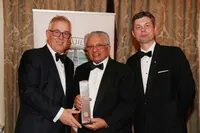 Our Chairman and Founder, Professor Lord Bhattacharyya, was honoured to receive a Special Commendation for WMG’s Contribution to Motoring, at The Guild of Motoring Writers’ annual dinner and awards last night.
The award was in recognition of our significant contribution to the automotive industry. The Guild of Motoring Writers' annual awards are arguably the most prestigious in automotive media. Whilst many of the awards focus on outstanding contributions from journalists there are also special awards for outstanding new competitors in motorsport, as well as for those who have made special contributions to motoring in Britain.
A full list of winners can be found here.
Greg Clark announces £80 million funding for Coventry, Warwickshire and University of Warwick partnership to create new national battery facility
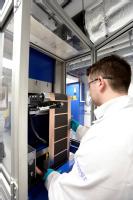 A partnership between WMG, at the University of Warwick, Coventry and Warwickshire Local Enterprise Partnership, and Coventry City Council has been awarded £80 million to establish a new National Battery Manufacturing Development Facility (NBMDF). The announcement was made by The Rt Hon Greg Clark, Secretary of State for Business, Energy and Industrial Strategy, while attending an energy conference on the University of Warwick campus on Wednesday 29th November 2017.
The new national facility will be established in the Coventry and Warwickshire area by WMG, the Coventry and Warwickshire LEP and Coventry City Council and it will enable UK based companies and researchers to come together to build and maintain a world leading position in manufacturing technologies for batteries and their components in vehicles and transportation. It will provide a crucial new strategic link between the research, development and full-scale industrialisation for battery technologies across the UK.
It will enable effective partnerships between manufacturers, researchers, and economic development leaders, while remaining independent from commercial interests and it will be governed with transparency.
PhD student scoops top young engineer award
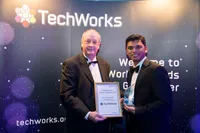 One of our PhD students, Siddartha Khastgir, has been declared the UK’s leading engineer under 30 at last night’s TechWorks Awards.
The awards celebrate the year’s key electronics innovations, people and companies from across the UK and Ireland. While these are the inaugural TechWorks Awards, they follow on from the NMI Awards, which ran from 2001 to 2016.
Siddartha was presented with his award by the BBC’s technology correspondent, Rory Cellan-Jones, who said the “quality of the field was outstanding.
“Siddartha’s personal skill set, work effort and initiative are making a big difference to WMG. Whilst still at an early stage in his career, he is already recognised widely, and internationally.”
Supporting the steel industry at WMG
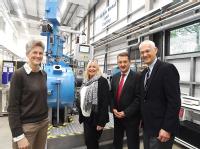 Businesses of all sizes in Coventry and Warwickshire can take advantage of a state-of-the-art facility to develop the next generation of lightweight steel products.
WMG (Warwick Manufacturing Group) at the University of Warwick has created a cutting-edge research, design and skills infrastructure zone in its Advanced Manufacturing and Materials Centre.
Its work is focused on supporting the development of new lightweight steel products as well as building an environment to develop the next generation of experts in this specialist field and can be accessed by SMEs as well as global businesses.
The three-year project has received £1 million of funding from the Government’s Local Growth Fund through the Coventry and Warwickshire Local Enterprise Partnership (CWLEP) to buy key R&D equipment and a further £1 million from WMG which includes industry funding.
WMG joins new £1.3 million vehicle battery recycling project
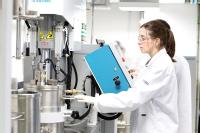 WMG, at the University of Warwick has joined a £1.3 million project with Connected Energy, Jaguar Land Rover and Videre Global to establish key components of a world leading second life battery value chain. The project is co-funded by an Innovate UK grant, awarded in October.
Connected Energy, a pioneer in site-integrated energy storage solutions, is based in Newcastle upon Tyne with a technical centre near Norwich. Its British designed E-STOR energy storage technology will be adapted to integrate recycled Jaguar Land Rover batteries, with other work to be undertaken by WMG on the use of varied second life battery modules. This innovative approach will further increase Connected Energy's knowledge base and performance of their E-STOR systems.
Reuse of electric vehicle batteries is compelling circular economy innovation. Second life enables greater exploitation of the carbon and energy embedded in the manufacturing of the batteries, adding to the sustainability credentials of electric vehicles as well as the electricity system. Using second life batteries also reduces system costs - making energy storage systems financially viable for a wider range of end users.
WMG at the University of Warwick is the academic research partner to the project. It is a department of the University of Warwick, and has a considerable reputation for energy storage research.
Queen’s wedding cake resurrected with scanning tech for 70th Anniversary
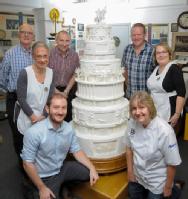 Cutting-edge technology has brought Queen Elizabeth II’s wedding cake back to life in time for hers and Prince Philip’s 70th anniversary, thanks to research by WMG at the University of Warwick.
Professor Mark Williams at WMG, alongside the British Sugarcraft Guild (BSG), employed 3D scanning technology to recreate a full-sized replica of a cake presented to the royal couple on their wedding day in November 1947 – which was almost totally destroyed by vandals in 2015.
The technology was able to accurately scan the cake to within 0.1mm and reproduce a high-resolution 3D model that was then be used to digitally repair the cake.
Analysing the surviving parts of the cake – an intricate 6ft ensemble, consisting of 6 tiers – Professor Williams was able to discover exactly how it was formed, and to determine precisely how to restore its original grandeur.
There were elaborate pictorial panels on each tier of the cake, the moulds of which had been lost through the decades. However, WMG’s engineering technology recreated these images from the wedding cake, and produced new silicone moulds through 3D scanning.
WMG software powers next generation intelligent JCBs
I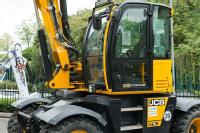 ntelligent construction machines which are more fuel-efficient and environmentally friendly are set to enter the market, thanks to pioneering software developed by WMG, at the University of Warwick, and JCB.
The software was created as part of the Off-Highway Intelligent Power Management (OHIPM) project – a collaboration between JCB, WMG and Pektron, part-funded by Innovate UK - which sought to create the next generation of JCB vehicles.
Wanting to produce machines which emit fewer CO2 emissions, and to maintain their business performance in a changing market, JCB enlisted the world-class expertise of Dr James Marco from WMG’s energy team.
Dr Marco’s team analysed huge amounts of JCB data to establish which parts of the machine fleet could be most effectively optimised through intelligent power solutions, and how to benefit JCB’s diverse range of customers around the world.
The team at WMG then created the control software to operate intelligent engines with automotive powertrain technology, enabling them to sense when the machines are idle and make the decision to switch themselves off (or power down) when power is not required – leading to optimal energy efficiency and minimal pollution.