
Biological Sciences MBio (UCAS C1A1)
Discover more about our Biological Sciences MBio at Warwick
Biological Sciences is the study of biology in its broadest sense – from the smallest molecules to large populations. Of the four degree courses taught by the School of Life Sciences, this is our widest ranging and most flexible degree in terms of module choice. You will study the molecules and cells that are the basis of life, through to biology of organisms (animals, plants, bacteria and viruses) and populations (evolution, epidemiology of disease, ecosystems).
This course is accredited by the Royal Society of Biology (RSB).
A level typical offer
AAA including Biology, or AAB including Biology and one of the following: Chemistry, Maths, Physics, Environmental Science, Statistics, Geology or Geography.
A level additional information
Applicants who are not taking Chemistry at A Level must have grade B/6 in GCSE Chemistry or grades BB/66 in GCSE Combined Science.
A level contextual offer
We welcome applications from candidates who meet the contextual eligibility criteria and whose predicted grades are close to, or slightly below, the contextual offer level. The typical contextual offer is AAB including Biology, or ABB including Biology and one of the following: Chemistry, Maths, Physics, Environmental Science, Statistics, Geology or Geography. See if you're eligible.
General GCSE requirements
Unless specified differently above, you will also need a minimum of GCSE grade 4 or C (or an equivalent qualification) in English Language and either Mathematics or a Science subject. Find out more about our entry requirements and the qualifications we accept.
We advise that you also check the English Language requirements for your course which may specify a higher GCSE English requirement. Please find the information about this below.
IB typical offer
36 to include 5 in Higher Level Biology, or 34 to include 5 in Higher Level Biology and 5 in Higher Level Chemistry, Physics, Maths or Geography.
IB additional information
Applicants who are not taking Higher Level or Standard Level Chemistry must have grade B/6 in GCSE Chemistry or grades BB/66 in GCSE Combined Science. Alternatively, we can consider Science in the IB Middle Years Programme.
IB contextual offer
We welcome applications from candidates who meet the contextual eligibility criteria and whose predicted grades are close to, or slightly below, the contextual offer level. The typical contextual offer is 34 including 5 in Higher Level Biology, or 32 including 5 in Higher Level Biology and 5 in Higher Level Chemistry, Physics, Maths or Geography. See if you're eligible.
General GCSE requirements
Unless specified differently above, you will also need a minimum of GCSE grade 4 or C (or an equivalent qualification) in English Language and either Mathematics or a Science subject. Find out more about our entry requirements and the qualifications we accept.
We advise that you also check the English Language requirements for your course which may specify a higher GCSE English requirement. Please find the information about this below.
We welcome applications from students taking BTECs as long as essential subject requirements are met. We are happy to consider applicants who are studying BTECs alongside A Level Biology. We are also happy to consider applicants who have taken the BTEC Level 3 National Extended Diploma in Applied Science on an individual basis.
General GCSE requirements
Unless specified differently above, you will also need a minimum of GCSE grade 4 or C (or an equivalent qualification) in English Language and either Mathematics or a Science subject. Find out more about our entry requirements and the qualifications we accept.
We advise that you also check the English Language requirements for your course which may specify a higher GCSE English requirement. Please find the information about this below.
International qualifications header International qualifications standard dropdown
Language requirements header Language standard block
FAQs
Our Biological Sciences course spans the entire scale of biological systems, from molecules to ecosystems. Our exceptionally wide range of options allow you to choose modules that are best suited to your interests and career ambitions.
You will be exposed to cutting-edge research in molecular, cellular and whole organism biology, while covering applications of science to major global challenges such as environmental management, food security and human health.
Our four-year MBio gives you the opportunity to undertake an extended final-year research project in-house.
Important information
Please note that we are planning to make some exciting changes to our Biological Sciences MBio degree for 2023 entry. We continually review our curricula to reflect developments in the relevant disciplines to deliver the best educational experience. The core and optional modules will undergo approval through the University's rigorous academic processes. As modules are approved, we will update the course information on this webpage and send offer holders an updated Course Material Information document via email. It is very important that you check this carefully prior to accepting an offer.
A core syllabus is offered in the first year for all degree courses providing the essential foundations in biology, biochemistry, genetics and chemistry. The same content in the first year means that it is often possible to transfer between the different degrees at the end of the first year. Core and optional modules in the second and third years allow students to tailor their degree.
All modules are core in the first year with optional modules in year two and three with the fourth year comprising of an Extended Research Project and Research Skills (training in advanced laboratory techniques, data handling and statistical analyses, critical analysis of the literature and designing research proposals).
Important information
Please note that we are planning to make some exciting changes to our Biological Sciences MBio degree for 2023 entry. We continually review our curricula to reflect developments in the relevant disciplines to deliver the best educational experience. The core and optional modules will undergo approval through the University's rigorous academic processes. As modules are approved, we will update the course information on this webpage and send offer holders an updated Course Material Information document via email. It is very important that you check this carefully prior to accepting an offer.
Year One
Molecules, Cells and Organisms
You'll study this module as the essential foundation for most other modules taught in the School of Life Sciences. You'll gain the basic knowledge you need of molecular and cellular aspects of biology, and also become familiar with whole-organism and developmental biology, in the context of evolution.
Read more about the Molecules, Cells and Organisms moduleLink opens in a new window, including the methods of teaching and assessment (content applies to 2021/22 year of study).
Animal and Plant Biology
Drawing on zoology and botany, on this module you'll broaden your biological knowledge to support your learning on second-year modules. By analysing and studying our current understanding of animal and plant evolution, diversity and physiological activities, you'll be able to integrate your organismal and molecular knowledge in a broad, evolutionary context. You'll also have opportunities to practise your skills in presentation and communication.
Read more about the Animal and Plant Biology moduleLink opens in a new window, including the methods of teaching and assessment (content applies to 2021/22 year of study).
Agents of Infectious Disease
You will start by gaining a thorough foundation in microbiology and virology, using infectious diseases as a common link to promote your understanding. Through your study of epidemiology, you will learn to appreciate the way that diseases spread and the methods used to investigate this spread. On completion, you can expect to understand the role of various structures associated with the bacterial cell in causing a range of diseases, and appreciate the structure of viruses and how this relates to their capacity to cause disease and the host response to viral challenge. This will equip you with the necessary theoretical foundations to underpin your future studies.
Read more about the Agents of Infectious Disease moduleLink opens in a new window, including the methods of teaching and assessment (content applies to 2021/22 year of study).
Physiology and Metabolism
On this module, you will learn how parts of the body function and work together in the whole organism. You will study the physiology of the nervous system, cardiovascular system, respiratory system and special senses. Your study of metabolism will help you to understand the generation of energy within the body, anabolism, the role of enzymes, and specific functions such as glycolysis, the citric acid cycle, pentose phosphate pathway and photosynthesis. You will then combine your learning to gain a thorough understanding of the way the body adapts to environmental conditions such as altitude, depth, cold and heat.
Read more about the Physiology and Metabolism moduleLink opens in a new window, including the methods of teaching and assessment (content applies to 2021/22 year of study).
Environmental Biology
On this module, you will gain foundational knowledge in the study of the natural and managed environment and start to understand the pressures on the planet that result from anthropogenic activities. You will also look in more depth at how society responds to the challenges posed by environmental change.
Read more about the Environmental Biology moduleLink opens in a new window, including the methods of teaching and assessment (content applies to 2021/22 year of study).
Quantitative Skills for Biology
All biological scientists need to understand and analyse quantitative data. So, this module will see you learning to use statistical methods for analysing and summarising experimental data (for example, from your lab classes), and learning the basic principles for modelling biological populations.
Read more about the Quantitative Skills for Biology moduleLink opens in a new window, including the methods of teaching and assessment (content applies to 2021/22 year of study).
Tutorials and Laboratories
Chemistry for Biologists - compulsory for entrants without A2 level Chemistry Tutorials and Laboratories
Year Two
Molecular Cell Biology
On this module, you will gain a sound knowledge of the organisation, complexity and essential processes that occur in the genomes and information-processing mechanisms in all three domains of life. You will study the molecular biology that underlies fundamental cellular processes, including the cytoskeleton in cellular structure, function and motility, the mechanisms that control cell proliferation and genome stability, protein processing in secretory pathway organelles, and programmed cell death in eukaryotic cells.
Read more about the Molecular Cell Biology moduleLink opens in a new window, including the methods of teaching and assessment (content applies to 2021/22 year of study).
Plant Molecular Development
You will discover the complexity of the eukaryotic cell and its subcellular compartments. You will gain an overview of cell division and its underlying control process, the cell cycle, and how this responds to growth signals and death signals, resulting in cell proliferation and programmed cell death respectively.
Read more about the Plant Molecular Development moduleLink opens in a new window, including the methods of teaching and assessment (content applies to 2021/22 year of study).
Genetics and Genomics
This module introduces concepts and techniques in genetics and genomics that are used to understand and manipulate complex traits. It includes hands-on workshops.
Read more about the Genetics and Genomics moduleLink opens in a new window, including the methods of teaching and assessment (content applies to 2021/22 year of study).
Ecology Principles and Processes
This module is designed to give an overview of ecological principles and processes to aid an understanding of the natural world, and to provide a foundation for later studies for students with a special interest in environmental studies.
Read more about the Ecology Principles and Processes moduleLink opens in a new window, including the methods of teaching and assessment (content applies to 2021/22 year of study).
Biological Oceanography
You will be introduced to the major marine habitats, the ecologically significant groups of organisms, and the biological processes in the oceans that play a crucial role in regulating the global fluxes of major elements. You will examine how anthropogenic influences are influencing the marine environment and, thereby, the climate.
Read more about the Biological Oceanography moduleLink opens in a new window, including the methods of teaching and assessment (content applies to 2021/22 year of study).
Evolution
An introduction to modern evolutionary theory, population and evolutionary genetics in order to understand the fundamental processes and the genetic make-up of populations.
Read more about Evolution this moduleLink opens in a new window, including the methods of teaching and assessment (content applies to 2021/22 year of study).
Year Three
Tutorials and Research Project
Year Four
Research Skills Training
In this module you will receive training in practical lab skills, data analysis, and research proposal writing and evaluation. You will also take part in a number of journal club sessions, reading and discussing scientific literature.
Read more about the Research Skills Training moduleLink opens in a new window, including the methods of teaching and assessment (content applies to 2021/22 year of study).
Extended Research Project
You will carry out a research project, supervised by an academic on an area that interests you, between late October and April. This forms the main component of year four.
Read more about the Extended Research Project moduleLink opens in a new window, including the methods of teaching and assessment (content applies to 2021/22 year of study).
Optional module header
Optional modules can vary from year to year. Example optional modules may include:
- Extreme Environment Biology
- Immunology
- Pharmacology
- Oncology
- Biological Clocks
- Integrative Neuroscience
- Interdisciplinary and Business modules
- One World Health and Neglected Tropical Diseases
- Introduction to Secondary Teaching in Biology
Approximately 35% of marks will be assessed by course work throughout the degree.
The final degree classification is determined by Year One (6%), Year Two (18%), Year Three (36%) and your final year (40%).
Students learn through a combination of tutorials, lectures, laboratory work, and independent and group research.
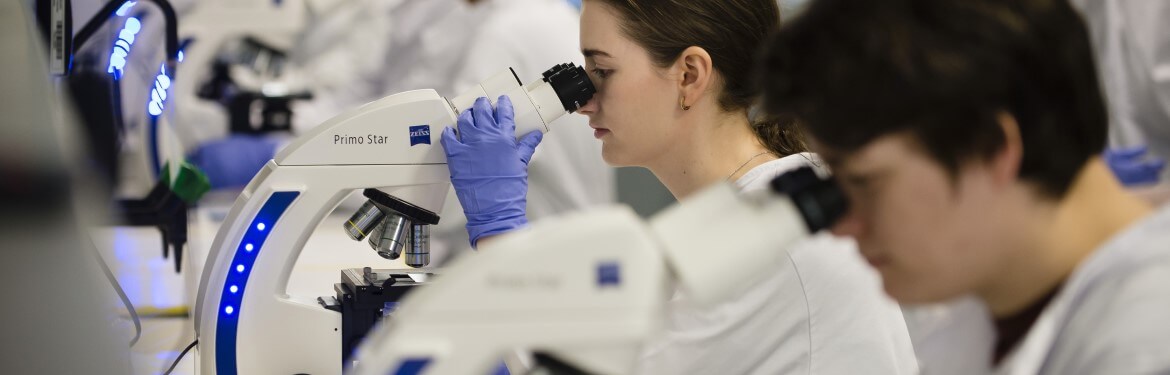
Purpose-built teaching facilities are fully integrated with research laboratories, meaning you will be learning alongside teaching and research staff who are at the cutting edge of their fields. You will spend one or two days a week undertaking lab work.
This becomes more project-oriented in your second year, culminating in a six-week individual research project in your third year. In their final year, MBio students undertake a further 27-week research project.
Seminar header
In your first year, lecture sizes are typically 370 students. The modules you take in years two and three will vary in class size.
The maximum number is typically 100 and the minimum 10 students.
Contact hours header
12 to 16 hours per week over 25 weeks.
In your first year you should expect around:
- 10 lectures a week,
- a full day in the laboratory,
- and a taught tutorial with your personal tutor and 6-7 of your peers.
Independent learning, reading and preparing for lectures, as well as preparing assessments, will occupy the rest of your study time.
Funding header
Your career
Graduates on our courses have gone on to work for employers including:
- AstraZeneca
- NHS
- Civil Service
- KPMG
- Johnson and Johnson
- Tesla
- ALS: Sarstedt Ltd
- Novartis
- Universities and Schools
They have pursued roles such as:
- Graduate-entry medicine students
- NHS scientists
- Biomedical research and development scientists
- Scientific publishing professionals
- Laboratory technicians
- Teachers
- Business, marketing and accountancy professionals
- Postgraduate student or researcher
Find out more about career opportunities from Life Sciences.Link opens in a new window
Helping you find the right career
Throughout your time in the School of Life Sciences your personal tutor, and careers and placements staff will work in conjunction with Student Opportunity to support you to find the right career. Through our unique taught tutorial system, you put into practice a range of scientific and transferable skills. As a Life Sciences student you will develop the hands-on laboratory, problem solving and research skills desired by employers. Our graduates are highly employable and go on to a range of scientific and non-scientific careers.
Our unique careers and placements service is tailored to your academic subject area. Our team offer a range of activities within the School to help you to consider your career once you graduate. Opportunities include:
- One-to-one careers advice appointments within the School
- Termly networking events featuring presentations from Life Sciences alumni and employers about a range of careers
- The option to undertake a full year industrial placement or study abroad year as part of your degree
- A wide range of summer work placement opportunities in industry and the School
- Careers talks throughout the degrees to ensure that you are thinking about your next steps throughout the programme
- Links with Warwick alumni to present to you the potential pathways of your degree
- We run a successful Medical School Application Support Programme (MASP) to prepare those interested in applying for graduate entry medicine. Since the programme started 4 years ago we have achieved remarkable success with 83% of MASP students getting an interview for Medical School and 66% being offered a place.
Life Sciences at Warwick
Warwick Life Sciences is an international centre of excellence with more than 80% of our research rated as 'world leading or internationally excellent' in the REF 2014 assessment. Our focus is in excellent teaching and research with impact.
Find out more about us on our websiteLink opens in a new window
Our courses
- Biochemistry (BSc)
- Biochemistry (MBio)
- Biochemistry with Industrial Placement (MBio)
- Biochemistry with Placement Year (BSc)
- Biological Sciences (BSc)
- Biological Sciences (MBio)
- Biological Sciences with Industrial Placement (MBio)
- Biological Sciences with Placement Year (BSc)
- Biomedical Science (BSc)
- Biomedical Science (MBio)
- Biomedical Science with Industrial Placement (MBio)
- Biomedical Science with Placement Year (BSc)
- Life Sciences and Global Sustainable Development (BASc)
- Neuroscience (BSc)
- Neuroscience (MBio)
- Neuroscience with Industrial Placement (MBio)
- Neuroscience with Placement Year (BSc)
Sign up for updates
Discover more about our courses and campus life with our helpful information and timely reminders.