
Gender and Sexuality
OVERVIEW
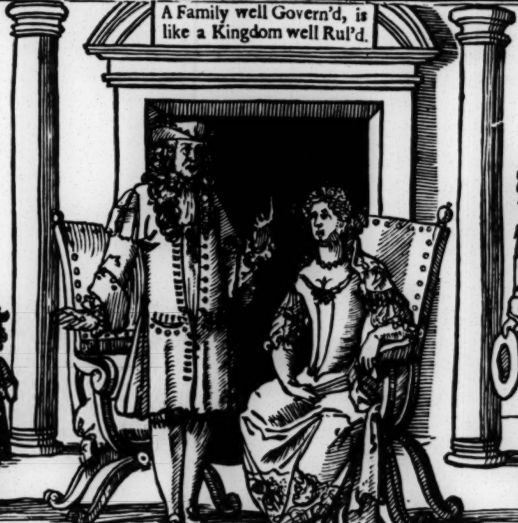
The family, gender, and sexuality each have histories. The experience of being male or female, of having sex, of desiring someone of the same gender, or of changing gender, can all be studied historically. Patriarchy, or rule by men, was the norm in early modern Europe, both in households and in public life. So was heterosexuality, and a binary distinction between men and women. But these norms were more complex and interesting than they appear at first sight. They varied across time, place, and social groups. They were sometimes questioned, suspended, or subverted. They were implicated in all the historical events we have covered in this module, from the Reformation to the Pacific voyages. There were signs that these norms were changing in the eighteenth century, but not necessarily for the better.
The seminar looks at this topic through the lens of historical fiction. The seminar readings include an (optional) film screening - Hamnet (trailer) - about Anne Hathaway, William Shakespeare, and their son Hamnet. There is also an excerpt from the novel on which the film was based, two other readings on the same topic, and the usual textbook introduction.
Film screening. The film 2025 Hamnet will be shown in the Faculty of Arts building on Wednesday 17th March. There will be a panel discussion from 4pm, about early modern gender, childhood and emotions, followed by the screening from 6pm. The panellists are Professor Erin Sullivan (Shakespeare Institute) and Dr. Anna French (Liverpool University). ETM students are warmly encouraged (though not required) to attend this event. This is an addition to the seminar rather than a substitute for it.
A note about content. This is a sensitive topic. You may find that the labels and language used by early modern writers (and historians) are not appropriate in modern-day contexts. But it is useful to see how attitudes and ideas surrounding these issues have changed and how this has shaped historical scholarship.
ESSENTIAL READING
Capp, Bernard, 'Gender and Family,' in Beat Kümin (ed.), The European World, 1500-1800: An Introduction to Early Modern History, 4th edn. (Taylor and Francis, 2022).
Roberts, Penny. 'Sexual Deviants,' a short section of the chapter 'Marginals and Deviants', in The European World, ed. Kümin, pp. 121-124.
O'Farrell, Maggie, Hamnet (London, 2021), the second chapter, starting 'If you were to stand...', ending 'nothing will stand in her way', and running from p. 28 to p. 59 (at least in the 2021 Tinder Press paperback edition, from which the scan on Talus Aspire is drawn)
Sheil, Katherine West, 'Millennial Anne Hathaways and Women Audiences,' in Sheil, Imagining Shakespeare's Wife (Cambridge, 2018), pp. 170-201.
Woolf, Virginia, A Room of One's Own, ed. David Bradshaw and Stuart N. Clarke (John Wiley & Sons, 2014), pp. 35-42 (last half of chapter 3) - please do use this edition, otherwise the page numbers won't line up
SPECIFIC QUESTIONS
- how far does Hamnet (the novel and/or the film) capture the reality of early modern gender and sexuality?
- 'Historical fiction teaches us nothing that historical facts cannot.' Discuss.
- what do recent fictional accounts of Anne Hathaway tell us about the world we are living in?
GENERAL QUESTIONS
- were women and men equally constrained by gender expectations?
- to what extent was domestic authority contested in early modern Europe?
- how was sexuality understood in early modern Europe?
RECOMMENDED READING
Bingham, Caroline C. ‘Seventeenth-Century Attitudes Toward Deviant Sex’, Journal of Interdisciplinary History, 1 (1971), 447-68.
Crawford, Katherine, European Sexualities, 1400-1800 (2007), ch. 3.
Dabhoiwala, Faramaerz, The Origins of Sex: A History of the First Sexual Revolution (2012), prologue: the culture of discipline. See also critique by Julie Hardwick, 'A Sexual Revolution in the Eighteenth Century?'.
Foyster, Elizabeth, ‘Male Honour, Social Control and Wife Beating in Late Stuart England’, Transactions of the Royal Historical Society, vol. 6 (1996), pp. 215-224.
Gowing, Laura, ‘Ordering the body: illegitimacy and female authority in seventeenth-century England’ in Michael J. Braddick and John Walter (eds), Negotiating Power in Early Modern Society: Order, Hierarchy, and Subordination in Britain and Ireland (2001), pp 43-62 (ebook).
Gowing, Laura, ‘Women’s Bodies and the Making of Sex in Seventeenth-Century England’, Signs 37, no. 4 (Summer, 2012), pp. 813-822.
FURTHER READING:
Bennett, Judith and Amy M. Froide, ‘A Singular Past’, in Bennett and Froide (eds), Singlewomen in the European Past, 1250-1800 (1998), pp. 1-38 (ebook).
Berry, Helen, and Elizabeth Foyster (eds), The Family in Early Modern England (Cambridge, 2007) (ebook)
Brown, Judith C., and Robert C. Davis eds., Gender and Society in Renaissance Italy (1998), chs 1, 7
Capp, Bernard, When Gossips Meet: Women, Family and Neighbourhood in Early Modern England (2003) (ebook), chs. 2-3.
Cattelona, G., ‘Control and Collaboration: The Role of Women in Regulating Female Sexual Behaviour in Early Modern Marseille’, French Historical Studies 18 (1993), 13-33
Chojnacka, Monica, and Merry E. Wiesner-Hanks (eds), Age of Woman, Ages of Man: Sources in European social history, 1400-1750 (2013) [an excellent collection of primary materials relating to this period]
Davis, Natalie, Society and Culture in Early Modern France (1975) (The Renaissance Beard: Masculinity in Early Modern England’ebook), ch. 5 women on top
Fisher, W., ‘The Renaissance Beard: Masculinity in Early Modern England’, Renaissance Quarterly (2001).
Gowing, Laura, Domestic Dangers: Women, Words, and Sex in Early Modern London (1996), ch. 6 ‘Domestic disorders: adultery and violence’
Hanley, S., ‘Engendering the State: Family Formation and State Building in Early Modern France’, French Historical Studies 16 (1980)
Rocke, Michael, Forbidden Friendships: Homosexuality and Male Culture in Renaissance Florence (Oxford, 1996) (ebook)
Roper, Lyndal, Oedipus and the Devil: witchcraft, sexuality and religion in early modern Europe (1994), chs 2, 4, 5.
Rublack, Ulinka (ed.), Gender in Early Modern German History (2002), chs. 2, 6 & 7.
Muir, E. and G. Ruggiero (eds), Sex and Gender in Historical Perspective (1990)
Shepard, Alex, Meanings of Manhood in Early Modern England (2003) (ebook)
Wiesner, Merry E., Women and Gender in Early Modern Europe (3rd ed., 2008), ch. 2

ELECTRONIC RESOURCES:
Perdita Manuscripts - documents written or compiled by women in the British Isles in the 16th and 17th centuries
Defining Gender - a collection of over 50,000 images from original documents relating to Gender Studies
English Broadside Ballad Archive
Italian Women Writers database
Internet Medieval Sourcebook: Selected Sources: Sex and Gender
Unruly Women and Failed Patriarchs: Paradoxical Patriarchy in Early Modern England
'The First Sexual Revolution', Not Just the Tudors Podcast [an interview with Prof. Faramaerz Dabhoiwala]