
Blazing New World
Title: The Description of a New World, Called the Blazing-World
Author: Duchess of Margaret Cavendish Newcastle
Release date: April 18, 2016 [eBook #51783]
Most recently updated: June 15, 2025
Language: English
Other information and formats: www.gutenberg.org/ebooks/51783
Credits: Produced by Marc D'Hooghe
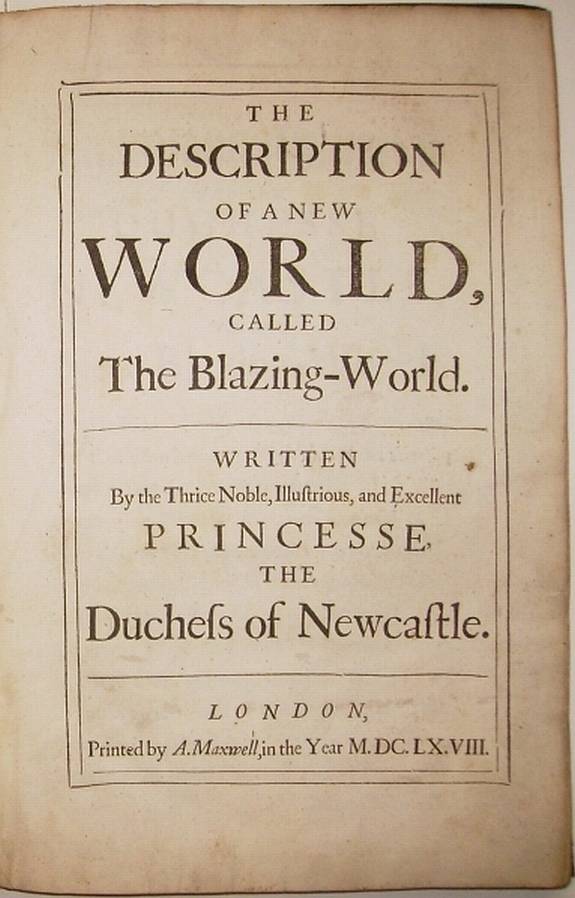
THE
DESCRIPTION
OF A NEW
WORLD
CALLED
The Blazing-World.
WRITTEN
By The Thrice Noble, Illustrious, and Excellent
PRINCESSE
THE
Duchess of Newcastle
Printed by A. Maxwell, in the Year M.DC.LX.VIII.
Contents
To The Duchesse of Newcastle, On Her New Blazing-World.
To all Noble and Worthy Ladies.
The Description of a New World, Called The Blazing-World.
The Second Part of the Description of the New Blazing-World.
The Epilogue to the Reader.
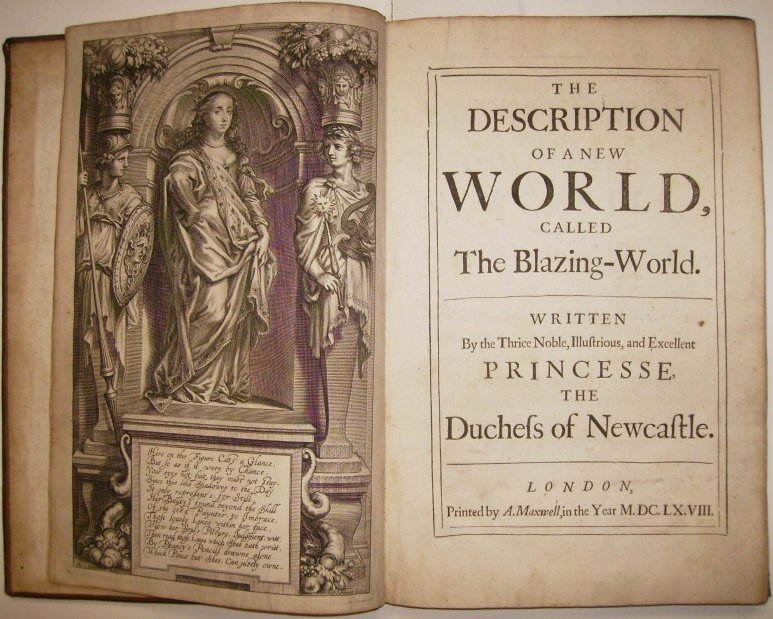
Here on this Figure Cast a Glance.
But so as if it were by Chance,
Your eyes not fixt, they must not Stay,
Since this like Shadowes to the Day
It only represent's; for Still,
Her Beauty's found beyond the Skill
Of the best Paynter, to Imbrace
These lovely Lines within her face.
View her Soul's Picture, Judgment, witt,
Then read those Lines which Shee hath writt,
By Phancy's Pencill drawne alone
Which Peces but Shee, can justly owne.
To The Duchesse of Newcastle, On Her New Blazing-World.
Our Elder World, with all their Skill and Arts,
Could but divide the World into three Parts:
Columbus, then for Navigation fam'd,
Found a new World, America 'tis nam'd;
Now this new World was found, it was not made,
Onely discovered, lying in Time's shade.
Then what are You, having no Chaos found
To make a World, or any such least ground?
But your Creating Fancy, thought it fit
To make your World of Nothing, but pure Wit.
Your Blazing-World, beyond the Stars mounts higher,
Enlightens all with a Cœlestial Fier.
William Newcastle.
To all Noble and Worthy Ladies.
This presentDescription of a New World, was made as an Appendix to myObservations upon Experimental Philosophy;and, having some Sympathy and Coherence with each other, were joyned together as Two several Worlds, at their Two Poles. But, by reason most Ladies take no delight in Philosophical Arguments, I separated some from the mentioned Observations, and caused them to go out by themselves, that I might express my Respects, in presenting to Them such Fancies as my Contemplations did afford. The First Part is Romancical; the Second, Philosophical; and the Third is meerly Fancy; or (as I may call it) Fantastical. And if (Noble Ladies) you should chance to take pleasure in reading these Fancies, I shall account my self a Happy Creatoress: If not, I must be content to live a Melancholly Life in my own World; which I cannot call a Poor World, if Poverty be only want of Gold, and Jewels: for, there is more Gold in it, than all the Chymists ever made; or, (as I verily believe) will ever be able to make. As for the Rocks of Diamonds, I wish, with all my Soul, they might be shared amongst my Noble Female Friends; upon which condition, I would willingly quit my Part: And of the Gold, I should desire only so much as might suffice to repair my Noble Lord and Husband's Losses: for, I am not Covetous, but as Ambitious as ever any of my Sex was, is, or can be; which is the cause, That though I cannot be Henry the Fifth, or Charles the Second; yet, I will endeavour to be, Margaret the First: and, though I have neither Power, Time nor Occasion, to be a great Conqueror, like Alexander, or Cesar; yet, rather than not be Mistress of a World, since Fortune and the Fates would give me none, I have made One of my own. And thus, believing, or, at least, hoping, that no Creature can, or will, Envy me for this World of mine, I remain,
Noble Ladies, Your Humble Servant, M. Newcastle.
The Description of a New World, Called The Blazing-World.
A Merchant travelling into a foreign Country, fell extreamly in Love with a young Lady; but being a stranger in that Nation, and beneath her, both in Birth and Wealth, he could have but little hopes of obtaining his desire; however his Love growing more and more vehement upon him, even to the slighting of all difficulties, he resolved at last to Steal her away; which he had the better opportunity to do, because her Father's house was not far from the Sea, and she often using to gather shells upon the shore accompanied not with above two to three of her servants it encouraged him the more to execute his design. Thus coming one time with a little leight Vessel, not unlike a Packet-boat, mann'd with some few Sea-men, and well victualled, for fear of some accidents, which might perhaps retard their journey, to the place where she used to repair; he forced her away: But when he fancied himself the happiest man of the World, he proved to be the most unfortunate; for Heaven frowning at his Theft, raised such a Tempest, as they knew not what to do, or whither to steer their course; so that the Vessel, both by its own leightness, and the violent motion of the Wind, was carried as swift as an Arrow out of a Bow, towards the North-pole, and in a short time reached the Icy Sea, where the wind forced it amongst huge pieces of Ice; but being little, and leight, it did by the assistance and favour of the gods to this virtuous Lady, so turn and wind through those precipices, as if it had been guided by some experienced Pilot, and skilful Mariner: But alas! Those few men which were in it, not knowing whither they went, nor what was to be done in so strange an Adventure, and not being provided for so cold a Voyage, were all frozen to death; the young Lady onely, by the light of her Beauty, the heat of her Youth, and Protection of the Gods, remaining alive: Neither was it a wonder that the men did freeze to death; for they were not onely driven to the very end or point of the Pole of that World, but even to another Pole of another World, which joined close to it; so that the cold having a double strength at the conjunction of those two Poles, was insupportable: At last, the Boat still passing on, was forced into another World; for it is impossible to round this Worlds Globe from Pole to Pole, so as we do from East to West; because the Poles of the other World, joining to the Poles of this, do not allow any further passage to surround the World that way; but if any one arrives to either of these Poles, he is either forced to return, or to enter into another World: and lest you should scruple at it, and think, if it were thus, those that live at the Poles would either see two Suns at one time, or else they would never want the Sun's light for six months together, as it is commonly believed: You must know, that each of these Worlds having its own Sun to enlighten it, they move each one in their peculiar Circles; which motion is so just and exact, that neither can hinder or obstruct the other; for they do not exceed their Tropicks: and although they should meet, yet we in this World cannot so well perceive them, by reason of the brightness of our Sun, which being nearer to us, obstructs the splendor of the Sun of the other World, they being too far off to be discerned by our optick perception, except we use very good Telescopes; by which, skilful Astronomers have often observed two or three Suns at once. But to return to the wandering Boat, and the distressed Lady; she seeing all the Men dead, found small comfort in life; their Bodies which were preserved all that while from putrefaction and stench, by the extremity of cold, began now to thaw, and corrupt; whereupon she having not strength enough to fling them over-board, was forced to remove out of her small Cabine, upon the deck, to avoid the nauseous smell; and finding the Boat swim between two plains of Ice, as a stream that runs betwixt two shores, at last perceived land, but covered all with Snow: from which came, walking upon the Ice, strange Creatures, in shape like Bears, only they went upright as men; those Creatures coming near the Boat, catched hold of it with their Paws, that served them instead of hands; some two or three of them entred first; and when they came out, the rest went in one after another; at last having viewed and observed all that was in the Boat, they spake to each other in a language which the Lady did not understand; and having carried her out of the Boat, sunk it, together with the dead men.
The Lady now finding her self in so strange a place, and amongst such wonderful kind of Creatures, was extreamly strucken with fear, and could entertain no other Thoughts, but that every moment her life was to be a sacrifice to their cruelty; but those Bear-like Creatures, how terrible soever they appear'd to her sight, yet were they so far from exercising any cruelty upon her, that rather they shewed her all civility and kindness imaginable; for she being not able to go upon the Ice, by reason of its slipperiness, they took her up in their rough arms, and carried her into their City, where instead of Houses, they had Caves under ground; and as soon as they enter'd the City, both Males and Females, young and old, flockt together to see this Lady, holding up their Paws in admiration; at last having brought her into a certain large and spacious Cave, which they intended for her reception, they left her to the custody of the Females, who entertained her with all kindness and respect, and gave her such victuals as they used to eat; but seeing her Constitution neither agreed with the temper of that Climate, nor their Diet, they were resolved to carry her into another Island of a warmer temper; in which were men like Foxes, onely walking in an upright shape, who received their neighbours the Bear-men with great civility and Courtship, very much admiring this beauteous Lady; and having discoursed some while together, agreed at last to make her a Present to the Emperor of their World; to which end, after she had made some short stay in the same place, they brought her cross that Island to a large River, whose stream run smooth and clear, like Chrystal; in which were numerous Boats, much like our Fox-traps; in one whereof she was carried, some of the Bear- and Fox-men waiting on her; and as soon as they had crossed the River, they came into an Island where there were Men which had heads, beaks and feathers, like wild-Geese, onely they went in an upright shape, like the Bear-men and Fox-men: their rumps they carried between their legs, their wings were of the same length with their Bodies, and their tails of an indifferent size, trailing after them like a Ladie's Garment; and after the Bear- and Fox-men had declared their intention and design to their Neighbours, the Geese- or Bird-men, some of them joined to the rest, and attended the Lady through that Island, till they came to another great and large River, where there was a preparation made of many Boats, much like Birds nests, onely of a bigger size; and having crost that River, they arrived into another Island, which was of a pleasant and mild temper, full of Woods and the Inhabitants thereof were Satyrs, who received both the Bear- Fox- and Bird men, with all respect and civility; and after some conferences (for they all understood each others language) some chief of the Satyrs joining to them, accompanied the Lady out of that Island to another River, wherein were many handsome and commodious Barges; and having crost that River, they entered into a large and spacious Kingdom, the men whereof were of a Grass-Green Complexion, who entertained them very kindly, and provided all conveniences for their further voyage: hitherto they had onely crost Rivers, but now they could not avoid the open Seas any longer; wherefore they made their Ships and tacklings ready to sail over into the Island, where the Emperor of the Blazing- world (for so it was call'd) kept his residence. Very good Navigators they were; and though they had no knowledg of the Load-stone, or Needle or pendulous Watches, yet (which was as serviceable to them) they had subtile observations, and great practice; in so much that they could not onely tell the depth of the Sea in every place, but where there were shelves of Sand, Rocks, and other obstructions to be avoided by skilful and experienced Sea-men: Besides, they were excellent Augurers, which skill they counted more necessary and beneficial then the use of Compasses, Cards, Watches, and the like; but, above the rest, they had an extraordinary Art, much to be taken notice of by Experimental Philosophers, and that was a certain Engin, which would draw in a great quantity of Air, and shoot forth Wind with a great force; this Engine in a calm, they placed behind their Ships, and in a storm, before; for it served against the raging waves, like Cannons against an hostile Army, or besieged Town; it would batter and beat the waves in pieces, were they as high as Steeples; and as soon as a breach was made, they forced their passage through, in spight even of the most furious wind, using two of those Engins at every Ship, one before, to beat off the waves, and another behind to drive it on; so that the artificial wind had the better of the natural; for, it had a greater advantage of the waves, then the natural of the Ships: the natural being above the face of the Water, could not without a down right motion enter or press into the Ships; whereas the artificial with a sideward-motion, did pierce into the bowels of the Waves: Moreover, it is to be observed, that in a great Tempest they would join their Ships in battel-aray: and when they feared Wind and Waves would be too strong for them, if they divided their Ships; they joined as many together as the compass or advantage of the places of the Liquid Element would give them leave. For, their Ships were so ingeniously contrived, that they could fasten them together as close as a Honey-comb, without waste of place; and being thus united, no Wind nor Waves were able to separate them. The Emperor's Ships, were all of Gold; but the Merchants and Skippers, of Leather; the Golden Ships were not much heavier then ours of Wood, by reason they were neatly made, and required not such thickness, neither were they troubled with Pitch, Tar, Pumps, Guns, and the like, which make our Woodden-Ships very heavy; for though they were not all of a piece, yet they were so well sodder'd, that there was no fear of Leaks, Chinks, or Clefts; and as for Guns, there was no use of them, because they had no other enemies but the Winds: But the Leather Ships were not altogether so sure, although much leighter; besides, they were pitched to keep out Water.
Having thus prepar'd, and order'd their Navy, they went on in despight of Calm or Storm: And though the Lady at first fancied her self in a very sad condition, and her mind was much tormented with doubts and fears, not knowing whether this strange Adventure would tend to her safety or destruction; yet she being withal of a generous spirit, and ready wit, considering what dangers she had past, and finding those sorts of men civil and diligent attendants to her, took courage, and endeavoured to learn their language; which after she had obtained so far, that partly by some words and signs she was able to apprehend their meaning, she was so far from being afraid of them, that she thought her self not onely safe, but very happy in their company: By which we may see, that Novelty discomposes the mind, but acquaintance settles it in peace and tranquillity. At last, having passed by several rich Islands and Kingdoms, they went towards Paradise, which was the seat of the Emperor; and coming in sight of it, rejoiced very much; the Lady at first could perceive nothing but high Rocks, which seemed to touch the Skies; and although they appear'd not of an equal heigth, yet they seemed to be all one piece, without partitions: but at last drawing nearer, she perceived a clift, which was a part of those Rocks, out of which she spied coming forth a great number of Boats, which afar off shewed like a company of Ants, marching one after another; the Boats appeared like the holes or partitions in a Honey-comb, and when joined together, stood as close; the men were of several Complexions, but none like any of our World; and when both the Boats and Ships met, they saluted and spake to each other very courteously; for there was but one language in all that World: nor no more but one Emperor, to whom they all submitted with the greatest duty and obedience, which made them live in a continued Peace and Happiness; not acquainted with Foreign Wars or Home-bred Insurrections. The Lady now being arrived at this place, was carried out of her Ship into one of those Boats, and conveighed through the same passage (for there was no other) into that part of the World where the Emperor did reside; which part was very pleasant, and of a mild temper: Within it self it was divided by a great number of vast and large Rivers, all ebbing and flowing, into several Islands of unequal distance from each other, which in most parts were as pleasant, healthful, rich, and fruitful, as Nature could make them; and, as I mentioned before, secure from all Foreign Invasions, by reason there was but one way to enter, and that like a Labyrinth, so winding and turning among the Rocks, that no other Vessels but small Boats, could pass, carrying not above three passengers at a time: On each side all along the narrow and winding River, there were several Cities, some of Marble, some of Alabaster, some of Agat, some of Amber, some of Coral, and some of other precious materials not known in our world; all which after the Lady had passed, she came to the Imperial City, named Paradise, which appeared in form like several Islands; for, Rivers did run betwixt every street, which together with the Bridges, whereof there was a great number, were all paved. The City it self was built of Gold; and their Architectures were noble, stately, and magnificent, not like our Modern, but like those in the Romans time; for, our Modern Buildings are like those Houses which Children use to make of Cards, one story above another, fitter for Birds, then Men; but theirs were more Large, and Broad, then high; the highest of them did not exceed two stories, besides those rooms that were under-ground, as Cellars, and other Offices. The Emperor's Palace stood upon an indifferent ascent from the Imperial City; at the top of which ascent was a broad Arch, supported by several Pillars, which went round the Palace, and contained four of our English miles in compass: within the Arch stood the Emperor's Guard, which consisted of several sorts of Men; at every half mile, was a Gate to enter, and every Gate was of a different fashion; the first, which allowed a passage from the Imperial City into the Palace, had on either hand a Cloyster, the outward part whereof stood upon Arches sustained by Pillars, but the inner part was close: Being entred through the Gate, the Palace it self appear'd in its middle like the Isle of a Church, a mile and a half long, and half a mile broad; the roof of it was all Arched, and rested upon Pillars, so artificially placed that a stranger would lose himself therein without a Guide; at the extream sides, that is, between the outward and inward part of the Cloyster, were Lodgings for Attendants; and in the midst of the Palace, the Emperor's own Rooms; whose Lights were placed at the top of every one, because of the heat of the Sun: the Emperor's appartment for State was no more inclosed then the rest; onely an Imperial Throne was in every appartment, of which the several adornments could not be perceived until one entered, because the Pillars were so just opposite to one another, that all the adornments could not be seen at one. The first part of the Palace was, as the Imperial City, all of Gold; and when it came to the Emperors appartment, it was so rich with Diamonds, Pearls, Rubies, and the like precious Stones, that it surpasses my skill to enumerate them all. Amongst the rest, the Imperial Room of State appear'd most magnificent; it was paved with green Diamonds (for there are in that World Diamonds of all Colours) so artificially, as it seemed but of one piece; the Pillars were set with Diamonds so close, and in such a manner, that they appear'd most Glorious to the sight; between every Pillar was a Bow or Arch of a certain sort of Diamonds, the like whereof our World does not afford; which being placed in every one of the Arches in several rows, seemed just like so many Rainbows of several different colours. The roof of the Arches was of blew Diamonds, and in the midst thereof was a Carbuncle, which represented the Sun; and the Rising and Setting-Sun at the East and West-side of the Room were made of Rubies. Out of this Room there was a passage into the Emperor's Bed-Chamber, the Walls whereof were of Jet, and the Floor of black Marble; the Roof was of Mother of Pearl, where the Moon and Blazing-Stars were represented by white Diamonds, and his Bed was made of Diamonds and Carbuncles.
No sooner was the Lady brought before the Emperor, but he conceived her to be some Goddess, and offered to worship her; which she refused, telling him, (for by that time she had pretty well learned their Language) that although she came out of another world, yet was she but a mortal. At which the Emperor rejoycing, made her his Wife, and gave her an absolute power to rule and govern all that World as she pleased. But her subjects, who could hardly be perswaded to believe her mortal, tender'd her all the Veneration and Worship due to a Deity.
Her Accoustrement after she was made Empress, was as followeth: On her head she wore a Cap of Pearl, and a Half-moon of Diamonds just before it; on the top of her Crown came spreading over a broad Carbuncle, cut in the form of the Sun; her Coat was of Pearl, mixt with blew Diamonds, and frindged with red ones; her Buskins and Sandals were of green Diamonds; In her left hand she held a Buckler, to signifie the Defence of her Dominions; which Buckler was made of that sort of Diamond as has several different Colours; and being cut and made in the form of an Arch, shewed like a Rain-bow; In her right hand she carried a Spear made of white Diamond, cut like the tail of a Blazing Star, which signified that she was ready to assault those that proved her Enemies.
None was allowed to use or wear Gold but those of the Imperial Race, which were the onely Nobles of the State; nor durst any one wear Jewels but the Emperor, the Empress and their Eldest Son; notwithstanding that they had an infinite quantity both of Gold and precious Stones in that World; for they had larger extents of Gold, then our Arabian Sands; their precious Stones were Rocks, and their Diamonds of several Colours; they used no Coyn, but all their Traffick was by exchange of several Commodities.
Their Priests and Governors were Princes of the Imperial Blood, and made Eunuches for that purpose; and as for the ordinary sort of men in that part of the World where the Emperor resided, they were of several Complexions; not white, black, tawny, olive or ash-coloured; but some appear'd of an Azure, some of a deep Purple, some of a Grass-green, some of a Scarlet, some of an Orange-colour, &c. Which Colours and Complexions, whether they were made by the bare reflection of light, without the assistance of small particles; or by the help of well-ranged and order'd Atoms; or by a continual agitation of little Globules; or by some pressing and re-acting motion, I am not able to determine. The rest of the Inhabitants of that World, were men of several different sorts, shapes, figures, dispositions, and humors, as I have already made mention, heretofore; some were Bear-men, some Worm-men, some Fish- or Mear-men, otherwise called Syrens; some Bird-men, some Fly-men, some Ant-men, some Geese-men, some Spider-men, some Lice-men, some Fox-men, some Ape-men, some Jack daw-men, some Magpie-men, some Parrot-men, some Satyrs, some Gyants, and many more, which I cannot all remember; and of these several sorts of men, each followed such a profession as was most proper for the nature of their Species, which the Empress encouraged them in, especially those that had applied themselves to the study of several Arts and Sciences; for they were as ingenious and witty in the invention of profitable and useful Arts, as we are in our world, nay, more; and to that end she erected Schools, and founded several Societies. The Bear-men were to be her Experimental Philosophers, the Bird-men her Astronomers, the Fly- Worm- and Fish-men her Natural Philosophers, the Ape-men her Chymists, the Satyrs her Galenick Physicians, the Fox-men her Politicians, the Spider- and Lice-men her Mathematicians, the Jackdaw- Magpie- and Parrot-men her Orators and Logicians, the Gyants her Architects, &c. But before all things, she having got a Soveraign power from the Emperor over all the World, desired to be informed both of the manner of their Religion and Government; and to that end she called the Priests and States men, to give her an account of either. Of the States men she enquired, first, Why they had so few Laws? To which they answered, That many Laws made many Divisions, which most commonly did breed Factions, and at last brake out into open Wars. Next, she asked, Why they preferred the Monarchical form of Government before any other? They answered, That as it was natural for one Body to have but one Head, so it was also natural for a Politick body to have but one Governor; and that a Common-wealth, which had many Governors was like a Monster with many Heads. Besides, said they, a Monarchy is a divine form of Government, and agrees most with our Religion: For as there is but one God, whom we all unanimously worship and adore with one Faith; so we are resolved to have but one Emperor, to whom we all submit with one obedience.
Then the Empress seeing that the several sorts of her Subjects had each their Churches apart, asked the Priests, whether they were of several Religions? They answered her Majesty, That there was no more but one Religion in all that World, nor no diversity of opinions in that same Religion for though there were several sorts of men, yet had they all but one opinion concerning the Worship and Adoration of God. The Empress asked them, Whether they were Jews, Turks, or Christians? We do not know, said they, what Religions those are; but we do all unanimously acknowledg, worship and adore the Onely, Omnipotent, and Eternal God, with all reverence, submission, and duty. Again, the Empress enquired, Whether they had several Forms of Worship? They answered, No: For our Devotion and Worship consists onely in Prayers, which we frame according to our several Necessities, in Petitions, Humiliations, Thanksgiving, &c. Truly, replied the Empress, I thought you had been either Jews, or Turks, because I never perceived any Women in your Congregations: But what is the reason, you bar them from your religious Assemblies? It is not fit, said they, that Men and Women should be promiscuously together in time of Religious Worship; for their company hinders Devotion, and makes many, instead of praying to God, direct their Devotion to their Mistresses. But, asked the Empress, Have they no Congregation of their own, to perform the duties of Divine Worship, as well as Men? No, answered they: but they stay at home, and say their Prayers by themselves in their Closets. Then the Empress desir'd to know the reason why the Priests and Governors of their World were made Eunuchs? They answer'd, To keep them from Marriage: For Women and Children most commonly make disturbance both in Church and State. But, said she, Women and Children have no Employment in Church or State. 'Tis true, answer'd they; but, although they are not admitted to publick Employments, yet are they so prevalent with their Husbands and Parents, that many times by their importunate perswasions, they cause as much, nay, more mischief secretly, then if they had the management of publick Affairs.
The Empress having received an information of what concerned both Church and State, passed some time in viewing the Imperial Palace, where she admired much the skil and ingenuity of the Architects, and enquired of them, first, Why they built their Houses no higher then two stories from the Ground? They answered her Majesty, That the lower their Buildings were, the less were they subject either to the heat of the Sun, or Wind, Tempest, Decay, &c. Then she desired to know the reason, why they made them so thick? They answered, That, the thicker the Walls were, the warmer they were in Winter, the cooler in Summer; for their thickness kept out both the Cold and Heat. Lastly, she asked, Why they Arched their Roofs, and made so many Pillars? They replied, That Arches and Pillars, did not onely grace a Building very much, and caused it to appear Magnificent, but made it also firm and lasting.
The Empress was very well satisfied with their answers; and after some time, when she thought that her new founded societies of the Vertuoso's had made a good progress in the several Employments she had put them upon, she caused a Convocation first of the Bird-men, and commanded them to give her a true relation of the two Cœlestial Bodies, viz. the Sun and Moon, which they did with all the obedience and faithfulness befitting their duty.
The Sun, as much as they could observe, they related to be a firm or solid Stone, of a vast bigness; of colour yellowish, and of an extraordinary splendor: But the Moon, they said, was of a whitish colour; and although she looked dim in the presence of the Sun, yet had she her own light, and was a shining body of her self, as might be perceived by her vigorous appearance in Moon-shiny-nights; the difference onely betwixt her own and the Sun's light was, that the Sun did strike his beams in a direct line; but the Moon never respected the Centre of their World in a right line, but her Centre was always excentrical. The Spots both in the Sun and Moon, as far as they were able to perceive, they affirmed to be nothing else but flaws and stains of their stony Bodies. Concerning the heat of the Sun, they were not of one opinion; some would have the Sun hot in it self, alledging an old Tradition, that it should at some time break asunder, and burn the Heavens, and consume this world into hot Embers, which, said they, could not be done, if the Sun were not fiery of it self. Others again said, This opinion could not stand with reason; for Fire being a destroyer of all things, the Sun-Stone after this manner would burn up all the near adjoining Bodies: Besides, said they, Fire cannot subsist without fuel; and the Sun-Stone having nothing to feed on, would in a short time consume it self; wherefore they thought it more probable that the Sun was not actually hot, but onely by the reflection of its light; so that its heat was an effect of its light, both being immaterial. But this opinion again was laught at by others, and rejected as ridiculous, who thought it impossible that one immaterial should produce another; and believed that both the light and heat of the Sun proceeded from a swift Circular motion of the Æthereal Globules, which by their striking upon the Optick nerve, caused light, and their motion produced heat: But neither would this opinion hold; for, said some, then it would follow, that the sight of Animals is the cause of light; and that, were there no eyes, there would be no light; which was against all sense and reason. Thus they argued concerning the heat and light of the Sun; but, which is remarkable, none did say, that the Sun was a Globous fluid body, and had a swift Circular motion; but all agreed, It was fixt and firm like a Center, and therefore they generally called it the Sun-Stone.
Then the Empress asked them the reason, Why the Sun and Moon did often appear in different postures or shapes, as sometimes magnified, sometimes diminished; sometimes elevated, otherwhiles depressed; now thrown to the right, and then to the left? To which some of the Bird-men answered, That it proceeded from the various degrees of heat and cold, which are found in the Air, from whence did follow a differing density and rarity; and likewise from the vapours that are interposed, whereof those that ascend are higher and less dense then the ambient air, but those which descend are heavier and more dense. But others did with more probability affirm, that it was nothing else but the various patterns of the Air; for like as Painters do not copy out one and the same original just alike at all times; so, said they, do several parts of the Air make different patterns of the luminous Bodies of the Sun and Moon: which patterns, as several copies, the sensitive motions do figure out in the substance of our eyes.
This answer the Empress liked much better then the former, and enquired further, What opinion they had of those Creatures that are called the motes of the Sun? To which they answered, That they were nothing else but streams of very small, rare and transparent particles, through which the Sun was represented as through a glass: for if they were not transparent, said they, they would eclipse the light of the Sun; and if not rare and of an airy substance, they would hinder Flies from flying in the Air, at least retard their flying motion: Nevertheless, although they were thinner then the thinnest vapour, yet were they not so thin as the body of air, or else they would not be perceptible by animal sight. Then the Empress asked, Whether they were living Creatures? They answered, Yes: Because they did encrease and decrease, and were nourished by the presence, and starved by the absence of the Sun.
Having thus finished their discourse of the Sun and Moon, the Empress desired to know what Stars there were besides? But they answer'd, that they could perceive in that World none other but Blazing Stars, and from thence it had the name that it was called the Blazing-World; and these Blazing-Stars, said they, were such solid, firm and shining bodies as the Sun and Moon, not of a Globular, but of several sorts of figures: some had tails; and some, other kinds of shapes.
After this, The Empress asked them, What kind of substance or creature the Air was? The Bird-men answered, That they could have no other perception of the Air, but by their own Respiration: For, said they, some bodies are onely subject to touch, others onely to sight, and others onely to smell; but some are subject to none of our exterior Senses: For Nature is so full of variety, that our weak Senses cannot perceive all the various sorts of her Creatures; neither is there any one object perceptible by all our Senses, no more then several objects are by one sense. I believe you, replied the Empress; but if you can give no account of the Air, said she, you will hardly be able to inform me how Wind is made; for they say, that Wind is nothing but motion of the Air. The Bird-men answer'd, That they observed Wind to be more dense then Air, and therefore subject to the sense of Touch; but what properly Wind was, and the manner how it was made, they could not exactly tell; some said, it was caused by the Clouds falling on each other; and others, that it was produced of a hot and dry exhalation: which ascending, was driven down again by the coldness of the Air that is in the middle Region, and by reason of its leightness, could not go directly to the bottom, but was carried by the Air up and down: Some would have it a flowing Water of the Air; and others again, a flowing Air moved by the blaz of the Stars.
But the Empress, seeing they could not agree concerning the cause of Wind, asked, Whether they could tell how Snow was made? To which they answered That according to their observation, Snow was made by a commixture of Water, and some certain extract of the Element of Fire that is under the Moon; a small portion of which extract, being mixed with Water, and beaten by Air or Wind, made a white Froth called Snow; which being after some while dissolved by the heat of the same spirit, turned to Water again. This observation amazed the Empress very much; for she had hitherto believed, That Snow was made by cold motions, and not by such an agitation or beating of a fiery extract upon water: Nor could she be perswaded to believe it until the Fish- or Mear-men had delivered their observation upon the making of Ice, which, they said, was not produced, as some hitherto conceived, by the motion of the Air, raking the Superficies of the Earth, but by some strong saline vapour arising out of the Seas, which condensed Water into Ice; and the more quantity there was of that vapour, the greater were the Mountains of Precipices of Ice; but the reason that it did not so much freeze in the Torrid Zone, or under the Ecliptick, as near or under the Poles, was, that this vapour in those places being drawn up by the Sun-beams into the middle Region of the Air, was onely condensed into Water, and fell down in showres of Rain; when as, under the Poles, the heat of the Sun being not so vehement, the same vapour had no force or power to rise so high, and therefore caused so much Ice, by ascending and acting onely upon the surface of water.
This Relation confirmed partly the observation of the Bird-men concerning the cause of Snow; but since they had made mention that that same extract, which by its commixture with Water made Snow, proceeded from the Element of Fire, that is under the Moon: The Emperess asked them, of what nature that Elementary Fire was; whether it was like ordinary Fire here upon Earth, or such a Fire as is within the bowels of the Earth, and as the famous Mountains Vesuvius and Ætna do burn withal; or whether it was such a sort of fire, as is found in flints, &c. They answered, That the Elementary Fire, which is underneath the Sun, was not so solid as any of those mentioned fires; because it had no solid fuel to feed on; but yet it was much like the flame of ordinary fire, onely somewhat more thin and fluid; for Flame, said they, is nothing else but the airy part of a fired Body.
Lastly, the Empress asked the Bird-men of the nature of Thunder and Lightning? and whether it was not caused by roves of Ice falling upon each other? To which they answered, That it was not made that way, but by an encounter of cold and heat; so that an exhalation being kindled in the Clouds, did dash forth Lightning, and that there were so many rentings of Clouds as there were Sounds and Cracking noises: But this opinion was contradicted by others, who affirmed that Thunder was a sudden and monstrous Blaz, stirred up in the Air, and did not always require a Cloud; but the Empress not knowing what they meant by Blaz (for even they themselves were not able to explain the sense of this word) liked the former better; and, to avoid hereafter tedious disputes, and have the truth of the Phænomena's of Cœlestial Bodies more exactly known, commanded the Bear-men, which were her Experimental Philosophers, to observe them through such Instruments as are called Telescopes, which they did according to her Majesties Command; but these Telescopes caused more differences and divisions amongst them, then ever they had before; for some said, they perceived that the Sun stood still, and the Earth did move about it; others were of opinion, that they both did move; and others said again, that the Earth stood still, and Sun did move; some counted more Stars then others; some discovered new Stars never seen before; some fell into a great dispute with others concerning the bigness of the Stars; some said, The Moon was another World like their Terrestrial Globe, and the spots therein were Hills and Vallies; but others would have the spots to be the Terrestrial parts, and the smooth and glossie parts, the Sea: At last, the Empress commanded them to go with their Telescopes to the very end of the Pole that was joined to the World she came from, and try whether they could perceive any Stars in it: which they did; and, being returned to her Majesty, reported that they had seen three Blazing-Stars appear there, one after another in a short time, whereof two were bright, and one dim; but they could not agree neither in this observation: for some said, It was but one Star which appeared at three several times, in several places; and others would have them to be three several Stars; for they thought it impossible, that those three several appearances should have been but one Star, because every Star did rise at a certain time, and appear'd in a certain place, and did disappear in the same place: Next, It is altogether improbable, said they, That one Star should fly from place to place, especially at such a vast distance, without a visible motion; in so short a time, and appear in such different places, whereof two were quite opposite, and the third side-ways: Lastly, If it had been but one Star, said they, it would always have kept the same splendor, which it did not; for, as above mentioned, two were bright, and one was dim. After they had thus argued, the Empress began to grow angry at their Telescopes, that they could give no better Intelligence; for, said she, now I do plainly perceive, that your Glasses are false Informers, and instead of discovering the Truth, delude your Senses; Wherefore I Command you to break them, and let the Bird-men trust onely to their natural eyes, and examine Cœlestial Objects by the motions of their own Sense and Reason. The Bear-men replied, That it was not the fault of their Glasses, which caused such differences in their Opinions, but the sensitive motions in their Optick organs did not move alike, nor were their rational judgments always regular: To which the Empress answered, That if their Glasses were true Informers, they would rectifie their irregular Sense and Reason; But, said she, Nature has made your Sense and Reason more regular then Art has your Glasses; for they are meer deluders, and will never lead you to the knowledg of Truth; Wherefore I command you again to break them; for you may observe the progressive motions of Cœlestial Bodies with your natural eyes better then through Artificial Glasses. The Bear-men being exceedingly troubled at her Majesties displeasure concerning their Telescopes, kneel'd down, and in the humblest manner petitioned, that they might not be broken; for, said they, we take more delight in Artificial delusions, then in Natural truths. Besides, we shall want Imployments for our Senses, and Subjects for Arguments; for, were there nothing but truth, and no falshood, there would be no occasion to dispute, and by this means we should want the aim and pleasure of our endeavors in confuting and contradicting each other; neither would one man be thought wiser then another, but all would either be alike knowing and wise, or all would be fools; wherefore we most humbly beseech your Imperial Majesty to spare our Glasses, which are our onely delight, and as dear to us as our lives. The Empress at last consented to their request, but upon condition, that their disputes and quarrels should remain within their Schools, and cause no factions or disturbances in State, or Government. The Bear-men, full of joy, returned their most humble thanks to the Empress; and to make her amends for the displeasure which their Telescopes had occasioned, told her Majesty, that they had several other artificial Optick-Glasses, which they were sure would give her Majesty a great deal more satisfaction. Amongst the rest, they brought forth several Microscopes, by the means of which they could enlarge the shapes of little bodies, and make a Lowse appear as big as an Elephant, and a Mite as big as a Whale. First of all they shewed the Empress a gray Drone-flye, wherein they observed that the greatest part of her face, nay, of her head, consisted of two large bunches all cover'd over with a multitude of small Pearls or Hemispheres in a Trigonal order: Which Pearls were of two degrees, smaller and bigger; the smaller degree was lowermost, and looked towards the ground; the other was upward, and looked sideward, forward and backward: They were all so smooth and polished, that they were able to represent the image of any object, the number of them was in all 14000. After the view of this strange and miraculous Creature, and their several observations upon it, the Empress asked them, What they judged those little Hemispheres might be? They answered, That each of them was a perfect Eye, by reason they perceived that each was covered with a Transparent Cornea, containing a liquor within them, which resembled the watery or glassie humor of the Eye. To which the Emperess replied, That they might be glassie Pearls, and yet not Eyes; and that perhaps their Microscopes did not truly inform them. But they smilingly answered her Majesty, That she did not know the vertue of those Microscopes: for they never delude, but rectifie and inform the Senses; nay, the World, said they, would be but blind without them, as it has been in former ages before those Microscopes were invented.
After this, they took a Charcoal, and viewing it with one of their best Microscopes, discovered in it an infinite multitude of pores, some bigger, some less; so close and thick, that they left but very little space betwixt them to be filled with a solid body; and to give her Imperial Majesty a better assurance thereof, they counted in a line of them an inch long, no less then 2700 pores; from which Observation they drew this following Conclusion, to wit, That this multitude of pores was the cause of the blackness of the Coal; for, said they, a body that has so many pores, from each of which no light is reflected, must necessarily look black, since black is nothing else but a privation of light, or a want of reflection. But the Empress replied, That if all Colours were made by reflection of light, and that Black was as much a colour as any other colour; then certainly they contradicted themselves in saying that black was made by want of reflection. However, not to interrupt your Microscopical Inspections, said she, let us see how Vegetables appear through your Glasses; whereupon they took a Nettle, and by the vertue of the Microscope, discovered that underneath the points of the Nettle there were certain little bags or bladders, containing a poysonous liquor, and when the points had made way into the interior parts of the skin, they like Syringe-pipes served to conveigh that same liquor into them. To which Observation the Empress replied, That if there were such poyson in Nettles, then certainly in eating of them, they would hurt us inwardly, as much as they do outwardly? But they answered, That it belonged to Physicians more then to Experimental Philosophers, to give Reasons hereof; for they only made Microscopical inspections, and related the Figures of the Natural parts of Creatures according to the representation of their glasses.
Lastly, They shewed the Empress a Flea, and a Lowse; which Creatures through the Microscope appear'd so terrible to her sight, that they had almost put her into a swoon; the description of all their parts would be very tedious to relate, and therefore I'le forbear it at this present. The Empress, after the view of those strangely-shaped Creatures, pitied much those that are molested with them, especially poor Beggars, which although they have nothing to live on themselves, are yet necessitated to maintain and feed of their own flesh and blood, a company of such terrible Creatures called Lice; who, instead of thanks, do reward them with pains, and torment them for giving them nourishment and food. But after the Empress had seen the shapes of these monstrous Creatures, she desir'd to know, Whether their Microscopes could hinder their biting, or at least shew some means how to avoid them? To which they answered, That such Arts were mechanical and below the noble study of Microscopical observations. Then the Empress asked them, Whether they had not such sorts of Glasses that could enlarge and magnifie the shapes of great Bodies as well as they had done of little ones? Whereupon they took one of their best and largest Microscopes, and endeavoured to view a Whale thorow it; but alas! the shape of the Whale was so big, that its Circumference went beyond the magnifying quality of the Glass; whether the error proceeded from the Glass, or from a wrong position of the Whale against the reflection of light, I cannot certainly tell. The Empress seeing the insufficiency of those Magnifying-Glasses, that they were not able to enlarge all sorts of Objects, asked the Bear-men, whether they could not make Glasses of a contrary nature to those they had shewed her, to wit, such as instead of enlarging or magnifying the shape or figure of an Object, could contract it beneath its natural proportion: Which, in obedience to her Majesties Commands, they did; and viewing through one of the best of them, a huge and mighty Whale appear'd no bigger then a Sprat; nay, through some no bigger then a Vinegar-Eele; and through their ordinary ones, an Elephant seemed no bigger then a Flea; a Camel no bigger then a Lowse; and an Ostrich no bigger then a Mite. To relate all their Optick observations through the several sorts of their Glasses, would be a tedious work, and tire even the most patient Reader, wherefore I'le pass them by; onely this was very remarkable and worthy to be taken notice of, that notwithstanding their great skil, industry and ingenuity in Experimental Philosophy, they could yet by no means contrive such Glasses, by the help of which they could spy out a Vacuum, with all its dimensions, nor Immaterial substances, Non-beings, and Mixt-beings, or such as are between something and nothing; which they were very much troubled at, hoping that yet, in time, by long study and practice, they might perhaps attain to it.
[...]
Then came the Lice-men, and endeavoured to measure all things to a hairs-breadth, and weigh them to an Atom; but their weights would seldom agree, especially in the weighing of Air, which they found a task impossible to be done; at which the Empress began to be displeased, and told them, that there was neither Truth nor Justice in their Profession; and so dissolved their society.
After this, the Empress was resolved to hear the Magpie- Parrot- and Jackdaw-men, which were her professed Orators and Logicians; whereupon one of the Parrot-men rose with great formality, and endeavoured to make an Eloquent Speech before her Majesty; but before he had half ended, his arguments and divisions being so many, that they caused a great confusion in his brain, he could not go forward, but was forced to retire backward, with great disgrace both to himself, and the whole society; and although one of his brethren endeavoured to second him by another speech, yet was he as far to seek, as the former. At which the Empress appear'd not a little troubled, and told them, That they followed too much the Rules of Art, and confounded themselves with too nice formalities and distinctions; but since I know, said she, that you are a people who have naturally voluble tongues, and good memories; I desire you to consider more the subject you speak of, then your artificial periods, connexions and parts of speech, and leave the rest to your natural Eloquence; which they did, and so became very eminent Orators.
Lastly, her Imperial Majesty being desirous to know what progress her Logicians had made in the Art of disputing, Commanded them to argue upon several Themes or Subjects; which they did; and having made a very nice discourse of Logistical terms and propositions, entred into a dispute by way of Syllogistical Arguments, through all the Figures and Modes: One began with an Argument of the first Mode of the first Figure, thus: Every Politician is wise: Every Knave is a Politician, Therefore every Knave is wise.
Another contradicted him with a Syllogism of the second Mode of the same Figure, thus: No Politician is wise: Every Knave is a Politician, Therefore no Knave is wise.
The third made an Argument in the third Mode of the same Figure, after this manner: Every Politician is wise: some Knaves are Politicians, Therefore some Knaves are wise.
The Fourth concluded with a Syllogism in the fourth Mode of the same Figure, thus; No Politician is wise: some Knaves are Politicians, Therefore some Knaves are not wise.
After this they took another subject, and one propounded this Syllogism: Every Philosopher is wise: Every Beast is wise, Therefore every Beast is a Philosopher.
But another said that this Argument was false, therefore he contradicted him with a Syllogism of the second Figure of the fourth Mode, thus: Every Philosopher is wise: some Beasts are not wise, Therefore some Beasts are not Philosophers.
Thus they argued, and intended to go on, but the Empress interrupted them: I have enough, said she, of your chopt Logick, and will hear no more of your Syllogisms; for it disorders my Reason, and puts my Brain on the rack; your formal argumentations are able to spoil all natural wit; and I'le have you to consider, that Art does not make Reason, but Reason makes Art; and therefore as much as Reason is above Art, so much is a natural rational discourse to be preferred before an artificial: for Art is, for the most part irregular, and disorders Men's understandings more then it rectifies them, and leads them into a Labyrinth where they'l never get out, and makes them dull and unfit for useful employments; especially your Art of Logick, which consists onely in contradicting each other, in making sophismes, and obscuring Truth, instead of clearing it.
But they replied to her Majesty, That the knowledg of Nature, that is, Natural Philosophy, would be imperfect without the Art of Logick; and that there was an improbable Truth which could no otherwise be found out then by the Art of disputing. Truly, said the Empress, I do believe that it is with Natural Philosophy, as it is with all other effects of Nature; for no particular knowledg can be perfect, by reason knowledg is dividable, as well as composable; nay, to speak properly, Nature her self cannot boast of any perfection, but God himself; because there are so many irregular motions in Nature, and 'tis but a folly to think that Art should be able to regulate them, since Art it self is, for the most part, irregular. But as for Improbable Truth I know not what your meaning is; for Truth is more then Improbability: nay, there is so much difference between Truth and Improbability, that I cannot conceive it possible how they can be joined together. In short, said she, I do no ways approve of your Profession; and though I will not dissolve your society, yet I shall never take delight in hearing you any more; wherefore confine your disputations to your Schools, lest besides the Commonwealth of Learning, they disturb also Divinity and Policy, Religion and Laws, and by that means draw an utter ruine and destruction both upon Church and State.
After the Empress had thus finish'd the Discourses and Conferences with the mentioned societies of her Vertuoso's, she considered by her self the manner of their Religion, and finding it very defective, was troubled, that so wise and knowing a people should have no more knowledg of the Divine Truth; Wherefore she consulted with her own thoughts, whether it was possible to convert them all to her own Religion, and to that end she resolved to build Churches, and make also up a Congregation of Women, whereof she intended to be the head her self, and to instruct them in the several points of her Religion. This she had no sooner begun, but the Women, which generally had quick wits, subtile conceptions, clear understandings, and solid judgments, became, in a short time, very devout and zealous Sisters; for the Empress had an excellent gift of Preaching, and instructing them in the Articles of Faith; and by that means, she converted them not onely soon, but gained an extraordinary love of all her Subjects throughout that World. But at last, pondering with her self the inconstant nature of Mankind, and fearing that in time they would grow weary, and desert the divine Truth, following their own fancies, and living according to their own desires; she began to be troubled that her labours and pains should prove of so little effect, and therefore studied all manner of ways to prevent it. Amongst the rest, she call'd to mind a Relation which the Bird-men made her once, of a Mountain that did burn in flames of fire; and thereupon did immediately send for the wisest and subtilest of her Worm-men, commanding them to discover the cause of the Eruption of that same fire; which they did; and having dived to the very bottom of the Mountain, informed her Majesty, That there was a certain sort of Stone, whose nature was such, that being wetted, it would grow excessively hot, and break forth into a flaming-fire, until it became dry, and then it ceased from burning. The Empress was glad to hear this news, and forthwith desired the Worm men to bring her some of that Stone, but be sure to keep it secret: she sent also for the Bird-men, and asked them whether they could not get her a piece of the Sun- stone? They answered, That it was impossible, unless they did spoil or lessen the light of the World: but, said they, if it please your Majesty, we can demolish one of the numerous Stars of the Sky, which the World will never miss.
The Empress was very well satisfied with this proposal, and having thus imployed these two sorts of men, in the mean while builded two Chappels one above another; the one she lined throughout with Diamonds, both Roof, Walls and Pillars; but the other she resolved to line with the Star-stone; the Fire- stone she placed upon the Diamond-lining, by reason Fire has no power on Diamonds; and when she would have that Chappel where the Fire-stone was, appear all in flame, she had by the means of Artificial pipes, water conveighed into it, which by turning the Cock, did, as out of a Fountain, spring over all the room, and as long as the Fire-stone was wet, the Chappel seemed to be all in a flaming-fire.
The other Chappel, which was lined with the Star- stone, did onely cast a splendorous and comfortable light; both the Chappels stood upon Pillars, just in the middle of a round Cloyster, which was dark as night; neither was there any other light within them, but what came from the Fire- and Star-stone; and being every where open, allowed to all that were within the compass of the Cloyster, a free prospect into them; besides, they were so artificially contrived, that they did both move in a Circle about their own Centres, without intermission, contrary ways. In the Chappel which was lined with the Fire-stone, the Empress preached Sermons of Terror to the wicked, and told them of the punishments for their sins, to wit, That after this life they should be tormented in an everlasting Fire. But in the other Chappel lined with the Star- stone, she preached Sermons of Comfort to those that repented of their sins, and were troubled at their own wickedness: Neither did the heat of the flame in the least hinder her; for the Fire-stone did not cast so great a heat but the Empress was able to endure it, by reason the water which was poured on the Stone, by its own self-motion turned into a flaming-fire, occasioned by the natural motions of the Stone, which made the flame weaker then if it had been fed by some other kind of fuel; the other Chappel where the Star-Stone was, although it did cast a great light, yet was it without all heat, and the Empress appear'd like an Angel in it; and as that Chappel was an embleme of Hell, so this was an embleme of Heaven. And thus the Empress, by Art, and her own Ingenuity, did not onely convert the Blazing-World to her own Religion, but kept them in a constant belief, without inforcement or blood-shed; for she knew well, that belief was a thing not to be forced or pressed upon the people, but to be instilled into their minds by gentle perswasions; and after this manner she encouraged them also in all other duties and employments: for Fear, though it makes people obey, yet does it not last so long, nor is it so sure a means to keep them to their duties, as Love.
Last of all, when she saw that both Church and State now in a well-ordered and setled condition, her thoughts reflected upon the World she came from; and though she had a great desire to know the condition of the same, yet could she advise no manner of way how to gain any knowledg thereof; at last, after many serious considerations, she conceived that it was impossible to be done by any other means, then by the help of Immaterial Spirits; wherefore she made a Convocation of the most learned, witty and ingenious of all the forementioned sorts of Men, and desired to know of them, whether there were any Immaterial Spirits in their World. First, she enquired of the Worm-men, whether they had perceived some within the Earth? They answered her Majesty, That they never knew of any such Creatures; for whatsoever did dwell within the Earth, said they, was imbodied and material. Then she asked the Fly-men, whether they had observed any in the Air? for you having numerous Eyes, said she, will be more able to perceive them, than any other Creatures. To which they answered her Majesty, That although Spirits, being immaterial, could not be perceived by the Worm-men in the Earth, yet they perceived that such Creatures did lodg in the Vehicles of the Air. Then the Empress asked, Whether they could speak to them, and whether they did understand each other? The Fly-men answered, That those Spirits were always cloth'd in some sort or other of Material Garments; which Garments were their Bodies, made, for the most part, of Air; and when occasion served, they could put on any other sort of substances; but yet they could not put these substances into any form or shape, as they pleased. The Empress asked the Fly-men, whether it was possible that she could be acquainted, and have some conferences with them?
They answered, They did verily believe she might. Hereupon the Empress commanded the Fly-men to ask some of the Spirits, Whether they would be pleased to give her a Visit? This they did; and after the Spirits had presented themselves to the Empress, (in what shapes and forms, I cannot exactly tell) after some few Complements that passed between them, the Empress told the Spirits that she questioned not, but they did know how she was a stranger in that World, and by what miraculous means she was arrived there; and since she had a great desire to know the condition of the World she came from, her request to the Spirits was, To give her some Information thereof, especially of those parts of the World where she was born, bred, and educated; as also of her particular friends and acquaintance: all which, the Spirits did according to her desire. At last, after a great many conferences and particular intelligences, which the Spirits gave the Empress, to her great satisfaction and content; she enquired after the most famous Students, Writers, and Experimental Philosophers in that World, which they gave her full relation of: amongst the rest she enquired, Whether there were none that had found out yet the Jews Cabbala? Several have endeavoured it, answered the Spirits, but those that came nearest (although themselves denied it) were one Dr. Dee, and one Edward Kelly, the one representing Moses, and the other Aaron; for Kelly was to Dr. Dee, as Aaron to Moses; but yet they proved at last but meer Cheats; and were described by one of their own Country-men, a famous Poet, named Ben. Johnson, in a Play call'd, The Alchymist, where he expressed Kelly by Capt. Face, and Dee by Dr. Subtle, and their two Wives by Doll Common, and the Widow; by the Spaniard the Play, he meant the Spanish Ambassador, and by Sir Epicure Mammon, a Polish Lord. The Empress remembred that she had seen the Play, and asked the Spirits, whom he meant by the name of Ananias? some Zealous Brethren, answered they, in Holland, Germany, and several other places. Then she asked them, Who was meant by the Druggist? Truly, answered the Spirits, We have forgot, it being so long since it was made and acted. What, replied the Empress, Can Spirits forget? Yes, said the Spirits; for what is past, is onely kept in memory, if it be not recorded. I did believe, said the Empress, That Spirits had no need of Memory, or Remembrance, and could not be subject to Forgetfulness. How can we, answered they, give an account of things present, if we had no Memory, but especially of things past, unrecorded, if we had no Remembrance? said the Empress, By present Knowledg and Understanding. The Spirits answered, That present Knowledg and Understanding was of actions or things present, not of past. But, said the Empress, you know what is to come, without Memory or Remembrance; and therefore you may know what is past without memory and remembrance. They answered, That their foreknowledg was onely a prudent and subtile Observation made by comparing of things or actions past, with those that are present; and that Remembrance was nothing else but a Repetition of things or actions past.
[...]
Great Fortune; The Duchess of Newcastle has proved her self, according to report, a very Proud and Ambitious Lady, in presuming to answer you her own self, in this noble Assembly without your Command, in a Speech wherein she did not onely contradict you, but preferred Honesty and Prudence before you; saying, That her Lord was ready to serve you honestly and prudently; which presumption is beyond all pardon; and if you allow Honesty and Prudence to be above you, none will admire, worship, or serve you; but you'l be forced to serve your self, and will be despised, neglected and scorned by all; and from a Deity, become a miserable, dirty, begging mortal in a Church-yard-Porch, or Noble-man's Gate: Wherefore to prevent such disasters, fling as many misfortunes and neglects on the Duke and Duchess of Newcastle, and their two friends, as your power is able to do; otherwise Prudence and Honesty will be the chief and onely Moral Deities of Mortals.
Rashness having thus ended her Speech, Prudence rose and declared her self in this manner:
Beautiful Truth, Great Fortune, and you the rest of my noble Friends; I am come a great and long journey in the behalf of my dear Friend the Duke of Newcastle; not to make more wounds, but, if it be possible, to heal those that are made already. Neither do I presume to be a Deity; but my onely request is, that you would be pleased to accept of my Offering, I being an humble and devout supplicant; and since no offering is more acceptable to the Gods, then the offering of Peace; in order to that, I desire to make an agreement between Fortune, and the Duke of Newcastle.
Thus she spake, and as she was going up, up started Honesty (for she has not always so much discretion as she ought to have) and interrupted Prudence.
I came not here, said she, to hear Fortune flattered, but to hear the Cause decided between Fortune and the Duke; neither came I hither to speak Rhetorically and Eloquently, but to propound the case plainly and truly; and I'le have you know, that the Duke, whose Cause we argue, was and is my Foster-son; for I Honesty bred him from his Childhood, and made a perpetual friendship betwixt him and Gratitude, Charity and Generosity; and put him to School to Prudence, who taught him Wisdom, and informed him in the Rules of Temperance, Patience, Justice, and the like; then I put him into the University of Honour, where he learned all Honourable Qualities, Arts, and Sciences; afterward I sent him to travel through the World of Actions, and made Observation his Governor; and in those his travels, he contracted a friendship with Experience; all which, made him fit for Heavens Blessings, and Fortunes Favours: But she hating all those that have merit and desert, became his inveterate Enemy, doing him all the mischief she could, until the God of Justice opposed Fortune's Malice, and pull'd him out of those ruines she had cast upon him: For this God's Favourites were the Dukes Champions; wherefore to be an Enemy to him, were to be an Enemy to the God of Justice: In short, the true cause of Fortunes Malice to this Duke is, that he would never flatter her; for I Honesty, did command him not to do it, or else he would be forced to follow all her inconstant ways, and obey all her unjust commands, which would cause a great reproach to him: but, on the other side, Prudence advised him not to despise Fortune's favours, for that would be an obstrustion and hinderance to his worth and merit; and He to obey both our advice and counsels, did neither flatter nor despise Her; but was always humble and respectful to her so far as Honour, Honesty and Conscience would permit: all which I refer to Truth's Judgment, and expect her final Sentence.
Fortune hearing thus Honesty's plain Speech, thought it very rude, and would not hearken to Truth's Judgment, but went away in a Passion: At which, both the Empress and Duchess were extreamly troubled, that their endeavours should have no better effect: but Honesty chid the Duchess, and said, she was to be punished for desiring so much Fortune's favours; for it appears, said she, that you mistrust the gods blessings: At which the Duchess wept, answering Honesty, That she did neither mistrust the gods blessings, nor relye upon Fortune's favours; but desired onely that her Lord might have no potent Enemies. The Empress being much troubled to see her weep, told Honesty in anger, she wanted the discretion of Prudence; for though you are commended, said she, yet you are apt to commit many indiscreet actions, unless Prudence be your guide. At which reproof Prudence smiled, and Honesty was somewhat out of countenance; but they soon became very good friends: and after the Duchess's Soul had stayed some time with the Empress in the Blazing-World, she begg'd leave of her to return to her Lord and Husband; which the Empress granted her, upon condition she should come and visit her as often as conveniently she could, promising that she would do the same to the Duchess.
Thus the Duchess's soul, after she had taken her leave of the Empress, as also of the Spirits, who with great civility, promised her, that they would endeavour in time to make a Peace and Agreement between Fortune and the Duke, returned with Prudence and Honesty, into her own World: But when she was just upon her departure, the Empress sent to Her, and desired that she might yet have some little conference with her before she went; which the Duchess most willingly granted her Majesty; and when she came to wait on her, the Empress told the Duchess, That she being her dear Platonick Friend, of whose just and Impartial Judgment, she had alwayes a very great esteem; could not forbear, before she went from her, to ask her Advice concerning the Government of the Blazing-World: For, said she, although this World was very well and wisely ordered and governed at first, when I came to be Empress thereof; yet the nature of Women being much delighted with Change and Variety, after I had received an absolute Power from the Emperor, did somewhat alter the Form of Government from what I found it; but now perceiving that the World is not so quiet as it was at first, I am much troubled at it; especially there are such continual Contentions and Divisions between the Worm- Bear- and Fly-men, the Ape-men, the Satyrs, the Spider-men, and all others of such sorts, that I fear they'l break out into an open Rebellion, and cause a great disorder; and the ruin of the Government; and therefore I desire your advice and assistance, how I may order it to the best advantage, that this World may be rendred peaceable, quiet and happy, as it was before. Whereupon the Duchess answered, That since she heard by her Imperial Majesty, how well and happily the World had been governed when she first came to be Empress thereof, she would advise her Majesty to introduce the same form of Government again, which had been before; that is, to have but one soveraign, one Religion, one Law, and one Language, so that all the World might be but as one united Family, without divisions; nay, like God, and his Blessed Saints and Angels: Otherwise, said she, it may in time prove as unhappy, nay, as miserable a World as that is from which I came, wherein are more soveraigns then Worlds, and more pretended Governours then Government, more Religions then Gods, and more Opinions in those Religions then Truths; more Laws then Rights, and more Bribes then Justices; more Policies then Necessities, and more Fears then Dangers; more Covetousness then Riches, more Ambitions then Merits, more Services then Rewards, more Languages then Wit, more Controversie then Knowledg, more Reports then noble Actions, and more Gifts by partiality, then according to Merit; all which, said she, is a great misery, nay, a curse, which your blessed Blazing-World never knew, nor 'tis probable, will never know of, unless your Imperial Majesty alter the Government thereof from what it was when you began to govern it: And since your Majesty complains much of the factions of the Bear- Fish- Fly- Ape- and Worm- men, the Satyrs, Spider-men, and the like, and of their perpetual disputes and quarrels, I would advise your Majesty to dissolve all their societies; for 'tis better to be without their intelligences, then to have an unquiet and disorderly Government. The truth is, said she, wheresoever Learning is, there is most commonly also Controversie and quarelling; for there be always some that will know more, and be wiser then others: some think their Arguments come nearer to Truth, and are more rational then others; some are so wedded to their own opinions, that they'l never yield to Reason; and others, though they find their Opinions not firmly grounded upon Reason, yet, for fear of receiving some disgrace by altering them, will nevertheless maintain them against all sense and reason, which must needs breed factions in their Schools, which at last break out into open Wars, and draw sometimes an utter ruin upon a State or Government. The Empress told the Duchess, that she would willingly follow her advice; but she thought it would be an eternal disgrace to her, to alter her own Decrees, Acts, and Laws. To which the Duchess answered, That it was so far from a disgrace, as it would rather be for her Majesties eternal honour, to return from a worse to a better, and would express and declare Her to be more then ordinary wise and good; so wise, as to perceive her own errors, and so good, as not to persist in them, which few did: for which, said she, you will get a glorious fame in this World, and an Eternal Glory hereafter; and I shall pray for it so long as I live. Upon which Advice, the Empress's Soul embrac'd and kiss'd the Duchess's Soul with an Immaterial Kiss, and shed Immaterial Tears, that she was forced to part from her, finding her not a flattering Parasite, but a true Friend; and in truth, such was their Platonick Friendship, as these two loving Souls did often meet and rejoice in each others Conversation.