
A Crisis of Social Relations? Deception, Authenticity and Deceit
Week 5
Tutor: Naomi Pullin
This seminar examines early modern social anxieties surrounding authenticity and deceit in social relationships. In addition to focusing on some examples of early modern imposters our wider discussion will reflect on why there was so much broader social, cultural and political anxieties about people not being who they claimed to be. Here, we will examine the importance of credit, trust and honour to reputation and how these were underpinned by the rise of politeness and ideas about gentility. Another genre - life writing - also poses interesting questions about truth-telling: were autobiographies or even biographies telling the truth about their subjects? There will also be opportunities to survey interactions between different racialised and religious groups that shaped clandestine encounters and accusations of deceit and forgery.
Required preparation
- Natalie Zemon Davis, The Return of Martin Guerre (1984), Introduction and Ch. 9 'The Return of Martin Guerre'.
- Choose one of the 'Key Texts' and at least one of the 'Primary Sources' from the list below. Be prepared to explain them to the rest of the group.
- Search The Proceedings of the Old Bailey, 1674-1913 online for examples of imposture, deceit and counterfeit identities, as well as crimes involving forgery and deception, e.g. coining offences. Come prepared to bring your example to the class.
Seminar questions
- What were the social, religious and political factors that shaped anxiety about fraud and deception?
- How did a rise of politeness in the early eighteenth century shape discourses on social authenticity and dissimulation?
- How did tales of real life imposters capture the broader public imagination?
-
Does life-writing tell the truth?
Key texts
- Nadine Akkerman and Pete Langman, Spycraft: Tricks and Tools of the Dangerous Trade from Elizabeth I to the Restoration (2025), esp. chapters 1 and 3.
- John Bossy, Under the Molehill: An Elizabethan Spy Story (2001).
- Natalie Zemon Davis, The Return of Martin Guerre (1984).
-
Clare Egan, ‘Libel in the Provinces: Disinformation and ‘Disreputation’ in Early Modern England’, Past & Present , 257 Suppl. 16 (2022) 75-110.
- Tobias Hug, Impostures in Early Modern England: Representations and Perceptions of Fraudulent Identities (Manchester University Press, 2013).
- Mary Jo Kietzman,The self-fashioning of an early modern Englishwoman : Mary Carleton's lives(2004)
- Daniel Jütte, The Age of Secrecy: Jews, Christians, and the Economy of Secrets (2015), ch. 1 'Age of Secrecy'.
- Anne Kugler, Errant Plagiary: The Life and Writing of Lady Sarah Cowper, 1644-1720 (2002).
- John E. Morgan, 'Counterfeit Egyptians': The Construction and Implementation of a Criminal Identity in Early Modern England', Romani Studies 26(2), 105-128.
-
Madeleine Pelling, Hoax. Truth and lies in the age of Enlightenment (Profile, 2026).
- Alexandra Shepard, Accounting for Oneself: Worth, Status, and the Social Order in Early Modern England (2015).
- Jon R. Snyder, Dissimulation and the Culture of Secrecy in Early Modern Europe (2009).
-
Soile Ylivuori, 'Whiteness, Polite Masculinity, and West-Indian Self-fashioning: The Case of William Beckford', Cultural & Social History (2021).
Primary sources
- Anon., The Tryal of William Fuller, Upon An Information for Being an Impostor, and of Ill Name and Reputation (1702).
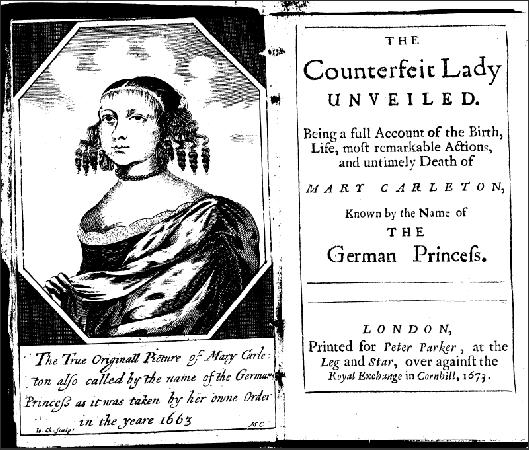
- Francis Kirkman, The Counterfeit Lady Unveiled (1673).
-
Edmund Ludlow, A Voyce from the Watchtower 1660-1662 (Camden fourth series, Volume 21., 1978 ed. Blair Worden)
- Niccolo Machiavelli, Machiavelli: The Prince (2019) [lots about secrecy and deceit]
- Janet Todd and Elizabeth Spearing (eds), Counterfeit Ladies: The Life and Death of Mal Cutpurse & The Case of Mary Carleton (1994).
- Race in Early Modern England, pp. 185-6 (Samuel Ridd), 81-82 (Queen Mary I and King Philip), 91-2 (Queen Elizabeth I of England').
Further reading
On deceit, sincerity and authenticity
- Sharon Achinstein, ‘The Uses of Deception: from Cromwell to Milton’ in Zeller and Schiffhorst,The Witness of Time(1993).
- Donna Andrew,The Perreaus and Mrs. Rudd: Forgery and Betrayal in Eighteenth-Century London(2001).
- Patricia M. Ball, ‘Sincerity: The Rise and Fall of a Critical Term’,The Modern Language Review59, no. 1 (1964): 1-11.
- G. J. Barker-Benfield,The Culture of Sensibility: Sex and Society in Eighteenth-Century Britain(1992).
- Terry Castle,Masquerade and Civilization: The Carnivalesque in Eighteenth-Century English Culture and Fiction(1996).
- Bernard Capp, 'Domestic Exclusions: The Politics of the Household in Early Modern England', in Naomi Pullin and Kathryn Woods (eds),Negotiating Exclusion in Early Modern England, 1550-1800 (2021).
- Catherine Craft-Fairchild, Masquerade and Gender: Disguise and Female Identity in Eighteenth-Century Fictions by Women (1993).
- Laura Gowing, Domestic Dangers: Women, Words and Sex in Early Modern London (1996).
- Leon Guilhamet, Sincere Ideal: Studies on Sincerity in Eighteenth-Century English Literature (Queen’s University Press, 1974).
- Robert G. Ingram, Reformation without end: religion, politics and the past in post-revolutionary England, Politics, culture, and society in early modern Britain (Manchester University Press, 2018).
- Heather Kerr, David Lemmings, and Robert Phiddian, Passions, Sympathy and Print Culture: Public Opinion and Emotional Authenticity in Eighteenth-Century Britain (2016).
- Mark Knights, The Devil in Disguise: Deception, Delusion, and Fanaticism in the Early English Enlightenment (2011).
- Charles Lindholm, ‘The Rise of Expressive Authenticity’, Anthropological Quarterly 86, no. 2 (2013).
- Kristie Macrakis, Espionage: A Concise History (2023), 'Espionage'.
- John Martin, “Inventing sincerity, refashioning prudence: The discovery of the individual in Renaissance Europe.” American Historical Review, vol. 102, no. 5, Jan. 1997, pp. 1309–42.
- Amy Milka, 'Impostors: Performance, Emotion and Genteel Criminality in Late Eighteenth-Century England,' Emotions: History, Culture, Society 1, 2 (2017): 81-107.
- Craig Muldrew, The Economy of Obligation: The Culture of Credit and Social Relations in Early Modern England (1998).
- Anna Pravdica, ‘See sincerity sparkle in thy practice’: Antidotes to Hypocrisy in British Print Sermons, 1640–95’, Studies in Church History 60 (May 2024), 238-263.
- Amelia Rauser, Caricature Unmasked: Irony, Authenticity, and Individualism in Eighteenth-Century English Prints (2008).
- Lionel Trilling, Sincerity and Authenticity (Harvard University Press, 1972).
- Soile Ylivuori, Women and Politeness in Eighteenth-Century England: Bodies, Identities, and Power (2018).
On life-writing, self-fashioning and autobiography
- Margaret Bottrall, Every Man a Phoenix: Studies in Seventeenth Century Autobiography (1958)
-
Andrew Cambers, 'Reading, the godly, and self-writing in England, circa 1580–1720', Journal of British Studies 46 (2007): 796–825.
-
Paul Delany, British autobiography in the seventeenth century(1969)
-
Elspeth Graham, Her Own Life: Autobiographical writings by seventeenth century Englishwomen (1989)
-
S. Greenblatt, Renaissance self-fashioning: from More to Shakespeare (1980)
- Mark Knights, on diaries of the Seventeenth Century: https://www.bbc.co.uk/history/british/civil_war_revolution/diaries_01.shtml
-
Kathleen Lynch, Protestant Autobiography in the Seventeenth-Century Anglophone World (2012).
-
H.Macdonald ‘The Law and Defamatory Biographies in the Seventeenth Century’, Review of English Studies (1944)
-
Michael Mascuch, Origins of the Individualist Self: Autobiography and self-identity in England 1591-1791 (1996)
-
John Morris, Versions of the Self: Studies in English Autobiography from Bunyan to Mill (1966)
-
Roy Porter, Rewriting the Self: Histories from the Renaissance to the Present (1997)
- Allan Pritchard,English Biography in the Seventeenth Century(2005)
-
John Jeffries Martin, Myths of Renaissance Individualism (2006)
-
Adam Smyth, Autobiography in Early Modern England (2010)
-
Adam Smyth, A History of English Autobiography (Cambridge, 2016)
-
Donald Stauffer, Biography before 1700 (1964)
If you'd like to investigate a particular author please ask Naomi or Mark for further reading.
On spies and espionage
- Stephen Alford, 'Some Elizabethan Spies in the Office of Sir Francis Walsingham', in Robyn Adams and Rosanna Cox (eds),Diplomacy and Early Modern Culture(2010).
- Nadine Akkerman, Invisible Agents: Women and Espionage in Seventeenth-Century Britain (2018).
- Christopher M. Andrew, The Secret World: A History of Intelligence (2018).
- J. P. D. Copper, The Queen's Agent: Sir Francis Walsingham and the Rise of Espionage in Elizabethan England (2013).
- Johannes Dillinger, 'Terrorists and Witches: Popular Ideas of Evil in the Early Modern Period', History of European Ideas 30(2) (2004), 167-182.
- Danielle Shaw, 'Thinker, Gaoler, Soldier and Spy: Sir John Peyton (1544-1630) and Early Modern Intelligence-Brokering in the Tower of London, History 108, no. 381 (2023), 262-281.
- D. Szechi, The Dangerous Trade: Spies, Spymasters and the Making of Europe (2010).
-
Rachel Weil, A Plague of Informers: Conspiracy and Political Trust in William III's England (Yale, 2013).
Gypsies, Counterfeit Egyptians and Terrorists
- David Cressy, Gypsies: An English History (2018).
- David Mayall, 'Egyptians and Vagabonds: Representations of the Gypsy in Early Modern Official and Rogue Literature', Immigrants & Minorities, 55-82.
- Francis Timbers, "'The Damned Fraternity": Constructing Gypsy identity in Early Modern England, 1500-1700 (2016).