Seminars and conferences in Italian Studies

Our seminars will normally take place in person, although some events may adopt a hybrid format (using MS Teams). If you'd like to attend one of our events or register for the entire programme, please email Professor Jenny Burns (J dot E dot Burns at warwick dot ac dot uk). All welcome!
Follow us on Instagram

Funded with the support of the Humanities Research Centre
2025-26 Events
Term 3
Week 2
PhD thesis showcase
Gennaro Ambrosino, Kerry Gibbons and Jacopo Mascoli will present their recently completed doctoral theses and discuss both their own projects and the broader doctoral research experience.
Wednesday 6th May, 4.30-6pm, FAB4.02
Week 3
Book launch
Marta Celati, Professor of Medieval and Humanist Literature (Dipartimento Filologia, Letteratura e Linguistica), University of Pisa and Maria Pavlova, Experienced Humboldt Fellow at Goethe Universität Frankfurt, will present their recently-published edited volume, The Prince and the "Condottiero" in Italian Humanism and Renaissance: Literature, History, Political Theory and Art (Peter Lang, 2025).
Presentations will also be offered by Jane Everson, Emeritus Professor, RHUL and Claudia Daniotti, Honorary Research Fellow, Centre for the Study of the Renaissance, Warwick.
Co-hosted with the Centre for the Study of the Renaissance.
Tuesday 12th May, 4-6pm, FAB2.32 and on Teams. Please register here.
Term 2
Week 5
Fabio Simonetti, Honorary Research Fellow, Brunel, University of London, author of Encounters in Wartime Italy: A Social History of Invasion, Liberation, and Occupation (OUP, 2025), 10th February, 3pm, Transnational Resources Centre (FAB4.76)
Week 7
Luca Caminati, Professor of Film Studies, Concordia University, Montreal, HRC Visiting Fellow, hosted by FTV and Italian Cinema Group
February 25th-27th
• Lecture: 'Sandokan’s Thickness: Libidinal Economy, the Subversive Seventies, and Italian Television', 25th February, 5 pm, FAB Cinema (0.21)
• Book presentation with Luca Peretti: ‘The Italian Anticolonial Film Archive: Global Counterculture (1955–1975)’, 26th February, 11.30am-1pm, TRC (FAB4.76)
Week 10
Eleanor Dobson, Associate Professor of English Literature, University of Birmingham, 'Seeing Double: Pompeii, the Gothic Imagination and Anglophone Archaeological Fantasy', 17th March, 5pm, FAB5.03
Abstract:
This talk begins by examining the formative role of Italy – its ruins, excavations, and mythicised landscapes – in shaping the early Anglophone Gothic imagination, inspiring texts by British authors responding to Italy from afar or through travel. Beginning with Horace Walpole, whose The Castle of Otranto (1764) – often pinpointed as the first Gothic novel – not only situates itself in an Italian setting but also frames its narrative through the faux rediscovery of a supposedly Neapolitan incunabulum, the talk opens by establishing how Italy’s material past became a catalyst for eighteenth‑century Gothic sensibilities. Walpole’s own encounters with the excavations at Herculaneum and, after his death, the transfer of Pompeiian artefacts from his collection to that of William Beckford (author of the Gothic-Orientalist fever-dream Vathek [1798]), further illuminate how the nascent discipline of archaeology informed the concerns of the Gothic as the genre emerged and crystallised.
Pompeii provides the most striking early example of this convergence. Systematically excavated from 1748, the site offered not only classical architecture and artworks but the profoundly uncanny traces of the dead themselves. The impression of a woman’s breast found in 1772 and, later, Giuseppe Fiorelli’s plaster casts of victims frozen in the moment of death (pioneered from 1863) themselves inspired countless poetic and artistic engagements that reveal a persistent cultural impulse to animate, aestheticise and even romanticise the dead. Such bodily ‘doubles’ (and counterparts immortalised in text) embody the Freudian uncanny: simultaneously human and not‑human, corpse and artefact, subject and object. In later literature and travel writing to which the talk then turns – from Felicia Hemans to Mark Twain, and subsequently in cinema – Pompeii (re)emerges as a site where archaeology performs a kind of Gothic resurrection, collapsing temporal strata and confronting audiences with the persistence of a perpetually haunting past.
By situating these Anglophone responses within Italy’s central role as both physical site and cultural imaginary, I argue that archaeology in Italy did not merely influence Gothic literature: it offered the quintessential terrain through which British and American writers – even when geographically distant – conceived of their own uncanny encounters with history, materiality and the dead. Subsequently, even in diverse genres, we see Pompeii retain a singular Gothic gravity, a place where ancient and modern bodies repeatedly surface as uncanny doubles of one another.
Term 1


2024-25 Events
Term 3


Term 2
15 January, OCO.05 and online: book launch. A conversation between Dr. Anna Lanfranchi and Dr. Mila Milani, chaired by Dr. Qian Liu, on Dr. Lanfranchi's recently published Translations and Copyright in the Italian Book Trade: Publishers, Agents, and the State (1900–1947) (Cham, Switzerland: Palgrave, 2024). An event of the Translation and Transcultural Studies Reading Group, in collaboration with the Italian Studies Research Seminar Series
11 April, 3PM, online: Speaking with the Dead 2.0. In collaboration with the Revolving Century Network and <em>Ottocentismi</em>Link opens in a new window
Term 1


2023-24 Events
Term 1


Term 2


Term 3


Previous years
Research Seminars 2021-22,organised by Dr Federica Coluzzi and Dr Luca Peretti
Term 2


Research Seminars 2020-21 organised by Dr Maria Pavlova and Dr Federica Coluzzi


Past Events
The 2022-23 Research seminars are now also available as podcast.
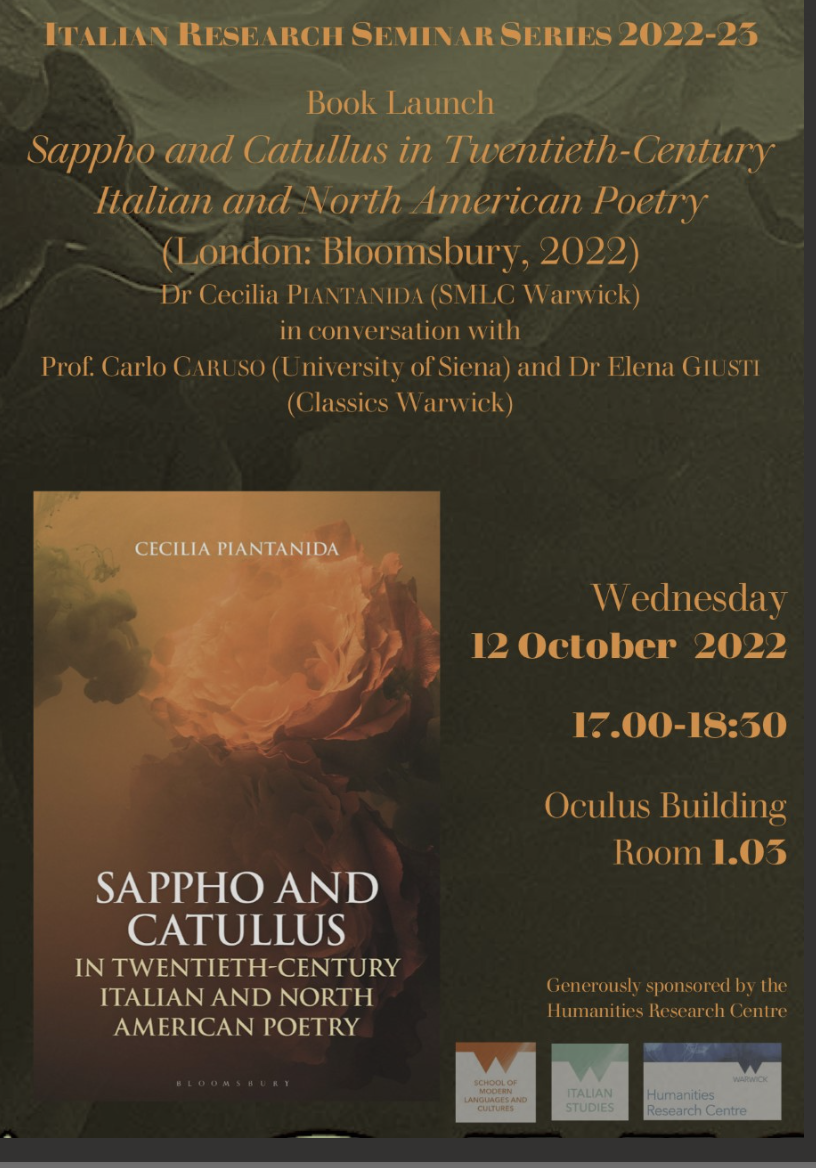
Listen to the Book launch of "Sappho and Catullus in Twentieth-Century Italian and North American Poetry (London: Bloomsbury, 2022), with Prof. Carlo Caruso (Siena), Dr Elena Giusti (Warwick) and author Dr Cecilia Piantanida (Warwick)