
The ABRC Presents: Guest Speaker Seminar Series
Upcoming Seminars in this Series
Professor Gina Rippon: The Lost Girls of Autism
How science failed autistic women and the new research thats changing the story
Thursday 19th March 2026 - GLT1, 12:30
(with a light lunch available for attendees from 12:00, outside GLT1)
This lecture will cover the long-standing male bias in autism studies. Professor Gina Rippon will examine how this skewed evidence base has limited understanding of sex differences in autism, discuss emerging findings on camouflaging and social engagement in autistic females, and outline proposed differences in cortical connectivity and activation within the social brain.
Register your attendance here!Link opens in a new window
find GLT1 here: https://link.mazemap.com/PbBGNyusLink opens in a new window
Teams link: https://teams.microsoft.com/meet/34154686115405?p=CrTh2ODhiHCJOPYApPLink opens in a new window
Talk Abstract
The long-standing stereotype of autism as primarily a male problem appears to have significantly skewed data collection in this area. A recent survey of more than 100 studies on social brain activation in autism, between the years of 1990 and 2020, revealed that nearly 70% of the studies were effectively ‘men only’. Of the more than four thousand autistic participants tested overall, less than 10% were female. It is clear that this corpus of research will have had little to offer in explorations of the brain bases of the sex-based differences in autism emerging from behavioural research.Whereas the traditional profile of autism is of aloof, socially isolated individuals (mainly male), it is now emerging that there is a significant proportion of autistic individuals (mainly female) who show high levels of attempted social engagement. This pattern of behaviour is associated with patterns of ‘camouflaging’ behaviour, where individuals devise social behavioural strategies aimed at concealing atypical behaviours which could mark them out as different or ‘other’.
This paper draws attention to newer studies which are beginning to explore the brain bases of such behavioural differences, and proposes a model based on autistic female/male differences in patterns of cortical connectivity and/or activation in the social brain.
Speaker Biography
Professor Gina Rippon is Professor Emeritus of Cognitive NeuroImaging at Aston University in the UK. Her research involves the use of state-of-the-art brain imaging techniques to investigate developmental disorders such as autism, profiling different patterns of brain activity in autistic children and adults.
Her current research explores the under-recognition of autism in women and girls, especially in neuroscience research. Her new book on this topic The Lost Girls of Autism was released in April 2025.
She also explores the use of neuroscience techniques to investigate social processes, especially those associated with sex/gender differences in the human brain. She has published and commented widely on neuroscience and psychology research in this area, challenging traditional sex/gender stereotypes and publishing guidelines to ensure accurate and transparent research in the area. Her book on such topics, ‘The Gendered Brain’, published by Bodley Head and Penguin Random House, came out in the UK in 2019.
She is an outspoken critic of ’neurotrash’, the populist (mis)use of neuroscience research to (mis)represent our understanding of brain-behaviour links, particularly on the topic of sex/gender differences. She campaigns widely against misinformation in science, frequently working with science journalists to ensure their stories accurately reflect what the science has shown. She also works with science writers to ensure they avoid misrepresentation or misunderstanding in their work. She and colleagues have published sets of recommendations and guidelines to ensure accuracy and transparency in science communication.
She is a passionate supporter of initiatives to address the under-representation of women in all spheres of influence, especially science. She has developed brain-based models with which to investigate gender gaps and has acted as a consultant for many professional Equality, Diversity and Inclusion initiatives world-wide, including international businesses’ and policy-making groups such as the UK’s Cabinet Office and the EU.
She is very active in the field of the public communication of science and has made many appearances in science and book festivals across the UK, as well as Europe the US and Australia. She is a member of Robert Peston’s Speakers4Schools and visits schools to talk to students about their brains. In 2015, she was made an Honorary Fellow of the British Science Association for services to science communication.
Past Seminars in this Series
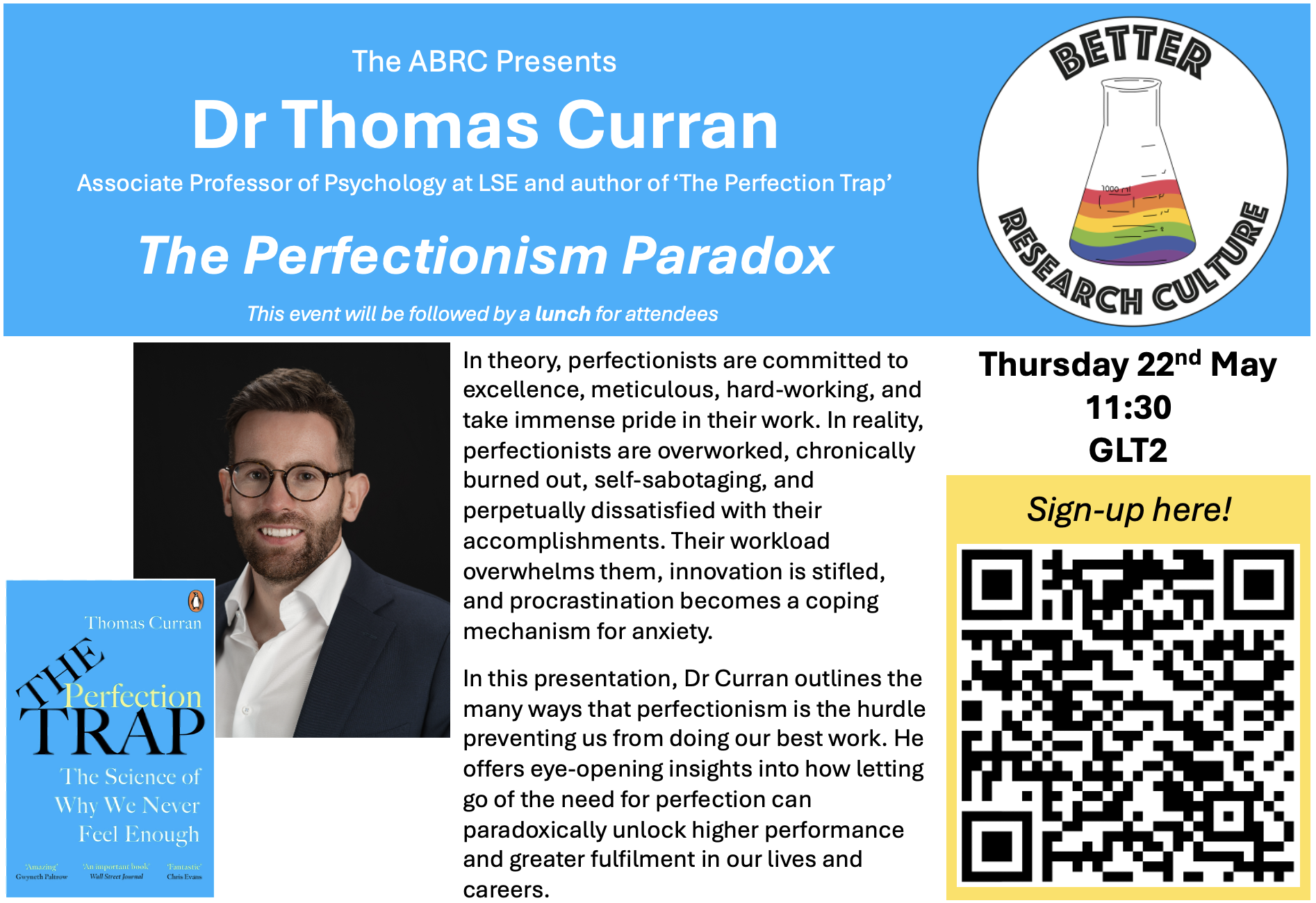
Dr Thomas Curran: The Perfectionism Paradox
The ABRC are excited to welcomeDr Thomas Curran, Associate Professor of Psychology at LSE and author of ‘The Perfection Trap’, in a discussion about perfectionism.
When: Thursday 22nd May, 11.30
Where: GLT2 (Gibbet Hill, Medical School Building)find it hereLink opens in a new window
This seminar will be followed by alunchfor attendees, inLower Ground Floor Atrium IBRB.
Sign-up is essential for catering purposes.
All are welcome to attend this event,please sign up here!Link opens in a new window
Primarily, this is an in-person event, but for those working elsewhere,please add this Teams link to your calendar.Link opens in a new window
Talk Abstract
In theory, perfectionists are committed to excellence, meticulous, hard-working, and take immense pride in their work. In reality, perfectionists are overworked, chronically burned out, self-sabotaging, and perpetually dissatisfied with their accomplishments. Not only do they suffer, their work suffers as well. Their workload overwhelms them because they struggle to delegate. Innovation is stifled because they’re too scared of failure to take risks and try new things. Procrastination becomes a coping mechanism for the anxiety that comes when facing challenging tasks. In this presentation, Thomas Curran outlines the many ways that perfectionism itself is the hurdle preventing us from doing our best work. With illuminating case studies and evidence-based strategies, he offers eye-opening insights into how letting go of the need for perfection can paradoxically unlock higher performance and greater fulfilment in our lives and careers.
Speaker Biography
Dr Thomas Curran is the world's leading expert on perfectionism, author of the international best-selling book The Perfection Trap, and acclaimed professor of psychology at the London School of Economics.
His TED Talk on perfectionism received over three million views, he has written for major international publications such as TIME magazine and the Harvard Business Review, and his work has been featured in the BBC, New Scientist, New York Times, CNN, and Wall Street Journal.
Through extensive research, public speaking, consulting services, and academic instruction, Thomas is leading the global conversation on perfectionism. His mission? To uncover: the root of perfectionism, what it does to us, why it's on the rise and what we can do to stop it.
As a self-proclaimed perfectionist, Dr Thomas Curran is fighting against the modern-day imperative of 'do more, have more' and instead brings realism to the table, teaching us that the unrelenting treadmill of perfectionism is not only burning us out but ultimately destructive for our happiness and performances.
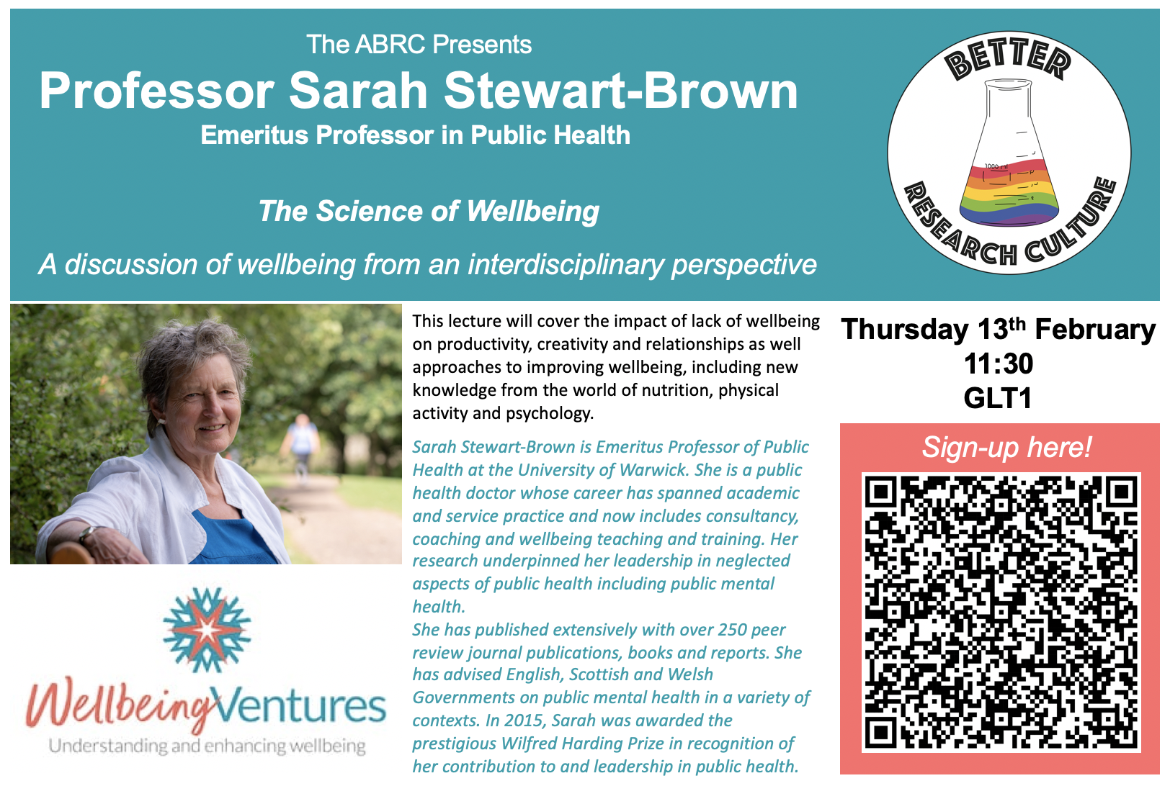
Professor Sarah Stewart-Brown: The Science of Wellbeing
The ABRC are excited to welcome Professor Sarah Stewart-Brown, from Wellbeing Ventures, in a discussion about wellbeing from a scientific perspective.
When: Thursday 13th February, 11.30
Where: GLT1 (Gibbet Hill, Medical School Building)
This seminar will be followed by a networking lunch for attendees, in Lower Ground Floor Atrium IBRB.
All are welcome to attend this event, please sign up here!Link opens in a new window
Talk Abstract
This lecture will address the science of wellbeing from an interdisciplinary perspective. It will cover the impact of lack of wellbeing on productivity, creativity and relationships as well approaches to improving wellbeing. It will discuss the value of changing the environment in the workplace and the value of changing the self, including new knowledge from the world of nutrition, physical activity and psychology.
Speaker Biography
Sarah Stewart-Brown is Emeritus Professor of Public Health at the University of Warwick. She is a public health doctor whose career has spanned academic and service practice and now includes consultancy, coaching and wellbeing teaching and training. Her research underpinned her leadership in neglected aspects of public health including public mental health. Her most recent contributions lie in the development and validation of measures of mental wellbeing, the identification of risk and protective factors for mental illness and primary and secondary research on different approaches to the promotion of mental health and wellbeing. She is currently an expert adviser to several research projects and programmes including the NIHR Public Health Intervention Responsive Studies Team (PHIRST) and ATTUNE, an MRC funded multisite collaboration between the Universities of Oxford Falmouth Kent Leeds QMUL KCL UCL and Greenwich exploring young people’s mental health following adverse childhood experiences
Early in her career Sarah worked in the UK NHS in paediatrics and in public health giving her practical experience of health care as well as expertise in research and teaching. She has published extensively with over 250 peer review journal publications, books, book chapters and reports. She holds a Doctor of Philosophy Degree from Bristol University and is a fellow of the Faculty of Public Health and the Royal College of Physicians of London.
She has advised English, Scottish and Welsh Governments on public mental health in a variety of contexts. In 2015 Sarah was awarded the prestigious Wilfred Harding Prize by the Faculty of Public Health in recognition of her contribution to and leadership in public health.