
WMG News - Latest news from WMG
WMG supports Kenilworth school children in national STEM competition
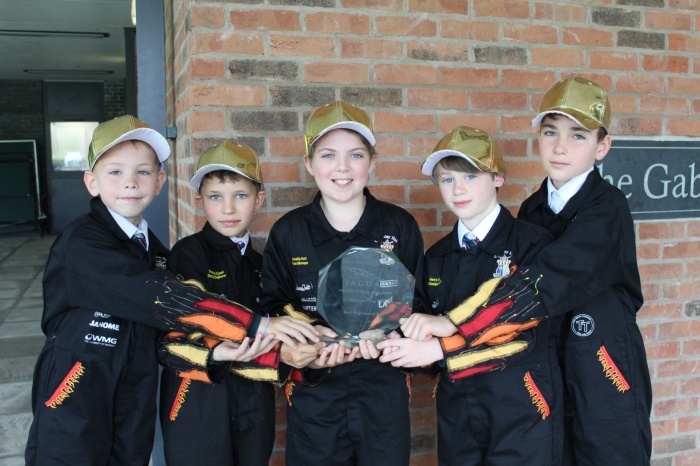 Staff from WMG have been supporting the Firecrackers, a team of five Year 4 children from Crackley Hall School in Kenilworth, at the Jaguar Primary School Challenge.
The Jaguar Primary School Challenge is a STEM competition, with the aim being to inspire children to consider engineering as a career.
Professor Alan Chalmers, Dr Ali Asadipour and Maria Vasquez Caropres supported the Firecrackers throughout the project to research, design, manufacture, test, promote and race the fastest car possible using standard chassis and engine housing nets to create a car body made only from card.
The team’s achievements were first put to the test at the Regional Finals at Princethorpe College in May. The standard was incredibly high, with the Firecrackers taking second place overall and qualifying for the National Finals. The team also won the awards for Best Engineered Car, Best Portfolio and Best Pit Display.
The WMG team then set about helping the Firecrackers to prepare and modify their car for the National Finals which was held in June at the British Motor Museum, Gaydon.
Each car was judged by a panel of experts from Jaguar Land Rover with the design, portfolio and pit display all examined in detail. The children were also required to give a presentation, before the car was plugged into a compressed air canister and raced down a special track.
Although not the fastest on the day, the judges were highly impressed by the final design, and the clear and articulate manner in which the children were able to present their design decisions. The Firecrackers were delighted to be awarded the “Best Engineered Car” title ahead of 38 other teams from across the country. 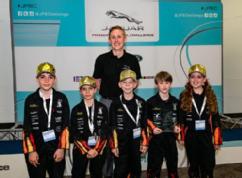
Professor Alan Chalmers said: “The collaboration has been rewarding for all involved. The children have on many occasions expressed their enthusiasm for engineering. We’re looking forward to supporting next year’s team, and perhaps even winning the title of Fastest Car!”
Find out more about the Jaguar Primary School Challenge here.
Royal Institution Masterclasses 2019
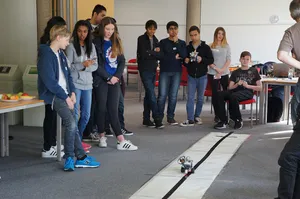
In the Autumn term, local schools were invited to nominate two year 9 pupils (1 boy, 1 girl) to attend the Saturday morning Royal Institution Engineering Masterclasses in WMG, at the University of Warwick in the spring term. These classes commenced on Saturday 26th January.
This Series aims to open the eyes of young people to the excitement, beauty and value of engineering, and in turn, inspire the next generation of scientists, mathematicians and engineers.
The Series is delivered by staff and students from WMG. Each masterclass focuses on an aspect of modern engineering and is presented by an engineer actively involved in research or working in industry. The classes take the form of interactive workshop sessions.
The dates for the RI Masterclasses 2019 Series are:
Saturday mornings January 26th, February 2nd and 9th, March 2nd, 9th, 16th.
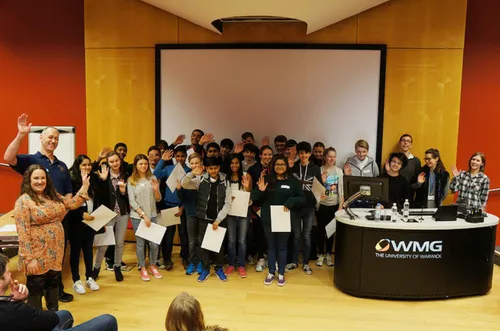
The sessions delivered in 2019 are listed below.
- Software and Control: Margaret Low
- Computer Aided Design and 3D printing: Diane Burton
- The Power of Process: Mairi Macintyre
- Crash Structures from Recycled Materials: Peter Wilson
- Autonomous Vehicles - a taste of things to come: Valentina Donzella
- Welcome to Batteries: Mel Loveridge + Eve Wheeler-Jones
Warwick submarine team are winners in the US
The Warwick Submarine team which consists of six 4th year engineering students, have won the ‘Smooth Operator’ award for their human powered submarine, at the International Submarine Races (ISR-15) in Maryland, USA.
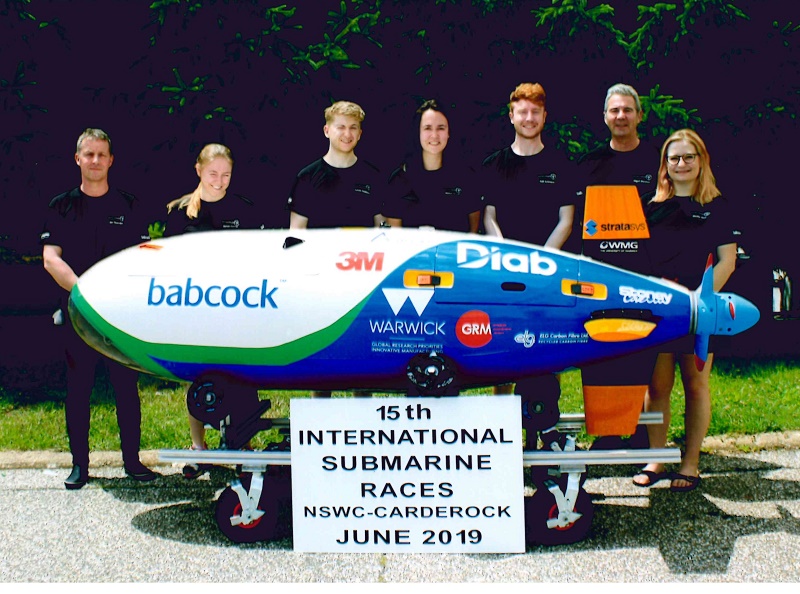 The Warwick Submarine team have entered the international competition six times since 2013, which this year was held in Maryland in the US, and won the award for ‘Smooth Operator’.
The six 4th year engineering students Helen Boyle, Sarah Kemp, Rebecca Seal, Ash Leonard, Giles Collee and Lewis Robbins had to design and build a human powered submarine and race it in an underwater course against other top science and marine engineering students from across the world.
In the racing, Godiva was able to achieve a speed of 2.88 knots – the best yet for the Warwick team and possibly a UK record. Godiva remains the UK champions in this competition.
The team had access to cutting-edge engineering research from WMG and the School of Engineering at the University of Warwick as well as help from their sponsorship partners, which include Babcock, Stratasys and 3M.
Nigel Denton from WMG (a Nationally-Qualified Diving Instructor) enabled the students on the team to become qualified divers. This is a requirement of all participants in the competition; notably, the pilot of the submarine breaths from on-board scuba equipment.
The pilot lies prone in the submarine and propels the submarine by pedalling. Derived from a bicycle, the pedal power transfers through a bevel-gearbox powertrain connected to the contra-rotating propellers. To steer the submarine, the pilot manipulates levers, which control dive-planes for pitch (up and down) and yaw (left and right).
To ensure the safety of the pilot, an emergency buoy is released to the surface if the pilot lets go of the spring-loaded ‘dead man's switch’. A light attached to the hull helps the support team locate the submarine in low light conditions. These measures alert the US Navy divers who provide close support.
The ‘Smooth Operator’ award recognises the team that was best organised in terms of race preparation, efficiency of operation (including on-the-startline pilot ‘lock-and-load’ drill), problem solving, effecting running repairs and overall reliability. It is a huge accolade for the Godiva team to have won this against very significant competition, notably from the Omer team (from the École de Technologie Supérieure, Montreal) and Delft’s WASUB team.
Ian Tuersley, from WMG, who has been the Project Director on the Warwick Submarine project for the past seven years said:
“Once again the Warwick Submarine ‘Godiva’ team have achieved an excellent result at the International Submarine Races. The ‘Smooth Operator’ award is testament to the hard work that the team have put in all year, not just to the engineering aspects of the project but also to such necessities as gathering the support of sponsors and the logistics of simply attending the competition with a viable racing submarine. In this project they have received support and advice from many people but the end result places us in a strong position for future development. I am immensely proud of all that they have achieved”.
Rebecca Seal, University of Warwick engineering student from the Godiva Warwick Submarine Team explains:
“Getting involved with ISR has helped translate theoretical knowledge of engineering to more practical and hands on skills. This sort of experience is exactly what I need to help pursue a career as a professional engineer.”
ENDS
NOTES TO EDITORS:
High-res images and videos are available.
Full list of sponsors include:
The principal external/industry sponsors:
· Babcock
· Stratasys
· 3M
Others who have provided very welcome support or advice are:
· Diab,
· GRM Consulting,
· Stoney Cove Diving Centre
· ELG Carbon Fibre
FOR FURTHER INFORMATION PLEASE CONTACT:
Alice Scott
Media Relations Manager – Science
University of Warwick
Tel: +44 (0) 2476 574 255 or +44 (0) 7920 531 221
E-mail: alice.j.scott@warwick.ac.uk
WMG welcomes a senior delegation from China Energy
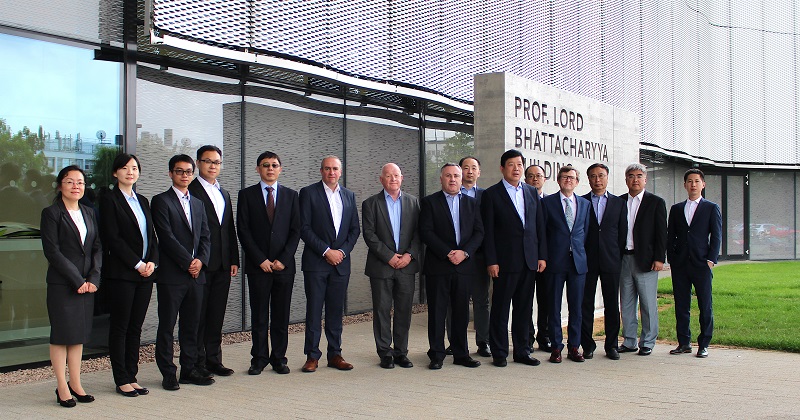 Professor David Mullins, Acting Head of WMG, was delighted to welcome Mr Li Dong, Executive Vice President of China Energy to WMG.
Mr Li Dong was accompanied by a senior delegation from China Energy and subsidiary companies China Shenhua Energy Co. Ltd - the largest coal company in the world, and Pujing Chemical Industry.
WMG’s Nanocomposites research team is currently working with colleagues at China Shenhua Energy Co. Ltd and Pujing Chemical Industry on the development of sustainable and environmentally friendly fully biodegradable plastics.
Dr Chaoying Wan and Professor Tony McNally updated the guests on the project, and the delegation toured other key WMG research facilities in Composites, Additive Layer Manufacturing (ALM), Metrology and Battery Technology.
Professor Tony McNally said: “At a time when the sustainability of single use plastics has become a global issue, the WMG partnership with China Shenhua Energy Co. Ltd and Pujing Chemical Industry is internationally leading. Our goal is to develop fully biodegradable plastics that decompose to benign components, such as water and, that can replace many of the single use plastics used in packaging.”
Do passengers prefer autonomous vehicles driven like machines or like humans?– research finds that “peeking round” corners provides answers
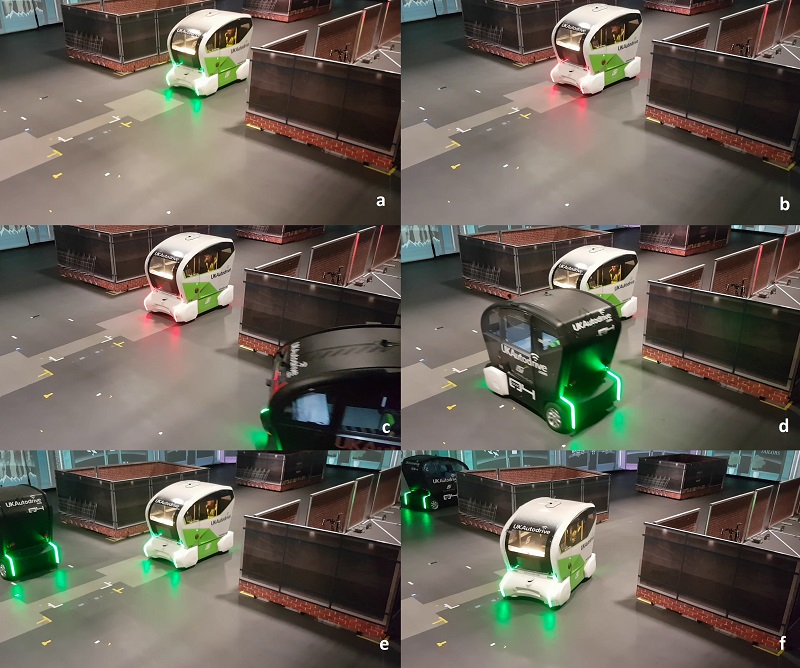 Passenger and pedestrian confidence and acceptance will be key to the future and development of autonomous vehicles so researchers at WMG at the University of Warwick have just conducted and reported an experiment to see which autonomous vehicles driving style engendered the highest levels of confidence among autonomous vehicles passengers – driving with full machine efficiency, or driving in a way that emulates average human driving. The surprising result was that neither was optimal but that a blend of both might be best.
The researchers took 43 volunteers into a large warehouse designed to resemble a pedestrianised area in a town centre with a series of routes that included a range of junctions. Half were given 4 journeys around the route in an autonomous vehicle driving with full machine efficiency using all its capabilities to drive in as safe and efficient manner as possible while the others were given 4 journeys around the route in autonomous vehicles that tried to closely emulate average human driving patterns. They then scored the level of trust in the autonomous vehicles. The result has have just been published in the journal Information (2019, 10, 219; doi:10.3390/info10060219).
The overall result was that there was only a marginal difference in trust between the two driving methods. The efficient machine method was slightly favoured but even that small gap between the two driving styles narrowed over the four runs. What was noticeable for both the “machine” and “human“ driving styles is that confidence in both grew with each new round suggesting that simple familiarity and growing accustomed to the experience will be one of the most effective ways of quickly building trust and acceptance of autonomous vehicles once their use becomes more widespread.
|
Mean scores of trust |
Human |
Machine |
|
First Run |
59.30 |
63.19 |
|
Second Run |
59.55 |
66.33 |
|
Third Run |
65.85 |
68.29 |
|
Fourth Run |
67.20 |
69.38 |
Dr Luis Oliveira from WMG at the University of Warwick and the lead author on the paper said:
“The overall trust in both driving methods grew with every run. In the machine-like driving style this was steady upwards curve throughout the four journeys but in human-like behaviour there was a particularly steep change upwards in the scores between runs 2 and 3. The passengers in the experiment also acknowledged that future generations may be more comfortable with AVs and its features, as they learn to live with the new technology.”
The researchers also asked the participants to give some narrative about their experience and this showed that there were advantages on both modes of driving that may therefore need to be blended together in any future final package. The researchers’ literature review and warehouse experiment made clear that there re were two particularly clear lessons to be learned:
Smooth speed change – Past studies had already shown that Human drivers’ tendency is to break most at the start of any manoeuvre that requires deceleration whilst the totally automated driving programmes applied speed changes more gradually and efficiently. Human passengers preferred the comfort of the smoother changes of acceleration and deceleration provided by the machine driving methods.
Sharp turns - A common complaint was a feeling that the vehicles were performing uncomfortable and worrying sharp turns. This feeling was actually expressed by both those in the machine and Human style driving set ups but it was much more noticeable in the machine-like driving style condition. One typical negative comment was “what you’d expect from a driver is a bit of a gradual turn….there were moments where it was accelerating around corners, I think it catches you unaware.”
WMG’s Dr Luis Oliveira said:
“This shows that the challenge is that the speed and trajectory of autonomous vehicles should be finely controlled, but at the same time the vehicle should be assertive to provide the benefits of automated driving."
However it was the AV’s behaviours at junctions in the WMG University of Warwick warehouse test that produced the most diverse and surprising reactions.
The machine driven AVs were left to make use of all of their sensors and ability to communicate with vehicles that may out of line of sight to decide whether to enter a junction. If their sensors said it was safe and their communications with other vehicles indicated no approaching threats they would simply enter the junction without stopping. If however they detected a vehicle that they believed should have right of way – even if it was not yet visible to the human passenger they would stop and let that vehicle pass. In contrast The AV’s emulating human driving would always stop at a junction and would even edge into the junction as if the peek at what the oncoming traffic might be.
The reactions to those two different approaches were very varied and surprising.
Some liked the human approach with one saying that the AV was “…probably trying to inspire confidence in the passenger, I’m guessing, in terms of like the way it behaved, kind of quite similar to a human, it’s only ever going to inspire confidence I think it’s because that’s what we’re used to”.
Some also liked the machine driving approach of stopping at junctions even though there was no visible issue but because it was in communication with another out of sight vehicle that it perceived had right of way. One passage said: “it stopped at a junction, because I assume it knew that something was coming, as opposed to it reacting to seeing something coming”.
Equally there was dislike for both the human and machine driving methods of handling a junction.
Some perceived problems with the machine approach of just entering the junction if it believed it to be clear to do so with one saying that they were concerned about vulnerable road users. “..such as pedestrians or cyclists that could have been there that don’t communicate with the pod. That may be a safer way of doing it rather than flying around the corner”.
However others were greatly surprised at the “human” driving method AV stopping at every junction as they saw it not just as waste of the machines capabilities to scan and communicate ahead to understand traffic. They were frustrated that the vehicle was not “more assertive” One passenger saying “sometimes I didn’t expect it to stop, because I thought the other pod was a bit further away but then it did, so I guess it’s cautious…if I was driving I’d probably have gone”. Another passenger said “If I was in an autonomous pod with sensors giving a 360-degree view at all times, I’d expect the vehicle to instantaneously know whether it was safe or not, and not need to edge out”.
A further passenger who tested the human-like version, commented that a machine driving like a human and trying to look around the corners seemed ironically unnatural saying: “I think it was a bit unexpected because my expectation with the pods is that that there would be some un-naturalism to it rather than a human driver”.
Despite this seeming mass of contradictions in views about how AVs should handle junctions the research team do think there are valuable lessons to be learned even here. In particular:
- There is clearly a need to give the general public the details of the driving systems, for example, the recent technological features such as vehicle to vehicle communication
- For passengers in a vehicle consideration should be given to having a display and/or audio information that shares some of the information the vehicle is using so users can understand that the system is aware of hazards beyond the field of view.
- There may be some merit in presenting the full benefits of the most efficient methods of machine based driving progressively when mass use is first introduced, so that passengers can build confidence over time
Note for editors: The full list of authors on the paper is Luis Oliveira (corresponding authour), Christopher G. Burns, and Professor Stewart Birrell (all of WMG at the University of Warwick at time of publication of the journal article) and Karl Proctor of Jaguar Land Rover.
For further details please contact:
Luke Walton, International Press Manager
University of Warwick
L.Walton.1@warwick.ac.uk
+44 (0) 7823 362 150
Or
Peter Dunn, Director of Press and Media Relations
University of Warwick
Tel office: 024 76523708 UK +44 (0)24 76523708 International
Mobile/Cell: 07767 655860 UK +44 (0)7767 655860 International
Email p.j.dunn@warwick.ac.uk
Or
Lisa Harding, Head of Marketing and Communications, WMG,
University of Warwick Tel: 024 76 524721 or 07824 540845
email L.Barwick@warwick.ac.uk
WMG brings together key experts to discuss the future of transport
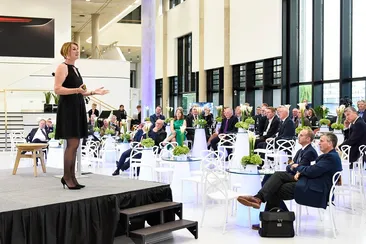 Last week, WMG High Value Manufacturing Catapult hosted an Autonomous, Connected, Electric and Shared (ACES) networking dinner in partnership with NatWest and Lombard.
The event brought together CEOs, CTOs and senior executives from UK leaders in the sector, speakers included Jaguar Land Rover, Aston Martin, Rolls Royce, GiffGaff, WMG, You.Smart.Thing and FiveAI, to discuss how ACES technologies will radically change the way we travel.
There is a global call to both reduce emissions and also to ease congestion and increase the simplicity, safety and speed at which passengers are able to get from point A to B. There is no doubt that the future of transport will be ACES.
The UK has always been at the forefront of transport innovation and manufacturing, and needs to continue to bring manufacturers and governing bodies together to push forward the ACES transport agenda and ensure the UK remains competitive in a global market.
WMG, NatWest and Lombard will be releasing thought leadership pieces from expert industry leaders, sharing the challenges and opportunities for the UK transport sector.
Click here to read the Natwest article
For more information or to get involved please contact: wmgbusiness@warwick.ac.uk
WMG staff begin 5 day marathon cycle in memory of Coventry boy with rare cancer
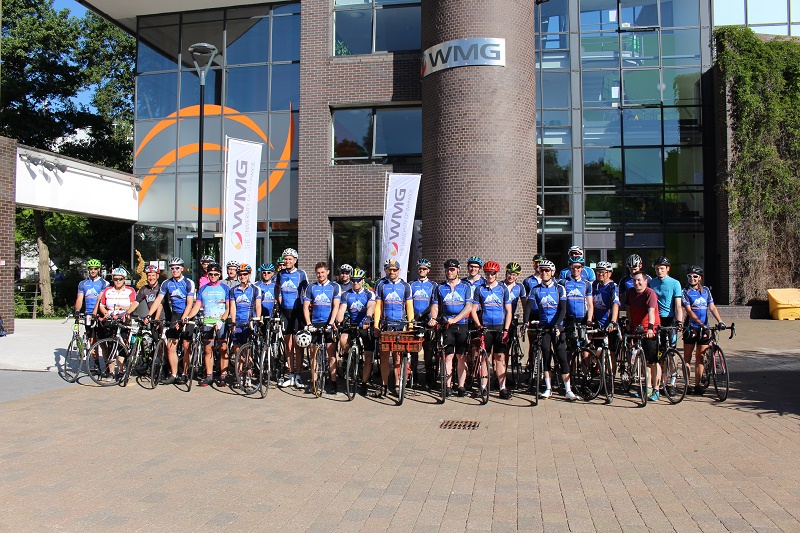 Nine staff from WMG at the University of Warwick have come together in a sponsored cycle marathon starting Tuesday 2nd July with the aim to raise £1,000 towards the total of £50,000 for charities researching a rare cancer called Alveolar Rhabdomyosarcoma, in memory of Ben Crowther, the young son of a WMG member of staff Scott Crowther, who died earlier this week.
The plan is to cycle from WMG at the University of Warwick to the partner centres of the UK-wide High Value Manufacturing (HVM) Catapult network. All of the “Pass the Smile for Ben” cycle team will cycle cycling 90 miles to the next HVM centre, AMRC in Sheffield. Two of the riders Benjamin Silverstone and James Black will continue for a full five days finishing at Glasgow on Friday 5th July.
The funds raised by the race and/or donated to Ben and charities researching Alveolar Rhabdomyosarcoma via this fundraising page
https://www.gofundme.com/f/wmg-hvmc-cycle-challenge
will go directly to research for Rhabdomyosarcoma.
The team will leave the WMG concourse, on the University of Warwick campus, on their marathon cycle ride at 8:30am on Tuesday 2nd of July.
Archie MacPherson presents at key ERC conference
Archie MacPherson, CEO of the High Value Manufacturing (HVM) Catapult at WMG is part of the expert panel at the Enterprise Research Centre (ERC)’s State of Small Business Britain Conference 2019, taking place at The Shard in London today.
 Archie joins automotive experts as well as representatives of the FSB and officials from the Department of Business, Innovation and Industrial Strategy, to discuss how to strengthen key sectors of the economy.
He explains: “Support is needed now, more than ever, from the High Value Manufacturing Catapult to ensure that UK businesses maintain competitiveness during this period of uncertainty in UK Manufacturing.”
The ERC’s State of Small Business Britain report, which was launched at the Conference, presents a new analysis of the fortunes of the manufacturing and services sectors since the Great Recession of a decade ago.
The report provides a broader snapshot of the health of UK manufacturers in light of recent announcements about factory closures and job losses by the carmakers Ford at Bridgend and Honda at Swindon which the Society of Motor Manufacturers and Traders (SMMT) has estimated could lead to the loss of 60,000 jobs directly and in supply chains. In May, British Steel collapsed into administration after a last-ditch appeal to the Government, putting a further 25,000 jobs at risk.
Following the Conference, Archie will be making his way back to WMG for “The Future will be Autonomous, Connected, Electric and Shared (ACES)” networking dinner bringing together global leaders in the transport and communications sector. Guests will discuss the opportunities and challenges that ACES technology can bring.
ENDS
About High Value Manufacturing (HVM) Catapult at WMG
WMG is one of the founding members of the High Value Manufacturing Catapult (HVMC), and the lead centre for Vehicle Electrification and Connected and Autonomous Vehicles (CAV) within the HVMC network. The centre is also active in showing how Digital Manufacturing technologies can help improve company and supply chain competitiveness.
As part of the £640m Government funding package for HVM Catapult, WMG was allocated £100m in 2018 to continue strengthening UK industry through collaborative R&D, innovation and technology transfer from automotive into other transport sectors over the next five years.
About the Enterprise Research Centre
ERC is the UK’s leading independent research institute on the drivers behind the growth and productivity of small and medium-sized enterprises (SMEs). It is funded by the Department for Business, Energy and Industrial Strategy (BEIS), the Economic and Social Research Council (ESRC), Innovate UK, The Intellectual Property Office (IPO) and the British Business Bank (BBB).
ERC is producing the new knowledge around SMEs that will allow us to create a business-friendly environment nationwide, grounded in hard evidence. We want to understand what makes entrepreneurs and firms thrive so we can spread the lessons from best practice and make the UK a more successful economy.
The Centre is led by Professors Stephen Roper of Warwick Business School and Mark Hart of Aston University, Birmingham. Our senior researchers are world-class academics from both Aston and Warwick Universities as well as from our partner institutions which include Imperial College, Queens University Belfast and the University of Strathclyde.
Professor Lord Bhattacharyya Lifetime Achievement Award presented to Lancaster University technician
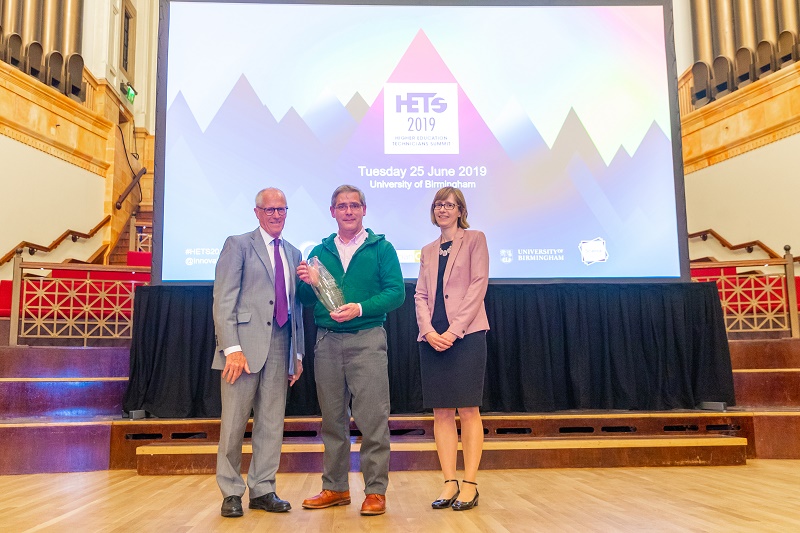 Yesterday (Tuesday 25th June) Jane Coleman, Chief Operating Officer at WMG, presented John Baum from Lancaster University with the Professor Lord Bhattacharyya Lifetime Achievement Award for Technical Excellence, at the Papin Prize Awards at The Higher Education Technicians Summit.
The Professor Lord Bhattacharyya Lifetime Achievement Award recognises continued excellence and/or significant achievements across an individual's technical career.
John was given the award for his strong commitment to Chemistry outreach, running activities for over 1000 kids and members of the community. He has been a lab technician since 1978 in Higher Education and industry. His nominator commented that “his devotion to outreach is outstanding, working weekends and long hours to prepare.”
The Summit is the largest event held specifically for UK Higher Education technical staff with sessions focused on technical skills and education including the importance of technical skills in driving forward innovation, and current initiatives to ensure the future provision of technical education to young people.
Professor Lord Bhattacharyya was passionate about tackling the UK’s skills shortage and highlighting the important role of technicians in contributing to internationally-leading education and research. He also recognised their role as ambassadors for science and engineering.
The Summit, hosted by Midlands Innovation in collaboration with Science Council, took place at the University of Birmingham. Find out more about the awards here.
How you charge your mobile phone could compromise its battery lifespan
Researchers at WMG at the University of Warwick have found that use of inductive charging, whilst highly convenient, risks depleting the life of mobile phones using typical LIBs (Lithium-ion batteries)
Consumers and manufacturers have ramped up their interest in this convenient charging technology, abandoning fiddling with plugs and cables in a favour of just setting the phone directly on a charging base.
Standardisation of charging stations, and inclusion of inductive charging coils in many new smartphones has led to rapidly increasing adoption of the technology. In 2017, 15 automobile models announced the inclusion of consoles within vehicles for inductively charging consumer electronic devices, such as smartphones – and at a much larger scale, many are considering it for charging electric vehicle batteries.
Inductive charging enables a power source to transmit energy across an air gap, without the use of connecting wire but one of the main issues with this mode of charging is the amount of unwanted and potentially damaging heat that can be generated. There are several sources of heat generation associated with any inductive charging system – in both the charger and the device being charged. This additional heating is made worse by the fact that the device and the charging base are in close physical contact, any heat generated in one device may be transferred to the other by simple thermal conduction and convection.
In a smartphone, the power receiving coil is close to the back cover of the phone (which is usually electrically non-conductive) and packaging constraints necessitate placement of the phone’s battery and power electronics in close proximity, with limited opportunities to dissipate heat generated in the phone, or shield the phone from heat generated by the charger. It has been well-documented that batteries age more quickly when stored at elevated temperatures and that exposure to higher temperatures can thus significantly influence the state-of-health (SoH) of batteries over their useful lifetime.
The rule of thumb (or more technically the Arrhenuis equation) is that for most chemical reactions, the reaction rate doubles with each 10 °C rise in temperature. In a battery, the reactions which can occur include the accelerated growth rate of passivating films (a thin inert coating making the surface underneath unreactive) on the cell’s electrodes. This occurs by way of cell redox reactions, which irreversibly increase the internal resistance of the cell, ultimately resulting in performance degradation and failure. A lithium ion battery dwelling above 30 °C is typically considered to be at elevated temperature exposing the battery to risk of a shortened useful life.
Guidelines issued by battery manufacturers also specify that the upper operational temperature range of their products should not surpass the 50−60 °C range to avoid gas generation and catastrophic failure.
These facts led WMG researchers to carry out experiments comparing the temperature rises in normal battery charging by wire with inductive charging. However the WMG were even more interested in inductive charging when the consumer misaligns the phone on the charging base. To compensate for poor alignment of the phone and the charger, inductive charging systems typically increase the transmitter power and/or adjust their operating frequency, which incurs further efficiency losses and increases heat generation.
This misalignment can be a very common occurrence as the actual position of the receiving antenna in the phone is not always intuitive or obvious to the consumer using the phone. The WMG research team therefore also tested phone charging with deliberate misalignment of transmitter and receiver coils.
All three charging methods (wire, aligned inductive and misaligned inductive) were tested with simultaneous charging and thermal imaging over time to generate temperature maps to help quantify the heating effects. The results of those experiments have been published in the journal ACS Energy Letters in an article entitled “Temperature Considerations for Charging Li-Ion Batteries: Inductive versus Mains Charging Modes for Portable Electronic Devices.”
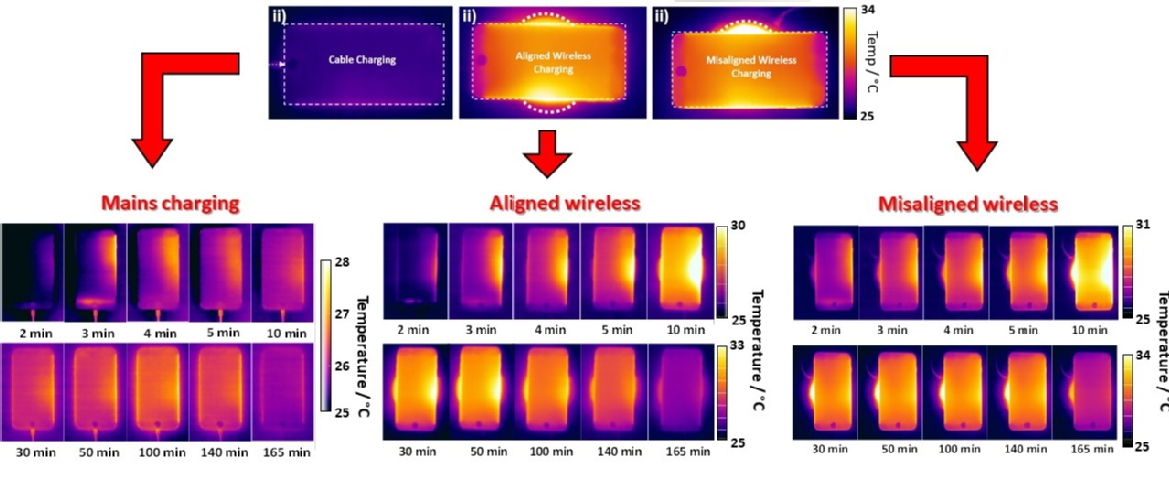 The graphics with this press release illustrates three modes of charging, based on (a) AC mains charging (cable charging) and inductive charging when coils are (b) aligned and (c) misaligned. Panels i and ii show a realistic view of the charging modes with a snapshot of the thermal maps of the phone after 50 min of charging. Regardless of the mode of charging, the right edge of the phone showed a higher rate of increase in temperature than other areas of the phone and remained higher throughout the charging process. A CT scan of the phone showed that this hotspot is where the motherboard is located In the case of the phone charged with conventional mains power, the maximum average temperature reached within 3 hours of charging did not exceed 27 °C.
In contrast this for the phone charged by aligned inductive charging, the temperature peaked at 30.5 °C but gradually reduced for the latter half of the charging period. This is similar to the maximum average temperature observed during misaligned inductive charging.
In the case of misaligned inductive charging, the peak temperature was of similar magnitude (30.5 °C) but this temperature was reached sooner and persisted for much longer at this level (125 minutes versus 55 minutes for properly aligned charging).
Also noteworthy was the fact that the maximum input power to the charging base was greater in the test where the phone was misaligned (11W) than the well-aligned phone (9.5 W). This is due to the charging system increasing the transmitter power under misalignment in order to maintain target input power to the device. The maximum average temperature of the charging base while charging under misalignment reached 35.3 °C, two degrees higher than the temperature detected when the phone was aligned, which achieved 33 °C. This is symptomatic of deterioration in system efficiency, with additional heat generation attributable to power electronics losses and eddy currents.
The researchers do note that future approaches to inductive charging design can diminish these transfer losses, and thus reduce heating, by using ultrathin coils, higher frequencies, and optimized drive electronics to provide chargers and receivers that are compact and more efficient and can be integrated into mobile devices or batteries with minimal change.
In conclusion, the research team found that inductive charging, whilst convenient, will likely lead to a reduction in the life of the mobile phone battery. For many users, this degradation may be an acceptable price for the convenience of charging, but for those wishing to eke out the longest life from their phone, cable charging is still recommended.
ENDS
26 JUNE 2019
NOTES FOR EDITORS
While one specific model of mobile phone was used to conduct the tests the issues raised obviously apply to all phones or portable devices now or in the future that seek to use inductive charging.
High-res image available at: https://warwick.ac.uk/services/communications/medialibrary/images/june2019/iphone_charging_mode_2.jpg

Credit: WMG, University of Warwick
Paper available to view at: https://pubs.acs.org/doi/10.1021/acsenergylett.9b00663
List of Authors (all WMG) include:
Melanie. J. Loveridge
Chaou C. Tan
Faduma M. Maddar
Guillame Remy
Mike Abbott
Shaun Dixon
Richard McMahon
Ollie Curnick
Mark Ellis
Mike Lain
Anup Barai
Mark Amor-Segan
Rohit Bhagat
Dave Greenwood