
Human-centred Automation – Why the Future Factory Needs More People, Not Fewer
Mass production is shifting towards mass customisation driven by automation. In a highly competitive global market, industries that use digital tools to run assembly lines can adapt rapidly to changes in demand. Flexibility has become the byword for success.
But what is the role of humans in this new landscape? Digitalisation has reduced the need for employees to perform some lower-skilled functions. Machines are taking over repetitive and time-consuming tasks such as inserting micro-screws into circuit boards or checking components for defects.

Associate Professor and Head of Sustainable Engineering and Manufacturing Education Group, WMG
Humans are still the future in a digital world
The critical question is whether this transformation will reduce reliance on skilled professionals. The answer is ‘no’, more people are needed, not fewer. They will be part of a digitally fluent workforce, able to navigate and adapt to a digital world while focusing on areas that add the greatest value to a product and processes.Upskilling by businesses is vital to empower staff to become decision-makers, not silent partners. The radical shift to digital has increased demand for professionals who can manage complex AI-based systems. While shop-floor workers are still critical in the future factory, their role is not solely to operate machines but to work alongside them, interpreting and using the data they generate to improve efficiency.
Filling the digital skills gap with training and investment
However, significant skills gaps exist, resulting in many roles remaining unfilled. As such, a major focus for UK companies should be to help workers to become digitally enabled. This country’s manufacturing sector has a reputation to be proud of, but in terms of digital capability, it ranks below some global competitors.
Over recent decades, manufacturing capacity has increasingly shifted towards countries such as China and India, with many firms outsourcing production to these industrial powerhouses. A shift in mindset is required, supported by greater investment in workforce training and skills development.
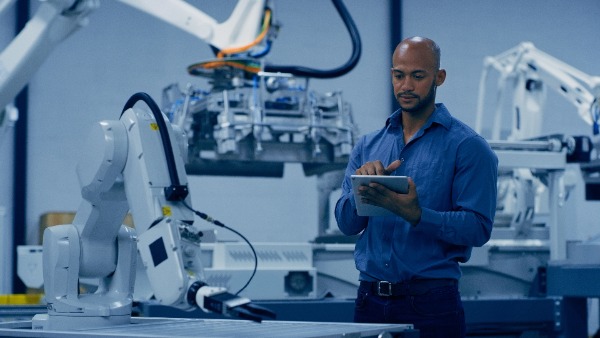
The radical shift to digital has increased demand for professionals who can manage complex AI-based systems.
Developing a multi-skilled and AI-literate workforce
By developing the skills of staff, businesses can enable them to use digital dashboards effectively to interpret and report on business data, key performance indicators, and metrics. In theory, AI systems can do this job. The reality is they lack the know-how gained by staff over time of the specific workflows, procedures, and operations within an organisation. To boost productivity, process knowledge is essential, alongside critical analysis, to spot patterns and trends in data, then link these with a company’s operational costs.
To be an expert in one job is no longer enough for a worker. As the conversation around Industry 5.0 continues to grow, the next generation of talent will need multiple skillsets that allow them to adapt quickly to new technologies and changing industrial environments.
Full automation is not the solution for success
Some of the world’s largest manufacturers have implemented workforce strategies based on hiring staff who are multi-skilled, flexible and adaptable – and training up those already employed. My view is that this approach should be the norm among UK businesses. Toyota, for example, rotates its employees so they experience different tasks and develop new expertise and capabilities. The global corporation’s philosophy is that the (human) worker is the centre of everything, and the foundation of the company’s success.
This contrasts with the concept of ‘lights-out’ production facilities that are fully automated. These factories, which operate 365 days a year without lights or workers, may boost productivity and lower upkeep costs. However, they’re not future-looking, in my opinion.
A human presence is fundamental in manufacturing and always will be. The perception is that automated factories are easier to run, but when a breakdown or malfunction occurs, businesses generally revert to human-based approaches.
Innovation relies on safe, sensible and compliant digital systems
The strength of AI systems lies in their ability to speed up processes and results. Nonetheless, algorithms are not accountable, humans are still needed to provide oversight and regulation. Without them, companies cannot ensure systems are safe, sensible and comply with current legislation.
Failure in industry is often treated as a cost to be avoided rather than a learning opportunity. However, the real risk lies in being left behind as technologies evolve faster than workforce capabilities. The future factory will therefore depend on a close partnership between human expertise and digital systems. AI will provide analytical power while people will bring judgement, accountability, and creativity.
Designing systems that are fit for the future will be essential to ensure the UK manufacturing sector continues to innovate and compete globally.
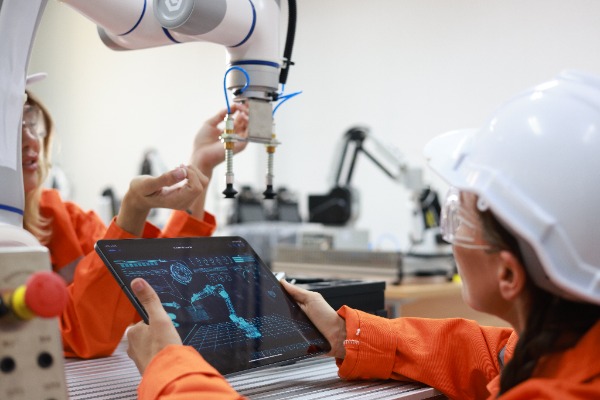
AI will provide analytical power while people will bring judgement, accountability, and creativity.
Staying competitive with continuous improvement
Evidence-based research is critical to progress, particularly when combined with close collaboration between industry and academia. What often stands in the way of progress is a lack of time. Managers and industry leaders often tell me they’re pressured into meeting everyday targets and this year’s bottom line. This represents a barrier to ongoing changes that could benefit them in the long-term. To stay competitive, firms must embed a strategy of continuous improvement from day one as part of their research and development commitment.
AI and humans united
There is no question that the role of human workers will evolve significantly in the future factory. The challenge is not replacing people with machines but designing systems where human and machine intelligence complement each other. Instead of conflict, there must be collaboration between these ‘minds’ which are different but have the same goal.