
Strategic Project Management – How AI Will Reshape Delivery
The focus of traditional project management has been how to produce deliverables on time and within budget. However, there has been a shift towards a more long-term and strategic approach. Instead of on ‘how’, the focus is on ‘why’ an initiative should be undertaken, if at all. With an emphasis on future success, the aim is to synchronise every complex proposal, portfolio and business activity with the company’s broader objectives.
The mission now is to drive value within organisations to embed a competitive advantage, and AI has the power to make this even more of a reality. It is set to revolutionise strategic project management and transform the role of project managers along with the work done by team members.

Associate Professor and Head of Industrial Management Education Group, WMG
AI to drive value
Those who adopt and adapt to AI will have the upper hand in this ever-changing landscape. The technology automates administrative tasks, speeds up data analysis and predicts risk - all of which frees up teams to reallocate their time to planning. Issues identified by AI can be flagged to the Project Manager, such as emails from clients written in a negative tone that need urgent action. Previously, it might have taken longer for an employee to filter the contents of an inbox.
Decision-making could be enhanced by AI using intelligent selection. By relying on intuition alone, this data-driven process can identify more accurately than a human which projects are of high value and benefit to a business. Imagine being able to simulate thousands of outputs and scenarios. AI can do just that to predict ahead of time the potential impact of an initiative and whether it will benefit an organisation.
Optimising workforce performance
Another advantage of project managers and business leaders adopting AI is the optimisation of workforce performance. AI’s abilities can be harnessed to choose, without bias, the best person for the job based solely on an assessment of candidates’ skills. This approach avoids selection based on biases and means a more junior but more capable member of the team gets the role. Of course, it is essential to retain confidence and motivate staff and a human will always be required to explain to senior colleagues the reason for the decision.

Those who adopt and adapt to AI will have the upper hand in this ever-changing landscape.
Predicting risk
The risk of a project overrunning or not delivering on quality is a major issue. As outlined already in this article, one of the strengths of AI is the ability to predict risk and offer solutions on how best this can be managed, based on analysis of relevant data. And the technology can provide this information in the very early stages. This has the potential to reshape engagement with each and every stakeholder. By reaching out proactively at the outset, businesses can identify concerns before they escalate and become a crisis.
Business reputation management
To manage expectations and provide clients with accurate updates it is vital to protect a firm’s reputation. No one wants to create a false alarm by asking a client for £5 million in increased spending then having to double this to £10m a few days later. Will AI tell you whether you are running behind on your project targets? Definitely, yes – and it will accurately predict the likelihood of the order you placed arriving on time. So, when you meet with a stakeholder, the update you provide on progress will be realistic.
Of course, any new approach requires cultural change within an organisation. Yet the human psyche is primed to resist change, to be reactive and not proactive. To copy competitors can be tempting. Or to embark on a development programme just because the budget or capability exists. However, if this does not align with a business strategy, then a firm may end up lagging behind – not leading – the market. A good example of strategic project management is Apple Inc. The multinational technology company tops the league in mobile phone manufacturing but has resisted bringing a flip phone to market up till now. Apple says the reason for holding back is that the design must be perfected to guarantee customers a flawless experience.
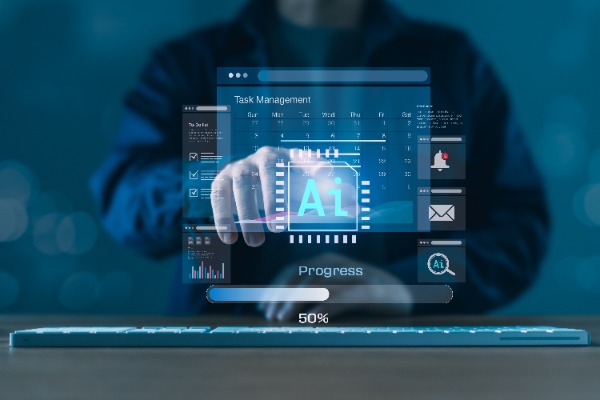
Data generated by AI should never be taken at face value. What is needed are seasoned project managers who can look at AI output, the source of the data and its reliability.
AI and data literacy for modern leadership
At WMG, we work intensively with senior leaders and with other staff to show how they can achieve their business objectives by embracing change. Leadership is now leveraging the use of AI, and we are also training managers to understand both the risks and benefits of AI, and how humans can collaborate with this rapidly advancing technology.
Upskilling to fill talent gaps
Data generated by AI should never be taken at face value. What is needed are seasoned project managers who can look at AI output, the source of the data and its reliability. To fill the talent gap, staff will also need upskilling to be able to adapt constantly and deliver. Project managers cannot afford to get left behind – they must not follow trends but anticipate them. And that means embracing AI in this technology-driven age.