Turn your passion for the ancient world into specialist expertise.
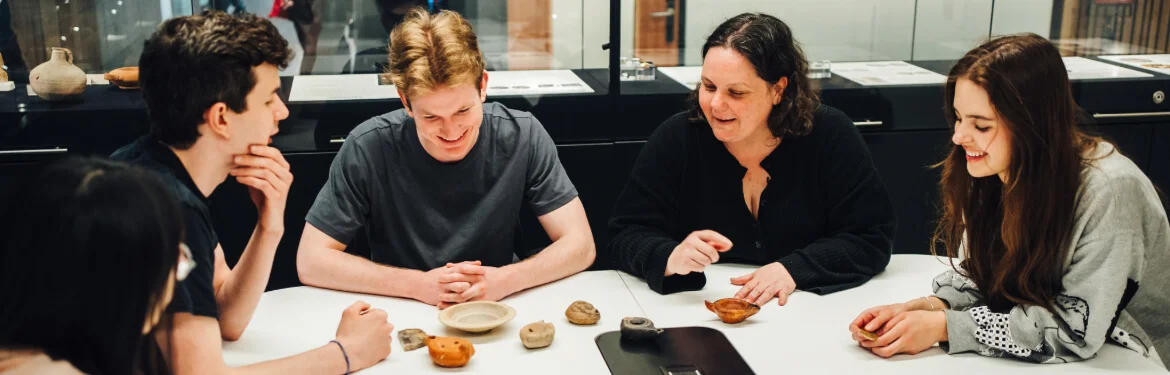
Explore the history within artefacts on an MA that opens up careers in museums, curatorial work, education or further research. You'll develop a detailed understanding of ancient visual and material culture of Ancient Greece and Rome - and have the opportunity to study at the heart of the Classical world in either Rome or Athens.
Warwick exceeded my greatest expectations. Its staff gave us the tools we needed to progress from students to young researchers, taking genuine interest in our ideas and inviting us to professional events where we could learn from, and interact with, the heavy-hitters in our field.
Charlotte Mann
Visual and Material Culture MA 2016/17, Currently a lecturer at the University of New England, Australia
Modules
Explore ancient cultures through the objects and evidence they left behind.
Material culture: investigate key approaches to studying ancient visual and material culture
Research expertise: develop specialist approaches used in fields such as art history, numismatics and epigraphy
International opportunities: develop specialist skill sets for handling materials with optional modules at the British School at Athens or the British School at Rome
Changing perspectives: understand how material culture has been studied since antiquity
Note that information found by following the links to the module catalogue is subject to change for future years of study, as we evolve our courses in response to the latest developments in academia and industry.
Subject to demand, the options above usually run each year.
It is also possible to take an approved module from other Departments across the Faculty.
Please note admission to the British School at Rome or British School at Athens options is subject to the discretion of the British Schools and cannot be guaranteed by Warwick.
Teaching and learning
Build advanced research and analytical skills for professional or academic progress.
Critical analysis: learn to present a structured argument as a cohesive whole
Problem-solving: negotiate challenges through applying appropriate methodologies
Research skills: conduct independent investigation and analysis
Communication: deliver ideas clearly through written and oral presentation
Transferable expertise: strengthen organisational and digital skills valued across multiple sectors
The classes of the taught modules comprise 5-10 students and up to 15-20 for Language classes. This size allows teaching to be tailored according to the students’ interests.
For this course, the contact hours are six hours per week.
This includes face-to-face guidance to direct you to identify your research topic and do your research.
Most modules (apart from language modules) will be assessed by a 5,000-word essay on a topic of your choice, decided upon by negotiation with a member of academic staff. The dissertation will be a piece of work 15,000-20,000 words and built on the research carried out whilst on the programme.
Entry requirements
Applicants will need to have achieved or be expecting to achieve a good 2:1 undergraduate degree in Classics/Ancient History/Archaeology or a relevant subject to be considered for entry.
IELTS overall score of 7.0, minimum component scores of two at 6.0/6.5 and the rest at 7.0 or above.
Please adjust your country as required:
We welcome applications from students with other internationally recognised qualifications. For more information, please visit the international entry requirements page.
We typically ask for one academic reference for taught courses.
You will be asked to include an email address for your referee(s) when submitting your application and we will contact them for you.
There are no additional entry requirements for this course.
Fees and scholarships
Tuition fees are payable for each year of your course at the start of the academic year, or at the start of your course, if later. Academic fees cover the cost of tuition, examinations and assessment and some student amenities.
We carry out an initial fee status assessment based on the information you provide in your application. Students will be classified as Home or Overseas fee status. Your fee status determines tuition fees, and what financial support and scholarships may be available. If you receive an offer, your fee status will be clearly stated alongside the tuition fee information.
Do you need your fee classification to be reviewed?
If you believe that your fee status has been classified incorrectly, you can complete a fee status assessment questionnaire. Please follow the instructions in your offer information and provide the documents needed to reassess your status.
As well as tuition fees and living expenses, some courses may require you to cover the cost of field trips or costs associated with travel abroad.
For departmental specific costs, please see the list of core and optional core modules with hyperlinks to our Module Catalogue, where module-related costs are detailed. Associated costs can be found on the Study tab for each module listed in the Module Catalogue (please note most of the module content applies to 2026/27 year of study).
Information about module specific costs should be considered in conjunction with the more general costs below:
Core text books
Printer credits
Dissertation binding
Robe hire for your degree ceremony
Dissertations and Assignments are only submitted digitally. However, students may wish to print and bind their dissertation for their own purposes. Students on some courses will have a final poster presentation as part of their project and the printing of posters may be at the students’ expense.
Find out about the different funding routes available, including; postgraduate loans, scholarships, fee awards and academic department bursaries.
We are home to a vibrant postgraduate community that allows you to reach your full potential. Ranked third in the UK for research excellence (REF 2021), Classics and Ancient History at Warwick offers an intellectually stimulating and interdisciplinary environment where the richness of the classical world converges with academic excellence.
Our comprehensive postgraduate programmes offer expertise across a wide range of research interests, including Greek and Latin literature, Greek and Roman history, material culture (including art, epigraphy and numismatics), the cultures of the Second Sophistic and Late Antiquity, the history of medicine, and the reception of Classical cultures in the Renaissance.
You’ll be based in Warwick’s striking £57.5 million Faculty of Arts Building - a space designed to bring creativity, collaboration and discovery together. Found in the University’s cultural quarter beside the refurbished Warwick Arts Centre, the sustainably built eight-storey hub offers high-quality teaching rooms, flexible study areas and social spaces. It’s a place designed to help your ideas flourish beyond the classroom.
We offer a dedicated postgraduate workspace within the department, which is also home to an antiquities collection and exhibition space for use by students. We have excellent library facilities to support your research, and offer financial contributions for travel or conference attendance. Our postgraduate students form an important part of our research community, and attend weekly research seminars with speakers from across the world.
Most of our postgraduate degrees offer an opportunity to include an experience abroad during your studies, whether through courses offered by the British Schools in Rome or Athens, or via other exchange arrangements with universities worldwide.
Careers
Our degrees equip you with the skills and experiences needed to excel in your career. With access to exceptional career services, industry connections, and global opportunities, we’ll inspire and help you to aim high and achieve your goals. Our guidance ensures you graduate as a well-rounded professional ready for lifelong success.
Typical career paths chosen by our graduates include jobs in*:
*Derived from the Graduate Outcomes survey, 2021/22, carried out approximately 15 months after completion of studies.
Conducted annually, Graduate Outcomes Link opens in a new window collects information on the activities and perspectives of graduates. Contains HESA data: Copyright Jisc 2024. Jisc cannot accept responsibility for any inferences or conclusions derived by third parties from its data.
Your career path is unique to you. Our university careers team offer personalised support to help you develop your skills, plan your career path, and get experience at any point during your time at Warwick, and after graduation.
Our department also has a dedicated professionally qualified Senior Careers Consultant. They offer impartial advice and guidance together with workshops and events throughout the year. Previous examples of workshops and events include:
What can you do with a Classics and Ancient History degree
Careers in the Creative Industries
Warwick careers fairs throughout the year
Next steps after your Classics degree… hear from our Alumni
While this course does not offer a formal work placement, postgraduate taught students at Warwick can self-source internships and work experience to complete alongside their studies, subject to visa conditions and the 20‑hour weekly limit for full‑time students.
Opportunities can vary in length and location, including in the UK, online and internationally. Postgraduate students find that shorter, remote and/or flexible opportunities work best around their studies, often seeking opportunities over the summer when teaching decreases and the focus moves to final dissertations and projects - although this can vary depending on the nature of the course and personal preference.
Support available:
The Internships, Placements and Work Experience team provide workshops to help you to source and prepare for work opportunities, and organise peer-to-peer support so you can hear about other students’ placement experiences.
The WorkReady Toolkit guides you through the whole process, from sourcing to completing work placements.
Our Work Experience Bursary can help you cover costs if undertaking unpaid work experience.
Part-time work allows you to gain experience and additional financial support, with opportunities advertised on Warwick’s careers portal, myAdvantage and Unitemps.
Warwick students worked 286,295 paid hours via Unitemps in 25/26.
Access short-term international study, work or volunteering abroad experiences, without extending the length of your studies (duration is typically between 3 days and 12 weeks), with opportunity to apply for funding.
Students can apply to TeamWork, a four-week part-time online international experience programme, helping them to gain work experience and improve their employability skills.
Volunteer for projects which support the local community through the award-winning Warwick Volunteers.
Getting involved in societies and sports teams, especially on exec teams.
In 25/26 our jobs portal advertised 1577 12-month placements, work experience opportunities, vacation employment and volunteering from 564 employers.
Whilst there is lots of support available at the University to help, students themselves are responsible for finding and securing a suitable internship or work experience. You will also be responsible for ensuring opportunities meet visa requirements, do not exceed the universities advised 20 hours per week for full-time students and for balancing extra-curricular activity with your studies.
Tags: Question and Answer, Faculty of Arts, Classics, Alumni profile, Postgraduate, Undergraduate, PG Course Page
Life at Warwick
This is where your journey begins. Our campus is the heart of it all. It’s more than just a campus - it's the places you visit, the people you meet, the fun that you have; the experiences you have here will be transformative.
Within a close-knit community of staff and students from all over the world, discover a campus alive with possibilities.
Our campus is where all the elements of your student experience come together in one place. You won't be short of ways to spend your time on campus - whether it's visiting Warwick Arts Centre, using our incredible sports facilities, socialising in our bars, nightclub and cafés, or enjoying an open-air event. Or if you need some peace and quiet, you can explore lakes, woodland and green spaces just a few minutes’ walk from central campus.
Follow our students around campus on our social channels to see their experiences first-hand.
Teaching facilities
Our campus is designed to cater for all of your learning needs. You will benefit from a variety of flexible, well-equipped study spaces and teaching facilities across the University.
Oculus, our outstanding learning hub, houses state-of-the-art lecture theatres and innovative social learning and network areas
Different study spaces offering you flexible individual and group study spaces, computers, printing and scanning facilities, multimedia resources and more
Supporting you
Our continuous support network is here to help you adjust to student life and to ensure you can easily access advice on many different issues. These may include managing your finances and workload, and settling into shared accommodation. We also have specialist disability and mental health support teams.
Whether you live on campus or off campus, in private accommodation in the well-serviced local area, you’ll be part of a community to get the most from your experience at Warwick.
Societies and sports play a huge part in community life at Warwick. With over 300 to choose from, getting involved is one of the easiest ways to make friends and share in experiences. Whether you’re into films, martial arts, astronomy, gaming or musical theatre, you can instantly connect with people with similar interests.
Your university experience is defined by far more than your course or the career path you follow. At Warwick, it’s where you discover who you could become.
68th
Warwick is ranked 68th in the world and top 10 in all major UK league tables
Our alumni community still call Warwick home. From a few hundred in 1965 to more than 310,000 alumni, and it's ever-growing.
As Warwick graduates, our students have access to employability support for two years after graduation, including access to careers appointments, job vacancies and professional networks.
Applications for courses starting in September and October 2027 are now open.
The on-time deadline for taught postgraduate courses starting in September/October 2027 is 2 August 2027.
We will still accept late applications, however cannot guarantee that the application will be processed in time to complete the admissions process if received in September or there are a number of conditions to meet.
If applying late please include your degree certificates and transcripts, English proficiency evidence (if needed) and ensure referees can submit references promptly to allow time for CAS and visa processing (if applicable).
This information is applicable for 2027 entry. Given the interval between the publication of courses and enrolment, some of the information may change. It is important to check our website before you apply. Please read our web page 'Important information to consider before making an application' in advance of applying to Warwick.
Next steps
Explore your future university further at an upcoming event, online or in-person. Can't join? Receive regular email updates or ask current students and staff questions about life at Warwick.