
Statistics with Data Science (MSc)
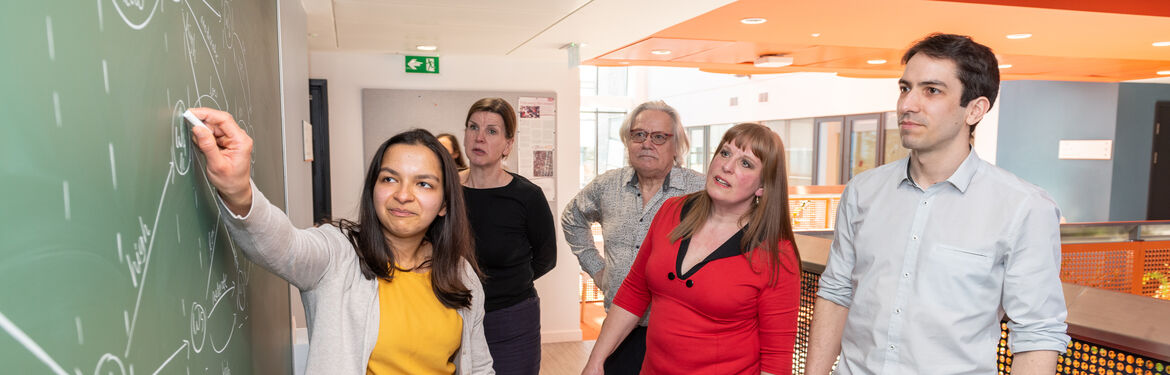
Find out more about our Statistics with Data Science Master's degree at Warwick
Warwick Statistics offers a choice between four degree titles - providing a broad choice in all Statistics subjects or a specialisation: MSc in Statistics, MSc in Statistics with Data Science, MSc in Statistics with Finance or MSc in Statistics with Probability.
The MSc in Statistics with Data Science is a specialised route offering a statistics degree focused on the modern data landscape. Your training will open the way to employment in many sectors, including marketing, insurance, banking and pharmaceutical industry. It may also provide the pathway to a research degree (PhD).
Course overview
In addition to core modules providing a grounding in statistical theory, methods and applications, this route features a compulsory module in the Theory of Data Science. This bespoke core module uses a mathematically rigorous approach to cover the theoretical underpinnings of the field. Students then build on this foundation by choosing from specialised modules in areas which may include statistical learning and big data, Bayesian forecasting, and Monte Carlo methods. To build strong computational expertise, students can also select technical electives from computer science in subjects such as high-performance computing, natural language processing, and image & video analysis. This combination ensures graduates are equipped with both the theoretical foundations and practical skills to tackle complex, data-driven challenges.
General entry requirements
Minimum requirements
2:1 undergraduate degree (or equivalent) in Statistics, Mathematics or a science with sufficiently high mathematical content.
English language requirements
You can find out more about our English language requirementsLink opens in a new window. This course requires the following:
- Band A
- No score lower than 6.0 in all IELTS fields with a total score of 6.5 minimum.
International qualifications
We welcome applications from students with other internationally recognised qualifications.
For more information, please visit the international entry requirements pageLink opens in a new window.
Academic References
We typically ask for two academic reference for taught courses.
You will be asked to include an email address for your referee(s) when submitting your application and we will contact them for you.
View our guide to academic references.Link opens in a new window
Additional requirements
There are no additional entry requirements for this course.
Core modules
The total load is exactly 180 credits (called CATS at Warwick). All students take 8 modules (each worth 15 CATS) in the taught component and a dissertation worth 60 CATS. All MSc students are required to take the following core modules:
Welcome Week
Core Modules
Optional modules
Further to the core modules students choose 5 optional modules. For the MSc in Statistics with Data Science your optional modules are geared towards covering themes in Bayesian statistics, machine learning, statistical learning, topics in data science, Monte Carlo methods. Subject to availability, you will also have access to a varying selection of modules from the Computer Science Department. Availability of optional modules can change from year to year but may include the following examples:
You may also choose up to three modules from a broad range of statistics and probability modules available on the MSc in Statistics.
Teaching
For the nine-month period from end of September to June, you will be engaged in the taught component of the programme by attending a set of eight modules covering the core and optional modules.
After successfully completing the taught component worth 120 CATS you will undertake a dissertation project, worth 60 CATS, over summer under the supervision of a member of staff. This final project offers the chance to apply knowledge to real-world challenges or delve into advanced research topics.
Assessment
Assessment is initially made for each module separately: some modules have an element of continuous assessment through coursework, but most modules are assessed through written examinations in January, May and June.
Your performance in the core and optional modules combined is then examined by an examinations board consisting of academic staff plus an External Examiner appointed from another university. Dissertations are examined in the Department and then by the External Examiner.
The MSc degree is awarded subject to satisfactory standard in the dissertation and the taught modules. Students who do outstandingly well in both taught modules and the dissertation may be awarded the MSc with Distinction or Merit.
Preliminary Knowledge
Students are expected to have pre-existing standard undergraduate knowledge in statistics and probability covering probability, random variables, expectations and important inequalities (see, for example, Part 1 in “All of Statistics: A Concise Course in Statistical Inference” by Larry Wasserman, Springer Texts in Statistics).
Students planning to take modules in probability and/or finance will be exposed to measure theory and must have a solid foundation in real analysis.
If you would like to view reading lists for current or previous cohorts of students, most departments have reading lists available through Warwick Library on the Talis Aspire platform.
You can search for reading lists by module title, code or convenor. Please see the modules tab of this page or the module catalogue.
Please note that some reading lists may have restricted access or be unavailable at certain times of year due to not yet being published. If you cannot access the reading list for a particular module, please check again later or contact the module’s host department.
Your timetable
Your personalised timetable will be complete when you are registered for all modules, compulsory and optional, and you have been allocated to your lectures, seminars and other small group classes.
Your career
Our degrees equip you with the skills and experiences needed to excel in your career. With access to exceptional career services, industry connections, and global opportunities, we’ll inspire and help you to aim high and achieve your goals. Our guidance ensures you graduate as a well-rounded professional ready for lifelong success.
The median salary for University of Warwick 2021/22 postgraduates whose main employment was full-time work in the UK was £38,000 (based on 971 respondents - 17% of the total postgraduate population)*.
Previous graduates from the Department of Statistics have gone on to work for employers worldwide such as*:
- Alliance Healthcare
- Barclays
- BNP Paribas
- Citibank
- GSK
- LCH
- McKinsey
- Pharmaceutical Product Development (PPD)
- PKF Littlejohn
Candidates with high distinction marks have gone on to pursue PhD degrees at prestigious universities such as Cambridge, Oxford, Imperial, LSE, etc. or in the US*.
They have pursued occupations such as the following*:
- Actuaries, economists and statisticians
- Business and related research professionals
- Chartered and certified accountants
- Data analysts
- Engineering professionals
- Finance and investment analysts and advisers
- IT business analysts, architects and systems designers
- Natural and social science professionals
- Programmers and software development professionals
*Derived from the Graduate Outcomes survey, 2021/22, carried out approximately 15 months after completion of studies.
Conducted annually, Graduate Outcomes Link opens in a new window collects information on the activities and perspectives of graduates. Contains HESA data: Copyright Jisc 2024. Jisc cannot accept responsibility for any inferences or conclusions derived by third parties from its data.
Helping you find the right career
Your career path is unique to you. Our university careers team offer personalised support to help you develop your skills, plan your career path, and get experience at any point during your time at Warwick, and after graduation.
Our department also has a dedicated professionally qualified Senior Careers Consultant. They offer impartial advice and guidance together with workshops and events throughout the year. Previous examples of workshops and events include:
- Career options with a degree in Statistics
- Warwick careers fairs throughout the year
- Interview skills for Statistics students
- Maths and Stats Careers Fair
Discover more about postgraduate careers support at Warwick.
Statistics at Warwick
Statistics and probability theory are key to understanding data and underlying processes involving risk and uncertainty.
We also explore applications in a wide array of areas and develop impact of our research in many scientific fields within sciences, social sciences, medicine, engineering, management science, finance, commerce and others.
Founded in October 1972, Warwick Statistics is internationally renowned for its wide-ranging and world-leading research and its innovative undergraduate and postgraduate degree programmes.
Find out more about us on our website.Link opens in a new window
Our Postgraduate courses
Tuition fees
Tuition fees are payable for each year of your course at the start of the academic year, or at the start of your course, if later. Academic fees cover the cost of tuition, examinations and registration and some student amenities.
Fee Status Guidance
We carry out an initial fee status assessment based on the information you provide in your application. Students will be classified as Home or Overseas fee status. Your fee status determines tuition fees, and what financial support and scholarships may be available. If you receive an offer, your fee status will be clearly stated alongside the tuition fee information.
Do you need your fee classification to be reviewed?
If you believe that your fee status has been classified incorrectly, you can complete a fee status assessment questionnaire. Please follow the instructions in your offer information and provide the documents needed to reassess your status.
Find out more about how universities assess fee statusLink opens in a new window
Additional course costs
As well as tuition fees and living expenses, some courses may require you to cover the cost of field trips or costs associated with travel abroad.
For departmental specific costs, please see the Modules tab on the course web page for the list of core and optional core modules with hyperlinks to our Module Catalogue (please visit the Department’s website if the Module Catalogue hyperlinks are not provided).
Associated costs can be found on the Study tab for each module listed in the Module Catalogue (please note most of the module content applies to 2025/26 year of study). Information about module department specific costs should be considered in conjunction with the more general costs below:
- Core text books
- Printer credits
- Dissertation binding
- Robe hire for your degree ceremony
Scholarships and funding
Scholarships and financial support
Find out about the different funding routes available, including; postgraduate loans, scholarships, fee awards and academic department bursaries.
Living costs
Find out more about the cost of living as a postgraduate student at University of Warwick.
Department specific funding and support
Learn more about exciting department specific opportunities.

Find out how to apply to us, ask your questions, and find out more.
How to apply checklist
Our how to apply checklist helps you prepare for your application.
I'm ready to apply
Learn more about the Applicant Portal.
Application deadlines
Applications for courses starting in September and October 2026 are now open.
The on-time deadline for taught postgraduate courses starting in September/October 2026 is 2 August 2026.
We will still accept late applications, however cannot guarantee that the application will be processed in time to complete the admissions process if received in September or there are a number of conditions to meet.
If applying late please include your degree certificates and transcripts, English proficiency evidence (if needed) and ensure referees can submit references promptly to allow time for CAS and visa processing (if applicable).