BSc Integrated Natural Sciences is a unique course that aims to teach you how to frame and solve scientific problems in a “without boundaries” way.
A radical new approach in the UK, Integrated Natural Sciences draws on an understanding of biology, chemistry, physics, maths and computing to address fundamental scientific questions about how the natural world works. The course seeks above all to help you develop as a scientist, able to frame good scientific questions about the mechanisms of living systems and to address them effectively by experiment.
Scientists ask questions about how the world works – especially the natural world – and then work to answer those questions using cycles of conjecture and experiment. Human curiosity leads us to ask basic questions. What is life? What distinguishes the living from the non-living? How do cells work? What causes disease?
BSc Integrated Natural Sciences aims to equip you to pose and answer scientific questions by drawing freely on the methods and mindsets of mathematics, physics, biology, chemistry and computation. By combining the strengths of Warwick Medical School (WMS) and School of Life Sciences (SLS), this course offers you unique opportunities to develop yourself as a scientist. The course is led by a diverse team of biologists, chemists and physicists.
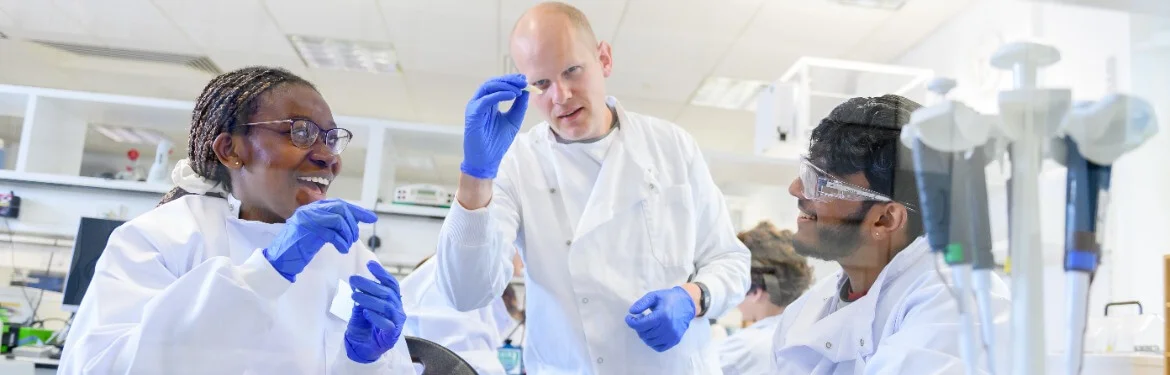
Laboratory experimental work in small teams is a key part of the course right from the outset. Parallel classroom sessions will teach you relevant scientific concepts and methods, ranging across multiple disciplines. Computing as a scientific tool is emphasised throughout the course.
In your second and third years, this integrated approach runs alongside a more in-depth look at the molecular and cellular basis of life.
AAB to include grade A in Mathematics or Physics, and grade A in either Biology or Chemistry.
You will also need GCSE English at grade C or grade 4 or above.
A level contextual offer
We welcome applications from candidates who meet the contextual eligibility criteria and whose predicted grades are close to, or slightly below, the contextual offer level. The typical contextual offer is ABB including grade A in either Mathematics or Physics, and grade B in either Biology or Chemistry. See if you're eligible.
We advise that you also check the English Language requirements for your course which may specify a higher GCSE English requirement. Please find the information about this below.
International Baccalaureate (IB) typical offer
34 to include 6 in Higher Level Mathematics or Physics, and 6 in either Higher Level Biology or Higher Level Chemistry.
International Baccalaureate (IB) contextual offer
We welcome applications from candidates who meet the contextual eligibility criteria and whose predicted grades are close to, or slightly below, the contextual offer level. The typical contextual offer is 32 with 6 at Higher Level in Mathematics or Higher Level Physics, and 5 in either Higher Level Biology or Higher Level Chemistry. See if you're eligible.
We advise that you also check the English Language requirements for your course which may specify a higher GCSE English requirement. Please find the information about this below.
BTEC
We welcome applications from students taking BTECs alongside A level Maths.
You will also need to have studied Biology or Chemistry, either at A level or through a relevant BTEC.
Scotland Advanced Highers
AA in two Advanced Highers including Mathematics and either Biology or Chemistry plus AAB in three further Highers subjects.
Welsh Baccalaureate
AAB including grade A in Mathematics and A in either Biology or Chemistry plus grade C in the Advanced Skills Baccalaureate Wales.
Access to Higher Education Diplomas
We will consider applicants returning to study who are presenting a QAA-recognised Access to Higher Education Diploma on a case-by-case basis.
Typically, we require 45 Credits at Level 3, including Distinction in 33 Level 3 credits and Merit in 12 Level 3 Credits. We may also require subject specific credits or an A level to be studied alongside the Access to Higher Education Diploma to fulfil essential subject requirements.
We advise that you also check the English Language requirements for your course which may specify a higher GCSE English requirement. Please find the information about this below.
Warwick may make differential offers to students in certain circumstances, such as those who have participated in a Widening Participation programme or who meet the University’s contextual data criteria. These offers are usually one or two grades below Warwick’s standard offer.
Do you offer foundation programmes?
All students who successfully complete the Warwick International Foundation Programme (IFP) and apply to Warwick through UCAS will receive a guaranteed conditional offer for a related undergraduate programme, for selected courses only. Further details are available in the standard offer and conditions for the IFP.
Can I take a gap year before starting my course?
Yes, Warwick welcomes applications for deferred (gap year) entry.
Will I need to interview for this course?
Warwick does not typically interview applicants. Offers are made based on the UCAS application, including predicted and achieved grades, the personal statement, and the school reference.
In Year 1 you will be taught by active research scientists with international reputations, who will help you to think creatively and quantitatively, formulate problems, and work effectively to solve them by drawing freely on the methods and mind sets of different scientific disciplines. Laboratory experimental work in small teams begins right from the outset, with parallel classroom sessions to teach you relevant scientific concepts and methods, ranging across multiple disciplines.
In Years 2 and 3 the Integrated Natural Sciences approach continues for your cohort, running alongside a more in-depth look at the molecular and cellular basis of life in modules taught by the School of Life Sciences. Core modules include enzymology, protein structure/function, structural molecular biology, and tools for discovery. In both years two and three, these are combined with optional modules chosen from an extensive menu, including the possibility to take courses outside of WMS and School of Life Sciences.
Note that information found by following the links to the module catalogue is subject to change for future years of study, as we evolve our courses in response to the latest developments in academia and industry.
Year 1
Year 2
You will choose 30-45 credits from the optional module list:
Year 3
You will choose 30-45 credits from the following optional core modules:
The Integrated Science Research Project may be taken as either a 30-credit module (MD3A2-30) or 45-credit module (MD3A2-45)
You will study 30-60 credits from the following optional modules
Fees and funding
Tuition fee
£10,050
For the 2027-28 academic year, the UK government announced in March 2026 that the tuition fee cap for UK undergraduate students for the 2027-28 academic year would be £10,050.
If you are joining Warwick for the 2026-27 academic year, the University of Warwick’s Executive Board has confirmed a change in fees to £9,790 (from the 2025-26 rate of £9,535), following the UK government announcement in November 2025 to increase in the tuition fee cap for Home students for the 2026-27 academic year.
Students who qualify for government-regulated fees are classed as ‘Home’ students for fees purposes. In future years, fees for continuing students may be subject to an increase in fees in line with any inflationary uplift as determined by the UK Government (if permitted by law or government policy).
We carry out an initial fee status assessment based on the information you provide in your application. Students will be classified as Home or Overseas fee status. Your fee status determines tuition fees, and what financial support and scholarships may be available. If you receive an offer, your fee status will be clearly stated alongside the tuition fee information.
If you believe that your fee status has been classified incorrectly, you can complete a fee status assessment questionnaire. Please follow the instructions in your offer information and provide the documents needed to reassess your status.
You will repay your loan or loans gradually once you are working and earning above a certain amount. For students starting their course after 1 August 2023 (on Student Finance England’s Plan 5), you will repay when your income is over £25,000 a year.
Repayments will be taken directly from your salary if you are an employee. If your income falls below the earnings threshold or you stop working, your repayments will stop until your income goes back up above this figure.
Access thousands of part-time opportunities through our agency UnitempsLink opens in a new window (such as office work, retail jobs or helping at events)
Choose to apply for a job as one of our Student Ambassadors to share your own experience at events like Open Days
There are many different funding routes available, including a number of bursaries and scholarships for full-time undergraduates. If you struggle to meet your essential living costs, our Student Funding team will be on hand to offer advice and support.
Provides additional financial support for qualifying Home students from lower income families of up to £2,500 for eligible students
This bursary is paid directly into your bank account in three equal termly instalments to help with the costs of studying
There is no application for this bursary as your details will be provided directly from the student support awarding bodies (Student Finance England, Student Finance Northern Ireland, and Student Awards Agency Scotland)
A number of scholarship opportunities are open to full-time undergraduate students. These include sporting and musical bursaries, and scholarships offered by commercial organisations.
If you experience financial difficulties during your studies, you may be eligible for Hardship Funding from the University, in the form of an Emergency Loan and/or a non-repayable award
There are no School scholarships available for our Undergraduate courses, however there are other scholarships which you may be eligible for. Please see our scholarships web pages for more information.
Tuition fee
If you are an overseas student enrolling in 2026-27, your annual tuition fees will be as follows:
Band 1 – £27,870 per year (classroom-based courses, including Humanities and most Social Science courses)
Band 2 – £35,530 per year (laboratory-based courses, plus Mathematics, Statistics, Theatre and Performance Studies, Economics, and courses provided by Warwick Business School, with exceptions)
Overseas Tuition fees for 2027-28 academic year have not been set. In future years, fees for continuing students may be subject to an increase in fees in line with an inflationary uplift. Please check our website for updates about 2027-28 fee rates before you apply.
If you are an EU student and eligible for student finance, you may be able to get a Tuition Fee Loan to cover your fees, please visit our Student Funding webpage for guidance for students ordinarily resident outside of England.
We carry out an initial fee status assessment based on the information you provide in your application. Students will be classified as Home or Overseas fee status. Your fee status determines tuition fees, and what financial support and scholarships may be available. If you receive an offer, your fee status will be clearly stated alongside the tuition fee information.
If you believe that your fee status has been classified incorrectly, you can complete a fee status assessment questionnaire. Please follow the instructions in your offer information and provide the documents needed to reassess your status.
Eligibility for student finance will depend on certain criteria, such as your nationality, residency status, course, and previous level of study. The information below is based on the package of financial support available to students starting their course in 2026.
Eligible European Union (EU) Undergraduates can apply for a loan to help with the cost of Tuition Fees. Eligible EU students who meet additional residency criteria may also be eligible for a loan to assist with living costs.For more information please see Student Finance for Undergraduates - EU StudentsLink opens in a new window.
Access thousands of part-time opportunities through our agency UnitempsLink opens in a new window (such as office work, retail jobs or helping at events)
Choose to apply for a job as one of our Student Ambassadors to share your own experience at events like Open Days
If you are an international student, you may be eligible for financial help from your own government, from the British Council or from other funding agencies. You can usually request information on scholarships from the Ministry of Education in your home country, or from the local British Council office.
A number of scholarship opportunities are open to full-time undergraduate students. These include sporting and musical bursaries, and scholarships offered by commercial organisations.
If you experience financial difficulties during your studies, you may be eligible for Hardship Funding from the University, in the form of an Emergency Loan and/or a non-repayable award.
As well as tuition fees and living expenses, some courses may require you to cover the cost of field trips or costs associated with travel abroad.
Associated costs can be found on the Study tab for each module listed in the Module Catalogue (please note most of the module content applies to 2025/26 year of study). Information about module specific costs should be considered in conjunction with the more general costs below:
Core text books
Printer credits
Dissertation binding
Robe hire for your degree ceremony
Are there any course specific costs?
For departmental specific costs, please see the list of core and optional core modules with hyperlinks to our Module Catalogue, where module-related costs are detailed.
Teaching and learning
This is an innovative programme and you will learn in many different ways.
As well as lectures, seminars, group work and tutorials, you will spend a significant amount of time carrying out laboratory experimental work. This will enable you to learn experimental approaches and techniques and be actively engaged in science and research from the start of the course.
In Year One you will learn entirely with your Integrated Natural Sciences cohort of approximately 25 students, ensuring that you have a high level of academic support.
In Years Two and Three, there will continue to be dedicated small classes for the course along with the opportunity to experience being part of a larger cohort in the School of Life Sciences and wider University. There is also ample opportunity to gain further laboratory experience.
Around 20 hours per week.
You will be assessed by a wide range of methods, including assignments, examinations, group assignments, lab reports and individual oral assessment.
The final degree classification is determined by:
Year One (15%)
Year Two (20%)
Year Three (65%)
You can opt to take a summer study programme.
Careers
In July 2024 we celebrated the successes of our inaugural Integrated Natural Sciences students. Graduates from similar courses have gone on to work for organisations including NHS, AstraZeneca, PMG, Diabetes UK and Taylor and Francis Scientific Publishing. Careers have varied across a wide array of areas, such as: Biotechnology Computing Philanthropy Medicine. Engineering Medical research.
You have access to a wide range of careers support, including online resources, careers tools, workshops and events. You can also speak to a member of the Careers team through drop-in opportunities and bookable appointments. Previous examples of workshops and events include:
Our Student Opportunity (Careers) department offer a wide range of workshops, from developing confidence and interview techniques to learning how to articulate what you have to offer in order to impress potential employers. Online resources are also available, including training in drafting CVs and covering letters, practice aptitude and psychometric tests, practice online interviews, and other resources to help you research job opportunities. The myAdvantage databaseLink opens in a new window also advertises job, placement and internship vacancies that are from employers who are targeting Warwick students for their recruitment.
You can arrange an internship during the summer vacation. Learn more about our current students who have undertaken summer internships.
Life at Warwick
This is where your journey begins. Our campus is the heart of it all. It’s more than just a campus - it's the places you visit, the people you meet, the fun that you have; the experiences you have here will be transformative.
Within a close-knit community of staff and students from all over the world, discover a campus alive with possibilities.
Our campus is where all the elements of your student experience come together in one place. You won't be short of ways to spend your time on campus - whether it's visiting Warwick Arts Centre, using our incredible sports facilities, socialising in our bars, nightclub and cafés, or enjoying an open-air event. Or if you need some peace and quiet, you can explore lakes, woodland and green spaces just a few minutes’ walk from central campus
Follow our students around campus on our social channels to see their experiences first-hand.
Teaching facilities
Our campus is designed to cater for all of your learning needs. You will benefit from a variety of flexible, well-equipped study spaces and teaching facilities across the University.
Oculus, our outstanding learning hub, houses state-of-the-art lecture theatres and innovative social learning and network areas
Different study spaces offering you flexible individual and group study spaces, computers, printing and scanning facilities, multimedia resources and more
Supporting you
Our continuous support network is here to help you adjust to student life and to ensure you can easily access advice on many different issues. These may include managing your finances and workload, and settling into shared accommodation. We also have specialist disability and mental health support teams.
Whether you live in a campus residence or in partnership accommodation off campus, you’ll be part of a community to get the most from your experience at Warwick.
Societies and sports play a huge part in community life at Warwick. With over 300 to choose from, getting involved is one of the easiest ways to make friends and share in experiences. Whether you’re into films, martial arts, astronomy, gaming or musical theatre, you can instantly connect with people with similar interests.
Your university experience is defined by far more than your course or the career path you follow. At Warwick, it’s where you discover who you could become.
68th
Warwick is ranked 68th in the world and top 10 in all major UK league tables
Our alumni community still call Warwick home. From a few hundred in 1965 to more than 310,000 alumni, and it's ever-growing.
As Warwick graduates, our students have access to employability support for two years after graduation, including access to careers appointments, job vacancies and professional networks.
Established in 2000, Warwick Medical School (WMS) forms part of the Faculty of Science, Engineering and Medicine at the University of Warwick. Alongside a range of educational opportunities, WMS has a reputation for research excellence, investigating solutions to significant global health challenges.
As a Warwick Medical School student, you will have access to high-quality teaching facilities. You will be taught in dedicated lecture rooms and have access to a variety of work spaces.
Our Gibbet Hill campus is surrounded by lush greenery and nestled next to Tocil Wood and nature reserves, it provides a peaceful and inspiring environment for study and research.
State-of-the-art labs and modern lecture theatres sit alongside open green spaces, perfect for relaxing between classes or taking a refreshing walk. The on-site cafés offer welcoming spaces to connect with fellow students, while the main campus is just a short walk away, ensuring easy access to Warwick’s wider academic and social opportunities.
This information is applicable for 2027 entry. Given the interval between the publication of courses and enrolment, some of the information may change. It is important to check our website before you apply. Please read our web page 'Important information to consider before making an application' in advance of applying to Warwick.
Next steps
Experience campus at an Open Day. Can't visit? Receive regular email updates or ask current students and staff questions about life at Warwick.