
Popular Culture and Witchcraft
Reformers such as Luther and Calvin aimed to change religion for everyone, not just for the wealthy and powerful. To understand the Reformation, we need to consider popular culture and its relationship with elite culture. The ideas and customs of ordinary people are usually harder for historians to access than those of monarchs, lawyers, university professors, and other literate elites. But there was no sharp distinction between elite and popular culture, especially considering everyday exchange, evolution over time and ever-changing fashions. Some of the early modern practices that seem strangest to us were endorsed right across the social spectrum. Witchcraft is a good example, not least because prosecutions for witchcrafts reached their height in the period 1560 to 1660, roughly the same period as the Reformation. The lecture introduces the study of early modern popular culture, using witchcraft as an extended example.
The seminar focuses on primary sources linked to witchcraft trials. Biblical texts, sermons, treatises by theologians and lawyers, and manuals for inquisitors, can all shed light on witchcraft. But historians have paid particular attention to sources relating to specific witchcraft trials. Tens of thousands of such trials were held across early modern Europe. Many trial documents are lost, but many survive in legal archives and there are other sources (such as letters and printed pamphlets) that recount particular trials. These documents are often poignant and revealing, but need to be read with care. We look at a small selection of British trial documents and at one historians' effort to reconstruct an especially telling trial.
ESSENTIAL READING
Roberts, Penny. ‘Witchcraft and Magic.’ In Beat Kümin (ed.), The European World, 4th edn. (2022), pp. 271-282
Capp, Bernard. 'Popular Culture(s).’ In Beat Kümin (ed.), The European World, 4th edn. (2022), pp. 283-292
Early Modern witch trials - The National Archives - look at all of these documents and choose three (though not the 'Act Against Witchcraft') that seem most interesting to you
Rowlands, Alison. "One Cannot...Hope to Obtain the Slightest Certainty From Him": the First Child-witch in Rothenburg, 1587.' In Witchcraft Narratives in Germany (2018), pp. 81-104.
PRIMARY-SOURCE QUESTIONS
- what do you find interesting about the three trial documents you have chosen?
- what are some of the pitfalls of reading documents relating to witchcraft trials?
- what did Alison Rowlands find interesting about the 1587 trial?
GENERAL QUESTIONS
- were early-modern witch-hunts a ‘war against women’?
- were they driven by the Reformation?
- what does witchcraft tell us about the relationship between elite and popular culture in early modern Europe?
RECOMMENDED READING
L. Apps and A. Gow, Male Witches in Early Modern Europe (Manchester, 2003)
S. Clark, Thinking with Demons: the Idea of Witchcraft in Early Modern Europe (Oxford, 1997)
R. Briggs, Witches and Neighbours: the social and cultural context of European witchcraft (London, 1996)
Peter Elmer, Witchcraft, Witch-hunting and Politics in Early Modern England (Oxford, 2016)
L. Roper, Oedipus and the Devil: Witchcraft, Sexuality and Religion in Early Modern Europe (London, 1994)
R. Hutton, The Witch: A History of Fear (New Haven, 2017)
On popular culture more generally
Burke, Peter, Popular Culture in Early Modern Europe (any edn), Chapter 2: ‘Unity and Variety in Popular Culture’ [online]
Ingram, Martin, ‘Ridings, Rough Music and the “Reform of Popular Culture” in Early Modern England’, in: Past & Present 105 (1984), 79-113 [online]
Scribner, R. W., ‘Is a history of popular culture possible?’, History of European Ideas, 10 (1989), 175-91 [online]
FURTHER READING
European witchcraft
Behringer, Wolfgang, ‘Weather, Hunger, Fear: The Origins of the European Witch Hunts in Climate, Society and Mentality’,German History, 13 (1995), 1–27 [online]
Durrant, Jonathan B.,Witchcraft, Gender and Society in Early Modern Germany (Leiden, 2007)
R. Briggs, Witches and Neighbours: the social and cultural context of European witchcraft (London, 1996)
J. Dillinger, ‘Terrorists and Witches: Popular Ideas of Evil in the Early Modern Period’, History of European Ideas, 30 (2004), 167-82
M. Douglas, 'Witchcraft and Leprosy: Two Strategies of Exclusion', Man, 26 (1991), 723-36
B.P. Levack (ed.), The Witchcraft Sourcebook (2nd edn, London, 2015)
L. Roper, Witch Craze: Terror and Fantasy in Baroque Germany (New Haven, 2004)
A. Rowlands, Witchcraft and Masculinities in Early Modern Europe (New York, 2009)
Many essays/articles are reproduced in the 5 volumes of B.P. Levack (ed), New Perspectives on Witchcraft, Magic and Demonology (New York & London, 2001)]
J. Barry et al (eds), Witchcraft in Early Modern Europe (Cambridge, 1996)
W. Behringer, ‘Weather, hunger and fear: origins of the European witch-hunts’, German History 13 (1995)
R. Briggs, The Witches of Lorraine (2007)
H.P. Broedel, The Malleus Maleficarum and the Construction of Witchcraft (Manchester, 2003)
S. Clark, ‘Inversion, Misrule and the Meaning of Witchcraft’, Past and Present, 87 (1980), 98-127
O. Davies and W. de Blécourt (eds), Beyond the Witch Trials: Witchcraft and Magic in Enlightenment Europe (Manchester, 2004)
S. Ferber, Demonic Possession and Exorcism in Early Modern France (London, 2004)
C. Holmes, ‘Women: Witnesses and Witches’, Past and Present, 140 (1993), 45-78
B.P. Levack (ed.), The Oxford Handbook of Witchcraft in Early Modern Europe and Colonial America (Oxford, 2014)
J. Machielsen, The Basque Witch-hunt: A Secret History (London, 2024)
(ed.), The Science of Demons (London, 2020)
R. Martin, Witchcraft and the Inquisition in Venice, 1550-1650 (Oxford, 1989)
E.W. Monter, ‘Toads and Eucharists: the Male Witches of Normandy, 1564-1660’, French Historical Studies, 20 (1997)
R. Raiswell, M.D. Brock and D.R. Winter (eds), The Routledge History of the Devil in the Western Tradition (London, 2025)
A. Rowlands, Witchcraft Narratives in Germany: Rothenburg 1561-1652 (Manchester, 2003)
W.F. Ryan, ‘The Witchcraft Hysteria in Early Modern Europe: was Russia an Exception?’, Slavonic and East European Review 76 (1998)
British witchcraft
Philip Almond, Demonic Possession and Exorcism in Early Modern England: Contemporary Texts and their Cultural Contexts (Cambridge, 2009)
William E. Burns, An Age of Wonders: Prodigies, Politics, and Providence in England, 1657–1727 (Manchester, 2002)
Owen Davies, Popular Magic: Cunning-folk in English History (Hambledon, 2007)
Sasha Handley, Visions of an Unseen World: Ghost Beliefs and Ghost Stories in Eighteenth-Century England (London, 2007)
Deborah Harkness, John Dee’s Conversations with Angels: Cabala, Alchemy, and the End of Nature (Cambridge, 1999)
Lizanne Henderson, Witchcraft and Folk Belief in the Age of Enlightenment: Scotland, 1670–1740 (Basingstoke, 2016)
Michael Hunter (ed.), The Occult Laboratory: Magic, Science, and Second Sight in Late Seventeenth-Century Scotland (Woodbridge, 2001)
Larner, Christina, Enemies of God: The Witch-Hunt in Scotland (Edinburgh, 2000)
Brian P. Levack, Witch-Hunting in Scotland: Law, Politics and Religion (Abingdon, 2008)
Brian P. Levack, The Devil Within: Possession and Exorcism in the Christian West (New Haven, 2013)
Phyllis Mack, Visionary Women: Ecstatic Prophecy in Seventeenth-Century England (Berkeley, 1992)
Peter Marshall, Invisible Worlds: Death, Religion and the Supernatural in England, 1500–1700 (London, 2017)
Martha McGill, Ghosts in Enlightenment Scotland (Woodbridge, 2018)
Darren Oldridge, The Supernatural in Tudor and Stuart England (Abingdon, 2016)
Sally Parkin, ‘Witchcraft, women’s honour and customary law in early modern Wales’, Social History 31 (2006), 295-318
Robert W. Scribner, ‘The Reformation, popular magic, and the “disenchantment of the world”’, Journal of Interdisciplinary History 23 (1993), 475-94
Jane Shaw, Miracles in Enlightenment England (New Haven, 2006)
Sharpe, James, Instruments of Darkness: Witchcraft in England, 1550–1750 (London, 1997)
Keith Thomas, Religion and the Decline of Magic (London, 1971)
Alexandra Walsham, ‘The Reformation and “the disenchantment of the world” reassessed’, Historical Journal 51 (2008), 497-528
Emma Wilby, Cunning Folk and Familiar Spirits: Shamanistic Visionary Traditions in Early Modern British Witchcraft and Magic (Brighton, 2005)
On popular culture more generally
Brennan, Thomas, Public Drinking and Popular Culture in Eighteenth-Century Paris (Princeton, 1988) [online]
Davis, Natalie Zemon, Society and Culture in Early Modern France (Stanford, 1975) [online]
Delumeau, Jean, Catholicism Between Luther and Voltaire: A New View of the Counter-Reformation, trans. Jeremy Moiser (London, 1977)
Fox, Adam, Oral and Literate Culture in England 1500-1700 (2000)
Ginzburg, Carlo, The Cheese and the Worms: The Cosmos of a Sixteenth-Century Miller (Harmondsworth, 1992)
Harris, Tim, (ed.), Popular Culture in England c. 1500-1850 (Basingstoke, 1995)
Hutton, Ronald, The Rise and Fall of Merry England: The Ritual Year 1400-1700 (Oxford, 1994)
Kümin, Beat, ‘Rural Society’, in Ulinka Rublack (ed.), The Oxford Handbook of the Protestant Reformations (Oxford, 2017) [online]
Levack, Brian, (ed.), The Witchcraft Source Book (London, 2014) [online primary sources]
Oldridge, Darren, (ed.), The Witchcraft Reader (London, 2002/2008)
Reay, Barry, Popular Cultures in England 1550-1750 (London, 1998)
Scribner, Robert W., Popular Culture and Popular Movements in Reformation Germany (London, 1987)
Scribner, Robert W., Religion and Culture in Germany 1400-1800, ed. L. Roper (Leiden, 2001)
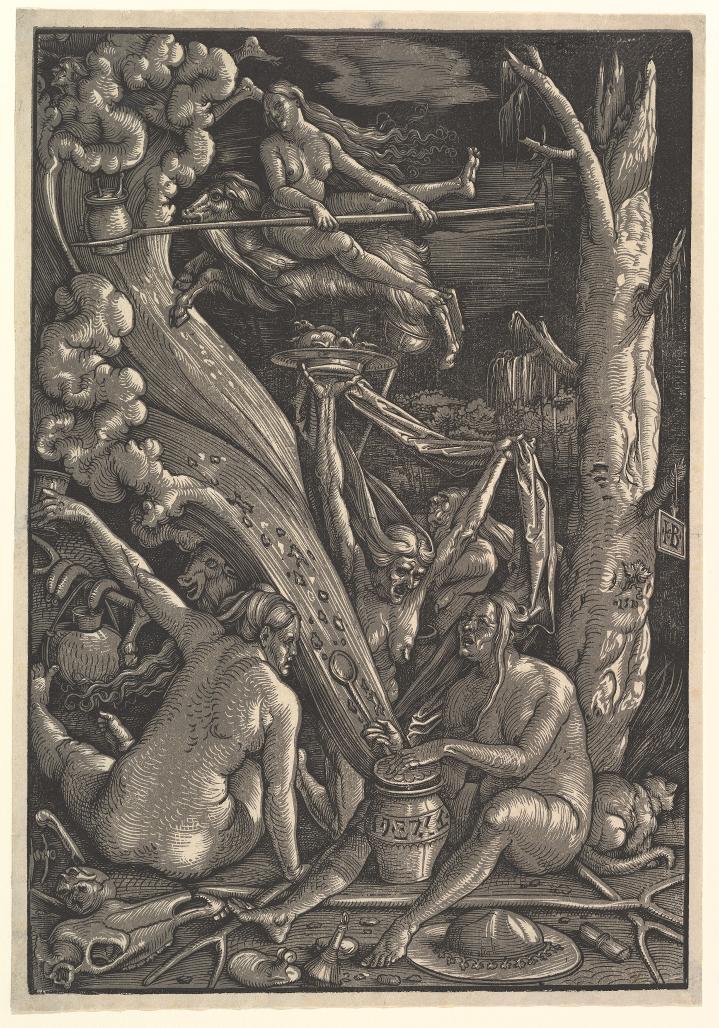
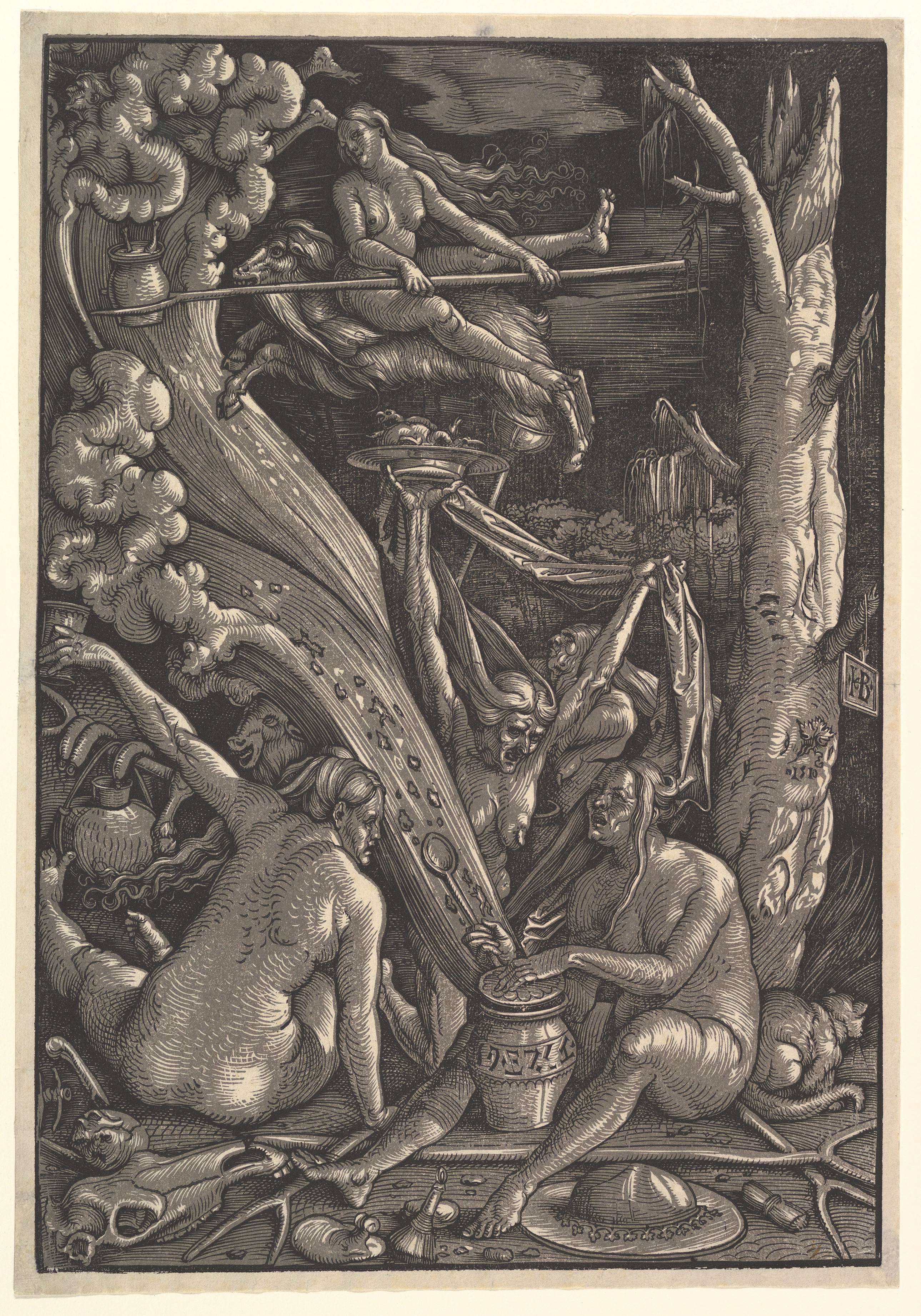
Large version. Source: Met Museum.
Electronic resources
Hans Baldung, ‘The Witches’ Sabbath’ (Woodcut, 1510) [Web Gallery of Art] Alternative version here