
England’s Culture Wars: Politics, Partisanship and Political Lying
Week 3
Tutor: Mark Knights
This seminar picks up on the theme of the last, to explore political oaths, their decline over the early modern period and the instabilities of political discourse. We will then examine the notion of the ‘politician’ as mendacious and Machiavellian; and the ways in which political partisanship (cavalier and roundhead, court and country, whig and tory), exacerbated anxieties about lying, dissimulation, fiction and conspiracy. It will finish with a brief look at political intelligence and the veracity of spies, and the instabilities of value in the financial system.
Required preparation:
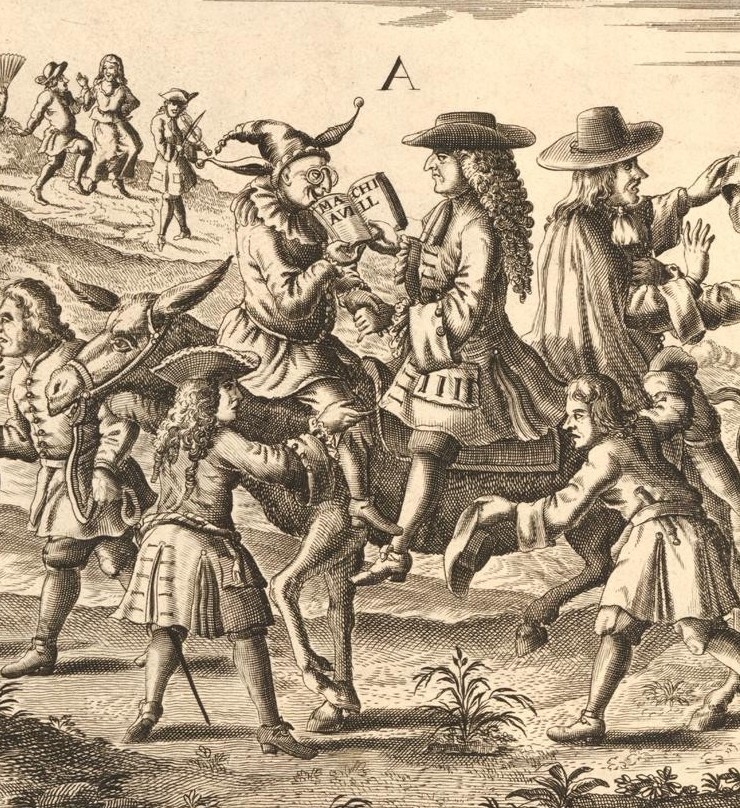
1) Read/view all the primary sources listed below and the image on the right hand side of this page showing a 'politician' - please link to the larger version of this print 'The Ass Age' (1708) at print; broadside; satirical print | British Museum.
2) come prepared to talk (for about ten minutes) about one of the topics, having analysed a primary source and two pieces of relevant secondary literature.
Primary sources:
1) Political Oaths: Conscience Puzzel'd, about Subscribing the new Engagement (1649) - to be 'true' to the new republican regime - available on Early English Books Online and Thomas Hobbes, Leviathan (1651) about how oaths add nothing to an obligation.
2) Plots and Plotters: 'Bob Ferguson or the Raree-Show of Mamamouchee Mufty' at print; satirical print | British Museum and Richard Kingston, The Life of William Fuller, by original a Butcher's son, by Education a Coney-Wool-Cutter, by Inclination an Evidence, by Vote of Parliament an Impostor (1701), 'Preface to the Reader'. Available on Eighteenth Century Collections Online.
3) Political Partisans: John Arbuthnot, Proposals for Printing a Very Curious Discourse ... intitled Pseudologia Politike, or a Treatise of the Art of Political Lying (1712).
4) The politics of money, shares and the financial revolution. The Bubblers Medley (1720) and Playing cards depicting the South Sea Bubble
Key texts
1) Political Oaths
Edward Vallance, ‘Oaths, Casuisty and Equivocation: Anglican Responses to the Engagement Controversy’, Historical Journal 44 (2001), 59-77
Edward Vallance, ‘The Decline of Conscience as a Political Guide: William Higden’s View of the English Constitution (1709), in H. Braun and Vallance (eds.), Contexts of Conscience in Early Modern Europe 1500-1700 (2004).
Quentin Skinner, 'Conquest and consent: Thomas Hobbes and the engagement controversy,' in Visions of Politics, volume 3 (2002), pp. 287-307
Christopher Hill, ‘From Oaths to Interest’ (chapter xi of Society and Puritanism 1964)
J. A. W. Gunn, “‘Interest Will Not Lie’: A Seventeenth-Century Political Maxim.” Journal of the History of Ideas, vol. 29, no. 4, 1968, pp. 551–64
2) Plots and Plotters
Tobias Hug, 'The Self-representation and Self-perception of William Fuller (1670–1733)' in his Impostures in Early Modern England: Representations and Perceptions of Fraudulent Identities (Manchester, 2010).
Andrea McKenzie, 'Fire, Fake News and the Standing Army : Arson and Moral Panics during the Popish Plot, 1678-81', in Cultural Histories of Law, Media and Emotion: Public Justice, edited by Katie Barclay and Amy Milka (Routledge, 2022), pp. 19-37
John McTague, Things that didn’t happen : writing, politics and the counterhistorical, 1678-1743 (Boydell Press, 2019), esp. chapters 1-3
Victor Louis Stater, Hoax : the Popish Plot that never was (Yale University Press, 2022)
For Fuller see this petition
3) Political Partisans
Conal Condren, Satire , Lies and Politics: The Case of Dr Arbuthnot (Palgrave, 1997) - ebook
Mark Knights, Representation and Misrepresentation (2006), chapter 6
4) The value of money.
Goerge Caffentzis, Clipped Coins, Abused Words, and Civil Government : John Locke's Philosophy of Money (1989, reprint at Pluto Press, 2021) - ebook
Peter Dickson, The South Sea Bubble (1993)
Seminar questions
- Why were oaths displaced by 'interest' as a way of establishing truth?
- What did the term 'politician' mean to contemporaries?
- In what ways did the period 1640-1660 destabilise meanings?
- How and why did the emergence of parties fuel accusations of lying? Was lying an intrinsic dimension of partisanship?
- Did party labels mean anything or were they fictions?
- In an age of 'plots' how did contemporaries know whose 'evidence' to believe?
Further reading
General:
Bernard Capp, England’s Culture Wars: Puritan Reformation and its Enemies in the Interregnum, 1649-1660 (2012).
1) Political Oaths
Edward Vallance, ‘Oaths, Casuisty and Equivocation: Anglican Responses to the Engagement Controversy’,Historical Journal44 (2001), 59-77
Edward Vallance,Revolutionary England and the National Covenant: State Oaths, Protestantism and the Political nation 1553-1682(2005)
Edward Vallance, ‘The Decline of Conscience as a Political Guide: William Higden’sView of the English Constitution(1709), in H. Braun and Vallance (eds.),Contexts of Conscience in Early Modern Europe 1500-1700(2004).
Quentin Skinner, 'Conquest and consent: Thomas Hobbes and the engagement controversy,' inVisions of Politics,volume 3 (2002), pp. 287-307
J.A.W. Gunn,Politics and the Public Interest in the Seventeenth Century(London, 1969).
Christopher Hill, ‘From Oaths to Interest’ (chapter xi ofSociety and Puritanism1964)
Glenn Burgess, 'Usurpation, Obligation and Obedience in the Thought of the Engagement Controversy',HJ29:3 (1986), 515-536.
2) Plots and Plotters
Alastair Bellany, The Politics of Court Scandal in Early Modern England: News Culture and the Overbury Affair, 1603–1660 (Cambridge University Press, 2002)
Beth Branscome, ‘Telling a tale with the names changed : contemporary comparisons of the Rye House Plot to the 1696 Assassination Plot’,Historical Research, 91:252 (2018) 255-273.
Conspiracies and conspiracy theory in early modern Europe : from the Waldensians to the French Revolution, ed. by Barry Coward and Julian Swann (Ashgate, 2004), pp. 113-34.
Eveline Cruickshanks and Howard Erskine-Hill, The Atterbury plot (Palgrave, 2004).
Peter Hinds,The horrid Popish plot : Roger L'Estrange and the circulation of political discourse in late seventeenth-century London(Oxford University Press, 2009).
Tobias Hug, 'The Self-representation and Self-perception of William Fuller (1670–1733)' in hisImpostures in Early Modern England: Representations and Perceptions of Fraudulent Identities(Manchester, 2010).
Newton Key, ‘Constructing Conspiracy: Reporting the Rye House Plot Trials’, inThe state trials and the politics of justice in later Stuart England, ed. by Brian William Cowan and Scott Sowerby (Boydell Press, 2021), pp. 135-160.
Mark Knights,Politics and Opinion in Crisis 1678-1681 (Cambridge, 1994)
David Lindley, The Trials of Frances Howard: Fact and Fiction at the Court of King James (Routledge, 1993)
Andrea McKenzie, 'Fire, Fake News and the Standing Army : Arson and Moral Panics during the Popish Plot, 1678-81', inCultural Histories of Law, Media and Emotion: Public Justice, edited by Katie Barclay and Amy Milka (Routledge, 2022), pp. 19-37
John McTague,Things that didn’t happen : writing, politics and the counterhistorical, 1678-1743(Boydell Press, 2019), esp. chapters 1-3
Allan A. Metcalf, The life of Guy : Guy Fawkes, the Gunpowder Plot, and the unlikely history of an indispensable word(Oxford University Press, 2019).
Victor Louis Stater, Hoax : the Popish Plot that never was(Yale University Press, 2022)
Rachel Judith Weil, A plague of informers : conspiracy and political trust in William III's England(Yale University Press, 2013).
Rachel Judith Weil, ‘Matthew Smith versus the 'great men' : plot-talk, the public spere and the problem of credibility in the 1690s’, in The politics of the public sphere in early modern England, ed. by Peter Lake and Steven C. A. Pincus (Manchester University Press, 2007), pp. 232-51.
3) Political Partisans
Conal Condren, Satire , Lies and Politics: The Case of Dr Arbuthnot (Palgrave, 1997) - ebook
Mark Knights, Representation and Misrepresentation (2006), chapter 6
James Holstun, Pamphlet Wars: Prose in the English Revolution (1992)
Sharon Achinstein, ‘The Uses of Deception: from Cromwell to Milton’ in Zeller and Schiffhorst, The Witness of Time (1993).
4) The value of money.
Malcolm Balen, A Very English Deceit: The Secret History of the South Sea Bubble and the First Great Financial Scandal (London, 2002)
Carswell, John, The South Sea Bubble (Cresset Press, 1960)
Richard Dale, The First Crash: Lessons from the South Sea Bubble (Princeton, 2004)
Peter Dickson, The South Sea Bubble (1993)
Julian Hoppit, "The Myths of the South Sea Bubble", Transactions of the Royal Historical Society, (2002), pp. 141–165
J.K. Horsefield, British Monetary Experiments 1650-1710 (1960)
Helen Paul, The South Sea Bubble: An Economic History of its Origins and Consequences (Oxford, 2011)
Rik Frehen, William Goetzmann and Geert Rouwenhorst, ‘New Evidence on the First Financial Bubble’ Journal of Financial Economics, 108:3 (2013), 585-607.
Colin Nicholson, Writing and the Rise of Finance (Cambridge, 1994)
Sandra Sherman, Finance and Fictionality in the Early Eighteenth Century (1996)
James Thompson, Models of Value: Eighteenth Century Political Economy and the Novel (1996)