
The Early Modern Press: Fake News, Rumour and Freedom of Speech
Week 4
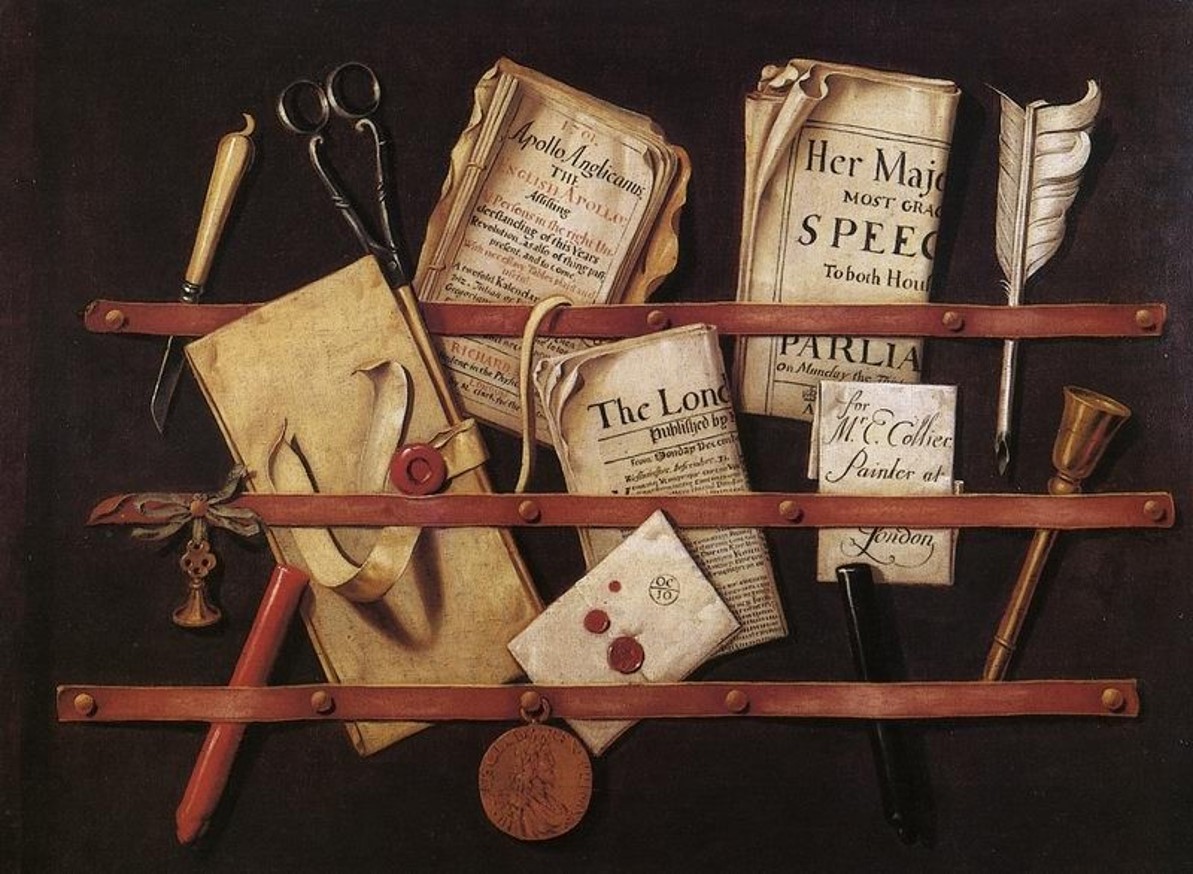
Tutor: Mark Knights
This seminar explores the ways in which communicative practices increased anxieties about truth and lying. It explores notions of fake news, the capacity of images to distort truth, and how far claims for freedom of speech turned on the idea that it was essential for truth to be found and conveyed. The image on the right hand side is a trompe l'oeil painting by Edwaert Collier, at Dutchman working in England, who specialised in depicting print culture.
Required preparation
Read or view at least four of the sources listed below. Come prepared to talk for up to 10 minutes on one of the topics, having read at least two secondary sources.
Primary sources
a) Libels: choose a libel from Early Stuart Libels. If you are presenting on this: analyse it - why were libels effective weapons and how truthful were they?
b) Ballad: A Looking-glass for all True Protestants (1679)
If you are presenting on this you might also look at other ballads on the Broadside Ballads website.
c) Rumour - Lillibulero [you'll need to 'borrow' the book to be able to read it all. Alternatively you can find the song on EEBO]
d) News and comment: choose two of the issues of The Examiner and The Medley, from Frank Ellis (ed.), Swift vs Mainwaring: The Examiner and The Medley (Oxford, 1985) - ebook
- e) Freedom of speech/the press: short extract from Milton, Areopagitica (1644) If you are presenting on this you might like to read more of the tract and also Cato's Letters (1722) no.100
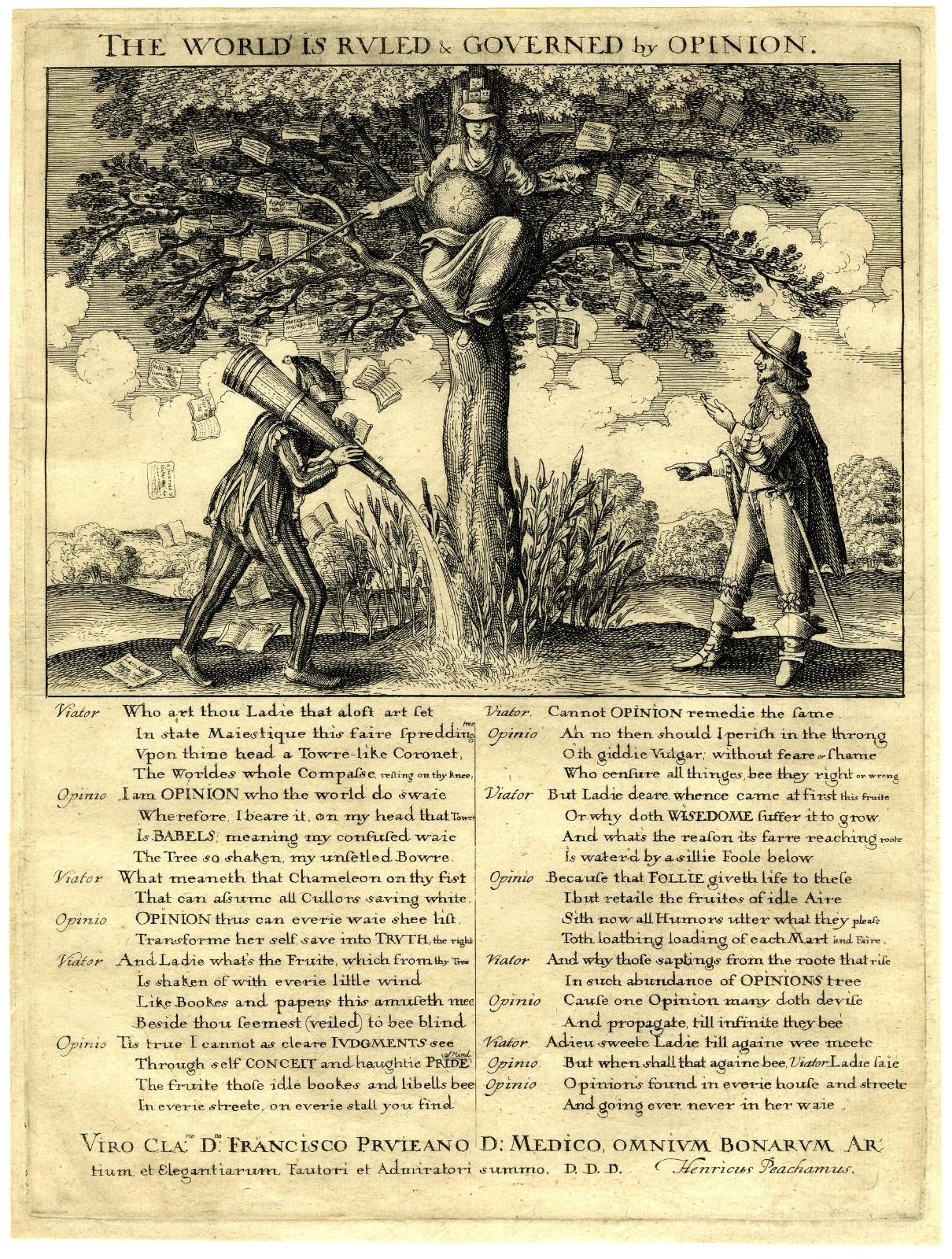
f) Images: 'The World is Ruled & Governed by Opinion' (1642); compare The Embleme of Englands distractions (1658) and The Embleme of Englands distractions (c. 1690)
Key texts
a) libels
Alastair Bellany, ‘ “Raylinge Rymes and Vaunting Verse”: Libellous Politics in Early Stuart England, 1603–1628’, in Kevin Sharpe and Peter Lake (eds.), Culture and Politics in Early Stuart England(Basingstoke: Macmillan, 1994), 285–310
Thomas Cogswell, ‘Underground Verse and the Transformation of Early Stuart Political Culture’, in Mark Kishlansky and Susan Amussen (eds.), Political Culture and Cultural Politics in Early Modern England(Manchester University Press, 1995), 277–300
Pauline Croft,‘Libels, Popular Literacy and Public Opinion in Early Modern England’, Historical Research, 68 (1995): 266–85.
b) Ballads:
Patricia Fumerton,The Broadside Ballad in Early Modern England : Moving Media, Tactical Publics(University of Pennsylvania Press, 2020).
Angela McShane, ‘Ballads and Broadsides from the beginnings of print to 1660’, inCheap print in Britain and Ireland to 1660, ed. by Joad Raymond, The Oxford history of popular print culture, 1 (Oxford University Press, 2011), pp. 339-362
c) Rumour
Patricia Bonomi, The Lord Cornbury Scandal: The Politics of Reputation in British America (1999)
David Coast and Jo Fox, ‘Rumour and Politics’, History Compass, 13:5 (2015) 222-234.
David Coast, News and rumour in Jacobean England : information, court politics and diplomacy, 1618-25 (Manchester University Press, 2014).
d) News and comment:
Mark Knights, Representation and Misrepresentation (2006), chapter 5
William Warner, 'Truth and Trust and the Eighteenth Century Anglophone Newspaper', in Siv Goril Brandtzaeg, Paul Goring and Christine Watson (eds.), Travelling Chronicles: News and Newspapers from the Early Modern Period to the Eighteenth Century (Brill, 2018)
David Colclough, Freedom of Speech in Early Stuart England (2005)
Dror Wahrman, Mr Collier's Letter Racks: A Tale of Art and Illusion (2012)
Mark Hallett, 'The Medley Print in Early Eighteenth-Century London' Art History 20(1997),214-237
Seminar questions
- How far did print introduce new forms of instabilities or build on what earlier forms of communication fostered?
- What differentiated news from opinion?
- How powerful was rumour in spreading truth or lies?
- Did free speech advance or hinder truth?
- Does satire tell the truth?
- How deceptive was visual culture?
Further reading
a) Libels
Alastair Bellany, 'Railing Rhymes Revisited: Libels, Scandals, and Early Stuart Politics', History Compass 5/4 (2007): 1136–1179
Alastair Bellany, ‘ “Raylinge Rymes and Vaunting Verse”: Libellous Politics in Early Stuart England, 1603–1628’, in Kevin Sharpe and Peter Lake (eds.), Culture and Politics in Early Stuart England (Basingstoke: Macmillan, 1994), 285–310
Thomas Cogswell, ‘Underground Verse and the Transformation of Early Stuart Political Culture’, in Mark Kishlansky and Susan Amussen (eds.), Political Culture and Cultural Politics in Early Modern England (Manchester University Press, 1995), 277–300
Pauline Croft, ‘Libels, Popular Literacy and Public Opinion in Early Modern England’, Historical Research, 68 (1995): 266–85.
Adam Fox, Oral and Literate Culture in England 1500-1700 (2000)
Adam Fox, "Ballads, Libels and Popular Ridicule in Jacobean England,"Past and Present145, no. 1 (1994)
Clare Egan, ‘Libel in the Provinces: Disinformation and ‘Disreputation’ in Early Modern England’, Past & Present, 257..Suppl. 16 (2022) 75-110
Adam Fox and Daniel R. Woolf (ed.),The Spoken Word: Oral Culture in Britain, 1500-1850(2002)
Harold Love, ‘Oral and Scribal Texts in Early Modern England’, inThe Cambridge History of the Book, ed. by John Barnard and D. F. McKenzie (2002)
Noah Millstone, Manuscript circulation and the invention of politics in early Stuart England (2016)
Andrew McRae, ‘The Literary Culture of Early Stuart Libelling’, Modern Philology, 97/3 (2000): 364–92
b) Ballads
Ballads and Broadsides in Britain, 1500-1800 edited by Patricia Fumerton, Anita Guerrini ; with the assistance of Kris McAbee (2010).
Patricia Fumerton, The Broadside Ballad in Early Modern England : Moving Media, Tactical Publics (University of Pennsylvania Press, 2020).
Angela McShane, ‘Ballads and Broadsides from the beginnings of print to 1660’, in Cheap print in Britain and Ireland to 1660, ed. by Joad Raymond, The Oxford history of popular print culture, 1 (Oxford University Press, 2011), pp. 339-362.
c) Rumour and gossip
Patricia Bonomi, The Lord Cornbury Scandal: The Politics of Reputation in British America (1999)
David Coast, ‘Rumor and "Common Fame": The Impeachment of the Duke of Buckingham and Public Opinion in Early Stuart England’, Journal of British Studies, 55:2 (2016) 241-267
David Coast and Jo Fox, ‘Rumour and Politics’, History Compass, 13:5 (2015) 222-234.
David Coast, News and rumour in Jacobean England : information, court politics and diplomacy, 1618-25 (Manchester University Press, 2014).
David Coast, ‘Misinformation and Disinformation in Late Jacobean Court Politics’, Journal of Early Modern History, 16:5 (2012) 335-354.
Adam Fox, ‘Rumour, news and popular political opinion in Elizabethan and early Stuart England’, Historical Journal, 40. (1997) 597-620.
Micheál Ó Siochrú, ‘Propaganda, rumour and myth : Oliver Cromwell and the massacre at Drogheda’, in Age of atrocity : violence and political conflict in early modern Ireland, ed. by David Edwards, Pádraig Lenihan and Clodagh Tait (Four Courts, 2007), pp. 266-282.
Arnold Hunt, ‘The succession in sermons, news and rumour’, in Doubtful and dangerous : the question of succession in late Elizabethan England, ed. by Susan Doran and Paulina Kewes (Manchester University Press, 2014), pp. 155-172.
Lauric Henneton, ‘Rumors, Uncertainty and Decision-Making in the Greater Long Island Sound (1652–1654)’, in Fear and the shaping of early American societies, ed. by Lauric Henneton and Louis H. Roper, Early American history series, 4 (Brill, 2016), pp. 115-136.
Harold Love, English clandestine satire, 1660-1702 (Oxford University Press, 2004).
Calvin F. Senning, Spain, rumour, and anti-Catholicism in mid-Jacobean England : the Palatine match, Cleves, and the Armada scares of 1612-1613 and 1614 (Routledge, 2019).
d) News and comment:
Ian Atherton, 'The Press and Popular Political Opinion' in Barry Coward (ed) A Companion to Stuart Britain (2002)
Helen Berry, Gender, society and print culture in late-Stuart England: the cultural world of the Athenian Mercury (2003)
R. Cust, ‘News and Politics in early Seventeenth Century England’, Past and Present (1986)
Nicholas Brownlees, The Language of Periodical News in Seventeenth-Century England (2011)
Ann Hughes, Gangraena and the Struggle for the English Revolution (2004)
Dagmar Freist, Governed by opinion: politics, religion and the dynamics of communication in Stuart London 1637-1645 (1997)
Jason McElligott (ed), Fear, exclusion and revolution : Roger Morrice and Britain in the 1680s (2006)
Mark Knights, The Devil in Disguise: Deception, Delusion and Fanaticism in the Early English Enlightenment (2011).
Jason Peacey, Politicians and Pamphleteers: propaganda during the English civil wars and Interregnum (2004)
Joad Raymond, The Invention of the Newspaper: English Newsbooks 1641-1649
(Oxford: Clarendon Press, 1996).
Joad Raymond (ed.), News, Newspapers and Society in early modern Britain (London: Frank Cass, 1999).
Joad Raymond, Pamphlets and Pamphleteering in early modern England (2003)
B. Worden, ‘ “Wit in a Roundhead”: the dilemma of Marchmont Nedham’, in S. Amussen and M. Kishlansky (eds.), Political Culture and Cultural Politics in Early Modern England: essays presented to David Underdown (Manchester University Press, 1995).
e) Freedom of speech
David Colclough, Freedom of Speech in Early Stuart England (2005).
J. Dunn, ‘The Claim to freedom of conscience: freedom of speech, freedom of thought, freedom of worship?’ in Dunn, The History of Political Theory (1996)
Robert G. Ingram, Jason Peacey and Alex W. Barber, Freedom of speech, 1500-1850 (Manchester: Manchester University Press, 2020).
David Norbrook, 'Areopagitica, Censorship and the early modern public sphere' in
The administration of aesthetics : censorship, political criticism, and the public sphere, edited by Richard Burt (1994)
Randy Robertson, Censorship and Conflict in Seventeenth Century England (2009)
There is an online 'index' of material that was censored in the seventeenth century at http://susqu.academia.edu/RandyRobertson/Papers
f) images
Vic Gatrell, City of Laughter: Sex and Satire in Eighteenth Century London (2006)
Mark Hallett, 'The Medley Print in Early Eighteenth-Century London' Art History
20 (1997), 214-237
Adam Morton, ‘Laughing at Hypocrisy: The Turncoats (1711), Visual Culture and Dissent in Early Eighteenth-Century England’, Studies in Church History, 60. (2024) 312-339.
Adam Morton, ‘Fighting popery with popery: subverting stereotypes and contesting anti-Catholicism in late seventeenth-century England’, in Stereotypes and stereotyping in early modern England : puritans, papists and projectors, ed. by Koji Yamamoto (Manchester University Press, 2022), pp. 184-217.
Malcolm Jones, The Print in early modern England: an Historical oversight (2010)
Helen Pierce, Unseemly Pictures: Graphic Satire and Politics in early modern England (New Haven, 2008).
Kevin Sharpe's trilogy on representations of monarchy:
Selling the Tudor Monarchy: authority and image in sixteenth century England
(New Haven, 2009); Image Wars: promoting kings and Commonwealths in England, 1603-1660 (New Haven, 2010); Rebranding Rule: images of Restoration and Revolution Monarchy, 1660-1714 (New Haven, 2013)
Dror Wahrman, Mr Collier's Letter Racks: A Tale of Art and Illusion (2012)
There are many images on the British Museum website, and the British Printed Images website.
Forgeries:
Literary Forgery in Early Modern Europe, 1450-1800 ed. Walter Stephens, Earle A. Havens, Janet E. Gomez (2019)
Beyond Britain:
Jordan Taylor, Misinformation Nation: Foreign News and the Politics of Truth in Revolutionary America (Baltimore: Johns Hopkins University Press, 2022)