
Physics Department News
Warwick Physicists attend STEM for Britain
Three members of the department were invited to attend STEM for Britain at the House of Commons on Tuesday 17th March to present their research posters.
Agrima Agarwal (Phd Student, Ultrafast and Terahertz Photonics Group), Edward Butler-Caddle (Ultrafast and Terahertz Photonics Group) and Sahl Rowther (Research Fellow, Astronomy & Astrophysics Group) applied to present their research at the event and were accepted following a rigorous process.
The event took place on Tuesday 17th March and over 120 early career researchers from across the UK attended. Applicants submitted a 1-page abstract about their research, and were judged by a panel of scientists. 422 applications were received with 120 finalists shortlisted and invited to the event at the House of Commons.
Representatives from the Department of Physics were:
Agrima Agarwal (Ultrafast and Terahertz Photonics Group)
Agrima presented her research on AI-based classification of skin conditions using terahertz scans. Terahertz light is safe, radiation free, and sensitive to water content in the tissue making it a potential diagnostic tool. She is part of the MacPherson group who built a terahertz skin scanner and scanned patients with skin conditions such as eczema, psoriasis, and skin cancer at the UHCW hospital. She trained machine learning models using these scans to differentiate skin conditions from healthy skin.
Reflecting on her experience, Agrima said, “It was exciting to be surrounded by exceptional researchers and to see the promising work being carried out across different fields. The audience consisted of not only scientists but also industry executives and members of the parliament. Hence, I tried to present my methodology and key findings in an accessible, layperson-friendly manner, making complex concepts easy to understand for the broad audience. I would highly recommend my fellow colleagues to apply for this opportunity.”
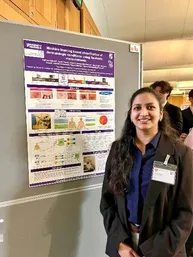
Agrima presenting her poster at STEM for Britain
Edward Butler-Caddle (Ultrafast and Terahertz Photonics Group)
Edward’s research uses laser pulses to observe the flow of electrons in solar cells at 1 trillion frames per second. The aim of his research is to understand how to make the solar cells more efficient, because this would make the electricity cheaper. The efficiency can be increased by increasing the number of electrons that manage to move from the inner layer to the outer layer in the solar cell. Edward measures this by using one laser pulse to energise electrons, like sunlight, and a second (terahertz) pulse to detect the energised electrons.
Edward tells us about his experience, “It was really enjoyable and satisfying to be able to share our research not only with parliamentary staff, but also with industry leaders that sponsored the event. Explaining science to non-scientists and scientists in the same session was a fun challenge. It was also great to see brilliant explanations of work done in different fields, as normally we only attend conferences in our own field. The event was held in a location that is not open to the general public, Portcullis House, and it was really interesting to see inside. A surprise bonus was that a Warwick alumnus working for a Coventry MP very generously toured us around the Palace of Westminster. Overall, a really worthwhile experience.”
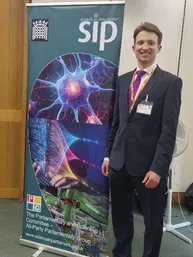
Edward at the STEM for Britain event
Sahl Rowther (Astronomy and Astrophysics Group)
Sahl’s research looks at the understanding of protoplanetary over the last decade, and how they are revolutionised by the discovery of diverse sub-structures visible across a wide range of spatial and temporal scales. Many of these protoplanetary discs exhibit a pattern of bright rings and dark gaps, which is often interpreted as a signature of a massive planet carving open a path around its orbit. However, the young ages of the protoplanetary discs raises a major challenge – How do planets form quickly enough to generate the sub-structures we observe?
Sahl tells us, “I am delighted to be presenting my work on rapid planet formation in gravitationally unstable discs at STEM for Britain. It’s a rare and invaluable opportunity to share directly with members of parliament how research into planet formation advances our understanding of planetary systems and drives innovation in modelling and high-performance computation. Engaging with policy-makers helps ensure that long-term investment into astrophysics continues to be supported.”
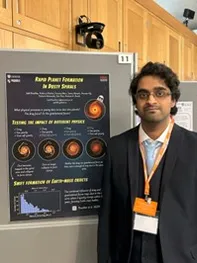
Sahl presenting his poster at the event
STEM for Britain is an annual poster competition for early career researchers in science, engineering, technology and math and has been taking place each year in Parliament since 1997. The aim of the event is to give members of Parliament an insight into the outstanding work being undertaken in UK universities by early career researchers.